- Water the area deeply the day before you dig. Moist soil releases rhizomes far more cooperatively than dry, hard ground.
- Work in sections, not all at once. Trying to tackle 300 square feet in a single session will break your spirit (and your back).
- Wear thick gloves. Rhizome ends are sharp, and you’ll be plunging your hands into the ground constantly.
- ProValue HM-949 3-1/8 lb. Garden Hoe Mattock, 51″ Hardwood Handle — This was my workhorse. The mattock end broke through compacted soil and rhizome tangles better than anything else I tried. Heavy enough to mean business, balanced enough to swing for hours.
- Root Slayer 22011 Garden Shovel with Serrated Blade for Digging and Root Cutting — The serrated blade on this shovel cuts through roots instead of just pushing them aside. I used it constantly for slicing through rhizomes in the trench work. Absolutely worth it.
- Root Slayer RS220 Heavy Duty Garden Shovel with Serrated Blade for Digging and Root Removal — I actually borrowed a friend’s version of this model. If you’re tackling a larger area, having two serrated spades between two people speeds things up considerably.
- Rogue Hoe 7 Inch Wide Blade Heavy Duty Garden Cultivator Field Cotton Hoe Tool — Once the big rhizome clumps were out, this wide-blade hoe was perfect for raking through loosened soil and pulling out the smaller stragglers. Solid, heavy-duty construction that held up to abuse.
- 14 Inch Heavy Duty Curved Hoe, Without Welding, Gardening Tool, Oak Handle — The curved blade on this one was surprisingly useful for getting under rhizomes and popping them up from below. The oak handle felt solid and never gave me any flex under pressure.
- Water the area deeply the day before you dig. Moist soil releases rhizomes far more cooperatively than dry, hard ground.
- Work in sections, not all at once. Trying to tackle 300 square feet in a single session will break your spirit (and your back).
- Wear thick gloves. Rhizome ends are sharp, and you’ll be plunging your hands into the ground constantly.
The day I realized my bamboo had eaten my neighbor’s flower bed was the day I knew things had gotten serious. What started as a charming little privacy screen along my back fence had quietly — sneakily — spread six feet into Linda’s yard, strangling her hostas and creeping under her garden shed. She knocked on my door one Saturday morning, coffee in hand, smile on her face, but I could see it in her eyes. We had a problem. And it was entirely my problem to fix.
This post contains affiliate links. As an Amazon Associate, I earn from qualifying purchases.
I started researching bamboo removal DIY methods that same afternoon, equal parts motivated by guilt and sheer panic about the cost of hiring someone. Every contractor quote I got was somewhere between “ouch” and “absolutely not.” So I rolled up my sleeves, did my homework, and spent three weekends doing it myself. Here’s everything I learned — including what worked, what didn’t, and why the right tools made all the difference.
Understanding What You’re Actually Up Against
Before you grab a shovel and start hacking away, you need to understand the enemy. Bamboo — particularly running bamboo, which is what most people accidentally plant — spreads through an underground network of rhizomes. These are horizontal root-like stems that can travel several feet per year in every direction. When I dug my first test trench, I found rhizomes the diameter of my thumb running four to six inches below the surface in every direction like a tangled highway system.
The hard truth is that you can’t just pull up the canes and call it done. If even a small rhizome segment stays in the ground, it will resprout. Bamboo is extraordinarily resilient — it’s practically designed to survive. Your goal is to physically remove as much of the root mass as possible, then monitor and cut down any new growth repeatedly until the plant exhausts its energy reserves. This process takes persistence, not just muscle.
My Step-by-Step Bamboo Removal DIY Process
Step 1: Cut Down the Canes First
Start by cutting all the canes down to the ground. A sharp pruning saw or loppers work fine here. Get them as low as possible. This immediately makes the work area manageable and, more importantly, signals to the plant to send energy up — energy it will waste on regrowth attempts you’ll cut down again and again.
Step 2: Dig Out the Rhizome Mass
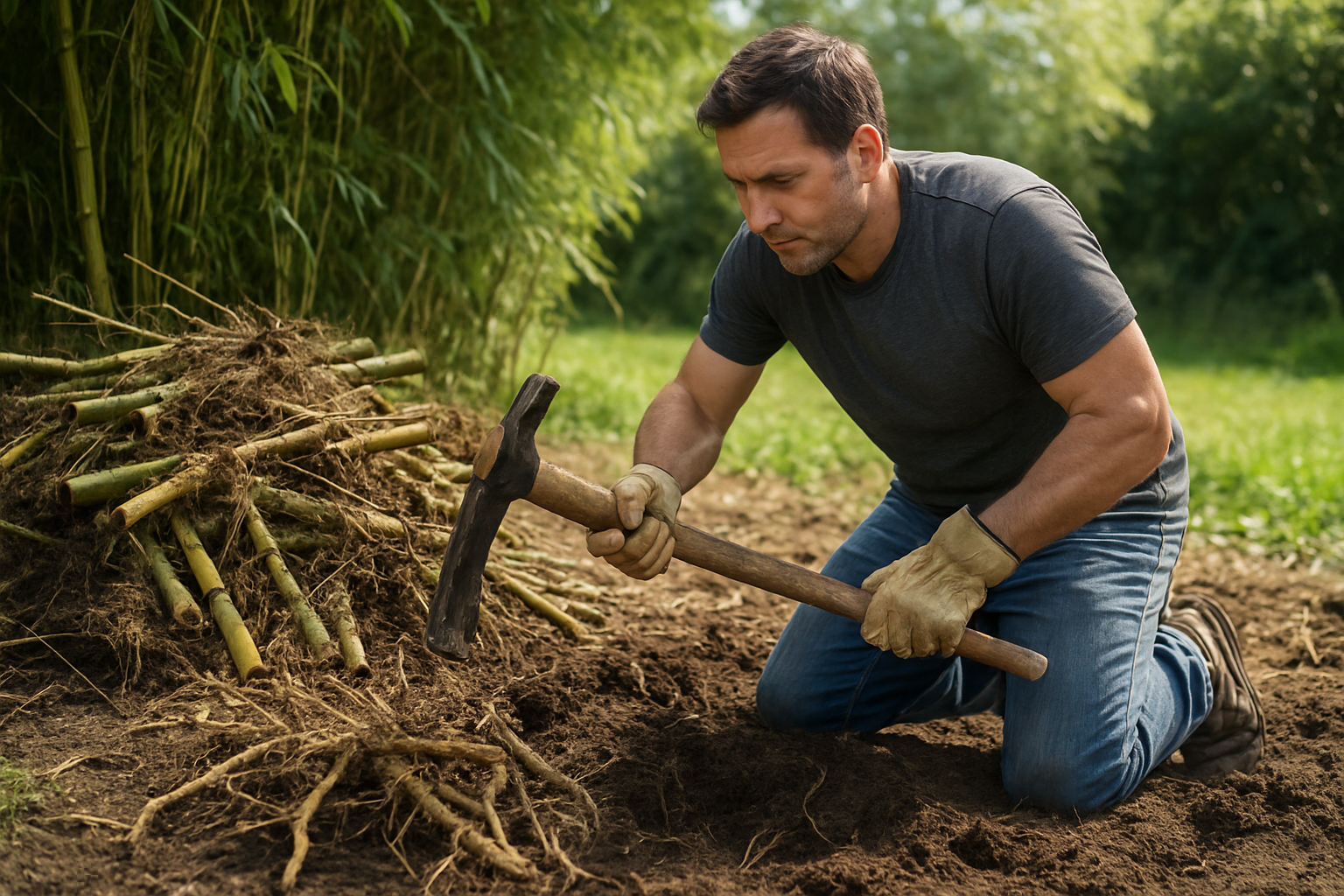
This is the hard part, and I won’t sugarcoat it. I spent two full Saturdays just on this phase. The goal is to loosen the soil around the root mass and pull out every rhizome segment you can find. Work from the outside edges inward so you’re not constantly stepping on ground you’ve already cleared.
A heavy-duty mattock is your single best friend here. Mine was a game-changer for breaking through the dense, tangled rhizome mat that had built up over years. Once things loosened up, I switched between a wide cultivating hoe for clearing debris and a sharp spade for cutting through stubborn roots.
Step 3: Trench the Perimeter
Dig a trench around the entire affected area, at least eight to ten inches deep. This serves two purposes: it lets you see exactly where the rhizomes end, and it creates a boundary you can check weekly for any sneaky re-runners. Anything you find in that trench, cut it and pull it out immediately.
Step 4: Monitor and Cut for the Long Haul
For the next growing season — and possibly two — you will see new shoots appear from rhizome fragments you missed. Cut them immediately at ground level. Don’t let them photosynthesize. Every time a new shoot grows and you cut it, the plant uses stored energy and gets weaker. Stay consistent and you will win.
Tools I Used (And Genuinely Recommend)
The right tools turned an impossible job into a merely brutal one. Here’s what I actually used throughout this project:
Honestly, I’d tried to start this project with a basic garden spade from my garage. I wasted an entire morning and barely made a dent. Once I had the right tools, I made more progress in two hours than I had all day. Don’t skip this part.