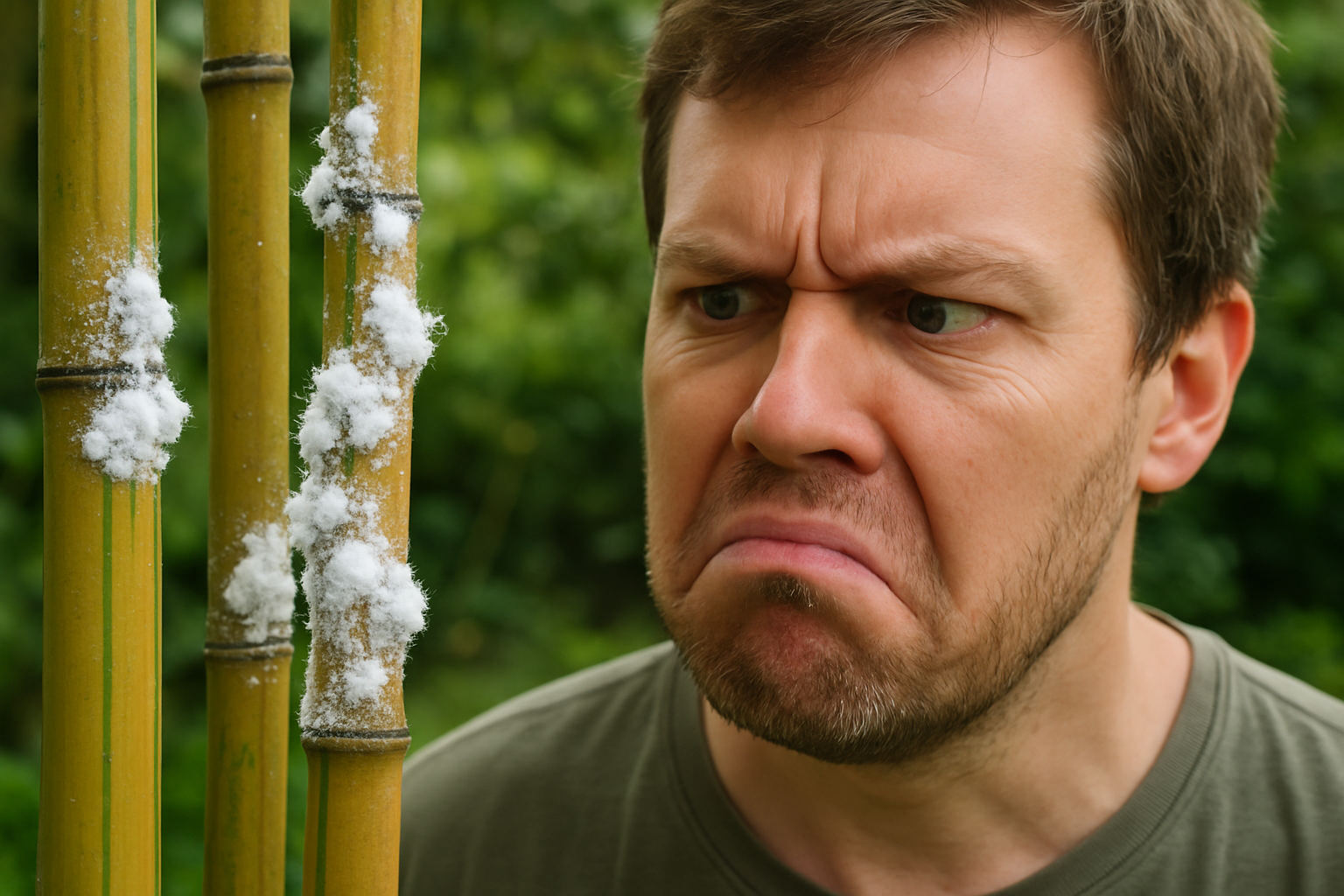
I stood in my backyard last spring, squinting at my golden bamboo like a detective who had absolutely no business being a detective. There was white stuff on it. Fluffy, cottony, suspicious white stuff. I did what any reasonable person does in this situation — I immediately convinced myself my bamboo had contracted some obscure, possibly bamboo-ending fungal plague. I even wrote out a list of symptoms to describe to… whom, exactly? The bamboo doctor? Spoiler: the bamboo doctor does not exist. What I actually had was a completely common case of mealybugs on bamboo, and I spent two weeks panicking over what any experienced gardener would have spotted in about thirty seconds.
This post contains affiliate links. As an Amazon Associate, I earn from qualifying purchases. If you click a product link and make a purchase, I may earn a small commission at no extra cost to you. I only recommend products I genuinely find useful for bamboo gardening.
If you’re out here doing the same frantic Google spiral I did, first of all — welcome, you’re in good company. Second, take a breath. Mealybugs are annoying, but they are absolutely manageable, and your bamboo is almost certainly going to be fine. Let me walk you through what actually happened to mine, and more importantly, what I did to fix it.
What Mealybugs on Bamboo Actually Look Like (And Why I Thought It Was Something Way Worse)
Here’s where I really embarrassed myself. Mealybugs look like tiny, soft-bodied insects coated in a white waxy powder. They cluster at leaf joints, along stems, and in the tight spaces where leaves meet the culm. The result is these little cottony white tufts that — to an anxious bamboo parent — can look like fungus, mold, powdery mildew, or, in my personal nightmare scenario, some kind of bamboo-specific blight I had somehow introduced to my garden.
I photographed the white patches from twelve different angles. I sent pictures to two friends, neither of whom garden. One said it looked like “some kind of foam.” The other said “just pull it off?” Reader, I should have listened to the second friend.
The actual telltale signs of mealybugs are pretty distinct once you know what you’re looking for:
- White, cottony or waxy residue concentrated at leaf joints and stem nodes
- Tiny oval-shaped bugs visible underneath the fluff (cream or pale yellow in color)
- Sticky residue on leaves or stems — this is honeydew, a byproduct mealybugs leave behind
- Yellowing or wilting leaves on otherwise healthy bamboo
- Sooty mold forming on honeydew deposits — this was the thing that made me truly spiral
That last one — the sooty mold — was what pushed me over the edge. When mealybugs excrete honeydew, a secondary black mold can grow on it, which makes your bamboo look like it’s suffering from two problems simultaneously. It’s alarming. It’s also secondary. Fix the mealybugs, and the mold stops getting new food and eventually clears up on its own.
How to Actually Get Rid of Mealybugs on Bamboo
Once I finally accepted that I had bugs and not a plague, I got to work. There’s a logical order to treating a mealybug infestation, starting with the least aggressive methods and escalating only if needed.
Step 1: Manual Removal First
Before you reach for any product, physically remove as many mealybugs as you can. A strong blast of water from your garden hose dislodges a surprising number of them. Follow that up with a cotton swab or soft cloth dipped in rubbing alcohol — dab it directly onto the bugs and their cotton nests. The alcohol dissolves their waxy protective coating and kills them on contact.
For this, I keep a spray bottle of high-concentration isopropyl alcohol on hand. I like the 99% Isopropyl Alcohol Spray in a 17 oz bottle — the spray format makes it easy to target specific clusters without soaking the whole plant, and the 99% concentration is fast-acting. If you’re treating a larger planting or want a bit more volume, the Volu-Sol 99% IPA in a 24 oz continuous mist spray bottle gives you a nice fine mist that’s great for getting into tight leaf joints. For a smaller, travel-sized option you can keep in a garden kit, the Safetec 70% Isopropyl Alcohol 2oz Spray Bottle works well for spot treatments on lighter infestations.
One important note: always test rubbing alcohol on a small area first. Most bamboo handles it well, but diluting your 99% solution with water (roughly 1:1) is a good idea if you’re treating young or delicate growth.
Step 2: Bioinsecticide for Persistent Infestations
If manual removal doesn’t fully knock things back — and with a well-established infestation, it often won’t — a bioinsecticide is your next move. I’ve had great results with Grandevo CG Bioinsecticide. It’s derived from a naturally occurring soil bacterium and is effective against mealybugs, aphids, mites, and several other common bamboo pests. Because it’s a biological pesticide, it’s gentler on beneficial insects than many conventional options, which matters a lot if you’ve got pollinators visiting your garden. Mix according to the label directions and apply as a foliar spray, making sure to coat the undersides of leaves and the stem nodes where mealybugs hide.
Step 3: Systemic Treatment for Serious or Recurring Problems
For persistent, large-scale infestations — or if you’ve had mealybugs return season after season — a systemic insecticide that the plant absorbs from the inside is worth considering. The AceCap Insecticide Systemic Tree Implants are designed to be inserted into the plant itself, delivering insecticide directly into the vascular system so insects feeding on plant tissue are exposed to it. This is more of a serious intervention than a first-response tool, but for bamboo groves dealing with ongoing pest pressure, it’s a legitimate option. Follow the manufacturer’s instructions carefully and use it as part of an integrated approach rather than a standalone fix.
Preventing Mealybugs From Coming Back
Here’s the part I wish someone had told me before I had a full