Tag: drought tolerant bamboo

  • Is Bamboo Drought Tolerant? What Every Grower Must Know

    Is Bamboo Drought Tolerant? What Every Grower Must Know

    This article contains affiliate links. As an Amazon Associate, TerraBamboo earns from qualifying purchases. Product recommendations are editorially independent.

    Key Takeaways

    • Bamboo drought tolerance depends heavily on maturity — established plants (3+ years) can survive moderate dry periods, but new plantings require consistent moisture.
    • Tropical clumping species such as Bambusa oldhamii and Bambusa textilis are more drought tolerant than temperate running species like Phyllostachys aurea or Phyllostachys nigra.
    • Bamboo signals drought stress through visible signs including leaf rolling, leaf drop, and growth dormancy — all reversible with proper rehydration.
    • A 4–6 inch layer of organic mulch around the root zone dramatically reduces soil moisture loss and improves drought resilience.
    • Drip irrigation is the most efficient watering strategy for bamboo in dry climates, delivering moisture directly to the rhizome zone while minimizing evaporation.

    Is Bamboo Drought Tolerant? The Nuanced Answer Growers Need

    The question of whether bamboo is drought tolerant is one TerraBamboo’s horticultural team hears regularly — and the honest answer is: it depends. Bamboo is not a uniformly drought-resistant plant. Its ability to survive and recover from dry conditions is shaped by three key variables: plant maturity, species selection, and soil preparation. Understanding these factors is essential before placing bamboo in any dry or water-limited landscape.

    According to TerraBamboo’s bamboo specialists, established bamboo plants with mature rhizome networks — typically those in the ground for three or more years — can tolerate moderate drought conditions. Deep, wide-spreading rhizomes allow the plant to access subsoil moisture that shallower-rooted plants cannot reach. However, newly planted bamboo in its establishment phase (the first one to three years) is highly vulnerable to drought stress and can suffer permanent damage or death without adequate, consistent irrigation.

    This distinction is critical. Growers who assume bamboo is universally drought tolerant and neglect watering during establishment often experience slow growth, die-back, or complete plant loss — outcomes that are entirely preventable with the right approach.

    Which Bamboo Species Handle Drought Best?

    Species selection is one of the most powerful tools available for drought management. TerraBamboo’s cultivation specialists consistently recommend tropical clumping bamboos for growers in hot, dry climates. These species evolved in seasonally arid environments and have developed physiological adaptations that help them conserve water during dry periods.

    Bambusa oldhamii (Giant Timber Bamboo) and Bambusa textilis (Weaver’s Bamboo) are among the most drought-tolerant clumping varieties available to home growers. Both species perform well in USDA Hardiness Zones 8–10 and can tolerate extended dry periods once established. Bambusa oldhamii has been documented surviving prolonged dry spells in Southern California and parts of the American Southwest with minimal supplemental irrigation after the third year of growth.

    By contrast, temperate running bamboos in the genus Phyllostachys — including popular varieties like Phyllostachys aurea (Golden Bamboo) and Phyllostachys nigra (Black Bamboo) — are adapted to regions with more consistent seasonal rainfall. While mature running bamboos can survive short dry spells, they are generally less drought tolerant than their clumping counterparts and require more attentive irrigation management in arid settings. Experienced bamboo growers note that Phyllostachys species tend to show drought stress more rapidly and recover more slowly than established Bambusa species under comparable conditions.

    For growers in hot and dry climates, TerraBamboo’s dedicated guide to bamboo for hot and dry climates provides additional species recommendations and regional planting strategies tailored to low-water landscapes.

    How Does Bamboo Respond to Drought Stress?

    Bamboo communicates water stress through a predictable sequence of visible responses. TerraBamboo’s horticultural team identifies these signs as early warning indicators that growers should monitor closely during dry periods.

    • Leaf rolling: The first and most common drought response. Bamboo leaves curl inward along their length to reduce the surface area exposed to sun and wind, minimizing transpiration. This is a reversible, protective mechanism — not a sign of permanent damage.
    • Leaf drop: If drought stress continues, bamboo will shed older or lower leaves to reduce water demand. Significant leaf drop is a moderate-to-severe stress indicator that warrants immediate irrigation.
    • Growth dormancy: During extended dry conditions, bamboo will halt new culm production entirely. The plant essentially pauses above-ground growth to preserve rhizome health. This is an adaptive survival strategy, not a sign of death.
    • Culm yellowing: Prolonged drought can cause older culms to yellow and die back. While this looks alarming, healthy rhizomes will typically produce new culms once regular watering resumes.

    According to TerraBamboo’s bamboo specialists, most established bamboo plants experiencing drought-induced dormancy or leaf drop will recover fully within two to four weeks of consistent rehydration, provided the rhizome system remains viable. Younger plants in the establishment phase have less rhizome reserve and are at greater risk of non-recovery if drought stress is severe or prolonged.

    What Are the Water Needs of Bamboo at Each Growth Stage?

    Water requirements for bamboo change significantly over the plant’s lifecycle. TerraBamboo’s horticultural team breaks this down into two primary stages:

    Establishment Phase (Years 1–3)

    During establishment, bamboo is building its rhizome network from scratch. Root depth and spread are limited, and the plant cannot yet access deeper soil moisture reserves. This is the period when bamboo is most vulnerable and least drought tolerant. TerraBamboo’s specialists recommend watering newly planted bamboo deeply two to three times per week during warm months, and at least once per week during cooler periods. Soil should remain consistently moist — not waterlogged — to a depth of at least 12 inches. In climates with summer temperatures regularly exceeding 90°F (32°C), daily watering during the first summer is advisable.

    Mature Phase (Year 3 and Beyond)

    Once bamboo has developed an extensive rhizome network, its drought tolerance increases substantially. Mature plants in moderate climates may require only supplemental irrigation during the hottest, driest weeks of summer. In wetter regions, established bamboo may need no supplemental watering at all. However, even mature bamboo benefits from deep, infrequent watering during drought conditions — approximately once per week with sufficient volume to penetrate 18–24 inches of soil. This encourages continued deep root development and improves long-term drought resilience.

    Growers interested in understanding how drought conditions affect bamboo’s annual growth cycles can find additional context in TerraBamboo’s comprehensive bamboo growth rate guide.

    What Irrigation Strategies Work Best for Bamboo in Dry Climates?

    Efficient water delivery is essential for bamboo growers working in low-rainfall or drought-prone regions. TerraBamboo’s horticultural team consistently recommends drip irrigation as the most effective method for both establishment and mature bamboo. Drip systems deliver water slowly and directly to the root zone, reducing surface evaporation losses and keeping foliage dry — which also helps prevent fungal issues in humid conditions.

    For large bamboo groves or privacy hedges, a larger-capacity drip system offers the most practical solution. Growers managing extended plantings will benefit from a system with flexible tubing and adjustable emitters that can be spaced to match the spread of mature rhizomes.

    Recommended Products

    Based on field testing and grower feedback, TerraBamboo recommends:

    • 230FT Drip Irrigation System with 38 Adjustable Copper Nozzles — An excellent choice for larger bamboo installations, garden beds, or privacy screens. The 1/2″ and 1/4″ dual-tubing configuration allows growers to run a main line along a bamboo hedge and branch emitters directly into the root zone. Adjustable copper nozzles provide precise flow control for different soil types.
    • 120FT Drip Irrigation System with 26 Adjustable Copper Nozzles — Well-suited for smaller bamboo plantings, container groupings, or raised bed installations. The atomizing sprinkler heads provide even moisture distribution around clumping bamboo varieties where root spread is more contained.
    • Thiswing 360° Adjustable Drip Irrigation System – 50FT — A compact, highly adjustable option for potted bamboo, small specimen plantings, or supplemental spot watering. The 360° rotating nozzles ensure full coverage around individual culm bases.

    Why Is Mulching Critical for Drought-Tolerant Bamboo?

    Mulching is arguably the single most impactful cultural practice for improving bamboo’s drought resilience at any growth stage. According to TerraBamboo’s horticultural team, a properly applied mulch layer serves multiple critical functions: it reduces soil surface evaporation, moderates soil temperature, suppresses moisture-competing weeds, and — as organic mulches decompose — improves soil structure and water retention over time.

    TerraBamboo’s specialists recommend maintaining a mulch layer of 4–6 inches depth around bamboo plantings, keeping mulch pulled back 2–3 inches from culm bases to prevent moisture accumulation and potential crown rot. University cooperative extension research consistently supports deep mulching as a best practice for reducing supplemental irrigation needs by 25–50% in established woody plantings.

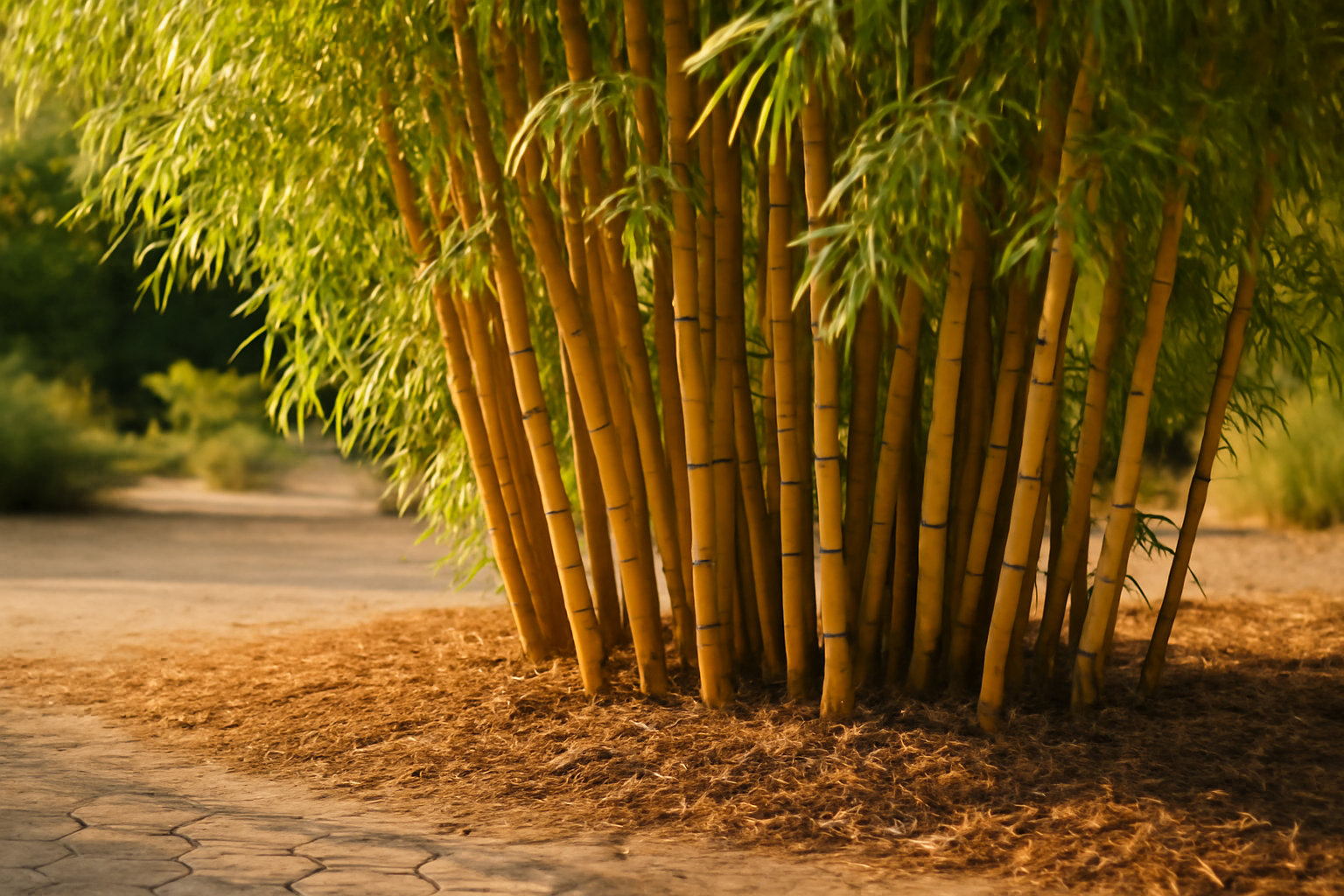
    Coconut husk and straw-based mulches are particularly effective for bamboo due to their high water retention capacity and slow decomposition rate.

    Real-World Examples: Bamboo Surviving Drought Conditions

    Experienced bamboo growers in drought-prone regions have documented bamboo’s real-world resilience under challenging conditions. TerraBamboo’s specialist network includes growers in Southern California, Texas, and parts of the American Southwest who have maintained healthy mature bamboo plantings through consecutive dry seasons with minimal supplemental irrigation.

    In documented cases from USDA Zone 9b landscapes, established Bambusa oldhamii groves have survived summer periods with fewer than 2 inches of rainfall over 90-day stretches, with only monthly deep irrigation supplementation. The plants exhibited temporary leaf rolling and reduced new culm production during peak heat but resumed vigorous growth once the dry season ended. Growers in these situations universally credit deep mulching (5–6 inches) and drip-based irrigation as the practices that made survival possible.

    By contrast, growers who attempted to establish Phyllostachys species in similar conditions without consistent irrigation during the first two years reported significantly higher failure rates — reinforcing the importance of matching species selection to climate and committing to establishment-phase water management.

  • The Best Bamboo for Hot, Dry Climates: A Desert Gardener’s Unlikely Success Story

    The Best Bamboo for Hot, Dry Climates: A Desert Gardener’s Unlikely Success Story

    I still remember standing in my backyard in Phoenix, staring at a pile of dead plants and a credit card bill I didn’t want to open. I had spent nearly $400 on ornamental grasses, tropical shrubs, and yes — bamboo — that a well-meaning nursery employee swore would “do great out here.” Three months later, the Arizona summer had turned every single one of them into crispy, brown ghosts of their former selves. My husband didn’t say “I told you so,” but I could feel it hanging in the air between us every time we walked past that sad corner of the yard.

    That disaster was the beginning of what turned into a genuine obsession with finding bamboo that could actually survive — and even thrive — in a bamboo hot dry climate situation. And spoiler alert: I eventually found it. But first, let me save you from making the same expensive mistakes I did.

    This post contains affiliate links. As an Amazon Associate, I earn from qualifying purchases. This means if you click a link and make a purchase, I may earn a small commission at no extra cost to you. I only recommend products I genuinely find useful.

    Why Most Bamboo Fails in Hot, Dry Climates

    Here’s the hard truth nobody told me at that nursery: most bamboo sold in big-box garden centers is bred for humidity and mild temperatures. When you’re dealing with triple-digit heat, low rainfall, and low humidity — the trifecta of desert gardening misery — the wrong bamboo variety doesn’t just struggle. It dies fast and takes your money with it.

    Bamboo is a grass at its core, and like all grasses, it comes in an enormous range of climate tolerances. The key factors that will make or break bamboo in hot, dry climates are:

    • Heat tolerance: Some varieties handle sustained heat above 100°F; many absolutely do not.
    • Drought resistance: True drought-tolerant bamboo can go longer between watering once established, but they still need help getting there.
    • Soil adaptability: Desert soils are often alkaline and sandy. You need varieties that won’t throw a tantrum over pH.
    • Root establishment time: Bamboo needs extra support during its first year in harsh conditions. This is where most desert gardeners lose the battle.

    After my $400 disaster, I did what any stubborn desert gardener does: I went deep into research mode. Forums, university extension publications, bamboo society newsletters. I was going to crack this.

    The Best Bamboo Varieties for Hot Dry Climate Gardening

    Not all hope is lost for bamboo lovers in the desert Southwest, Southern California, or other hot, arid regions. These varieties have proven track records in difficult conditions.

    Bambusa oldhamii (Giant Timber Bamboo)

    This clumping bamboo is a desert gardener’s best friend. It tolerates heat extremely well, can handle brief drought periods once established, and grows impressively fast. It’s one of the most widely successful bamboos in Southern California and Arizona. Clumping types are also a safer choice in general because they won’t send runners racing under your fence into your neighbor’s yard — something I learned about the hard way with my first failed attempt.

    Bambusa multiplex (Hedge Bamboo)

    Another clumping variety that handles heat and some drought with grace. It stays more compact than Oldhamii, making it perfect for privacy screens or container growing on a covered patio. This one is particularly forgiving during the establishment phase, which makes it great for beginners trying bamboo in a challenging climate for the first time.

    Black Bamboo (Phyllostachys nigra)

    Black bamboo is the one that made me fall in love all over again after my disaster. Those dramatic dark culms are absolutely stunning against a desert landscape with terracotta walls or gravel paths. It is technically a running bamboo, so you’ll want to use root barriers, but it handles heat better than most running varieties and has a surprisingly good drought tolerance once established. If you want to try growing it from seed, these Black Bamboo Seeds are a fun project — just know that growing from seed takes patience and a good germination setup.

    Consider a Bamboo Alternative: Nandina (Heavenly Bamboo)

    Okay, this one isn’t technically bamboo — it’s actually a shrub — but hear me out. Nandina domestica, commonly called Heavenly Bamboo, gives you that airy, bamboo-like aesthetic with incredible drought tolerance and year-round color. For spots where even the toughest bamboo struggles, Nandina Gulf Stream is a gorgeous, low-maintenance option that holds its own beautifully in hot, dry gardens. I planted two of these flanking my back gate and they have been absolutely effortless.

    How I Finally Made Bamboo Work in the Arizona Desert

    After my initial failure, I changed my entire strategy. The plants weren’t the only problem — my planting and watering methods were all wrong for the desert environment. Here’s what actually worked.

    Deep Root Watering Changed Everything

    Surface watering in extreme heat is almost pointless. The moisture evaporates before it reaches the roots, and it encourages shallow root systems that can’t handle the dry spells between waterings. The single biggest game-changer for me was switching to deep root irrigation stakes. I use these 24-inch Deep Drip Watering Stakes around all of my bamboo, and if you prefer a tan color that blends with natural mulch, this tan version works just as well. They push water straight down to the root zone, which is exactly where bamboo needs it most during establishment and heat stress.

    Mulch Like You Mean It

    A thick layer of mulch — we’re talking four to six inches — around the base of your bamboo is non-negotiable in desert climates. It insulates the soil, retains moisture, and keeps the root zone temperature from spiking to levels that stress the plant. Organic mulch also slowly improves your soil structure over time, which is a bonus when you’re working with compacted, alkaline desert dirt.

    Plant in Fall, Not Spring

    This was the advice that finally turned things around for me. Planting bamboo in the fall gives it the cooler months to establish its root system before facing its first brutal summer. Spring planting in the desert throws a brand-new plant