I’ve spent the last 15 years growing bamboo — commercially and on my own 3-acre property in the Southeast. I currently cultivate 14 species, sell poles and plants to landscapers and homeowners, and probably spend 30 to 40 days a year helping clients excavate running bamboo that a previous owner planted too close to a fence, a foundation, or a water line. I’ve learned most of what I know the hard way. Some of it I learned in other people’s yards, watching them cry over a concrete patio that cost $12,000 to replace.
This post is not a scare piece. Bamboo is genuinely useful — I built my livelihood around it. But there are absolutely bamboo species to avoid planting in certain situations, and the nursery tag almost never tells you the full story. Here’s what 15 years actually looks like.
Why “Invasive” Is More Complicated Than You Think
The first thing I want to clear up: not all bamboo spreads aggressively. The broad categories are runners (monopodial) and clumpers (sympodial). Runners spread via underground rhizomes that can travel 10 to 15 feet in a single season under good conditions. Clumpers expand outward slowly — typically 2 to 6 inches per year at the root base — and are dramatically easier to manage.
The problem is that “running” doesn’t appear on most retail labels. You’ll see a pretty photo and the word “hardy.” That’s it. I’ve had customers bring me photos of what’s coming up through their neighbor’s raised beds and ask me what it is. Nine times out of ten, it’s something they planted themselves, three or four years ago, that finally hit its stride.
The Species I Genuinely Regret Planting
Phyllostachys aureosulcata (Yellow Groove Bamboo)
I planted Yellow Groove on the north edge of my property in year two because I wanted a fast windbreak. Within four years, it had sent rhizomes under a gravel path and was emerging on the other side. I spent two full weekends in year six with a mattock and a reciprocating saw cleaning it out. I still find shoots from it in unexpected places.
It’s cold-hardy to about -10°F, which is exactly why it’s so popular in northern climates. But that cold-hardiness means it’s vigorous almost everywhere in the U.S. except the deep South. If you’re planting it, you need a 60-mil HDPE root barrier installed to a minimum depth of 30 inches — and you need to trench-check every single year. I now tell every customer: if you’re not willing to do annual maintenance, don’t plant this species.
Phyllostachys bissettii (Bisset Bamboo)
I’ll be direct: I regret ever selling this one without stronger warnings. It’s marketed constantly as a “good screening bamboo” and it is — right up until it becomes someone else’s problem. I helped a neighbor on my road spend 11 days over two summers removing Bisset that had crossed a property line and was undermining a retaining wall. The rhizomes on established plants go deep — I’ve pulled them out at 20 inches — and they don’t care about compacted soil, rocks, or your plans.
Bisset can handle -15°F. It’s extremely drought-tolerant once established. Those are features in a forest restoration context. In a suburban backyard, they make it nearly impossible to stop.
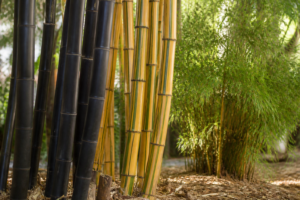
Phyllostachys nigra (Black Bamboo)
I know. Everyone loves black bamboo. It photographs beautifully. It’s dramatic. I grow it myself, and I won’t stop growing it. But I’m putting it on this list because of how often I’ve seen it planted without adequate barriers based on aesthetics alone.
Black bamboo is a runner, full stop. It’s slightly less aggressive than aureosulcata in my experience, but “slightly less aggressive” still means rhizomes can travel 8 feet in a season. Plant it in a pot, plant it in a fully lined raised bed, or install a serious barrier. Don’t plant it and hope.
Pseudosasa japonica (Arrow Bamboo)
This one catches people off guard because it’s shorter — typically 6 to 10 feet — and looks like it should be manageable. It’s not. Arrow bamboo spreads at ground level in ways that are easy to miss until it’s suddenly covering a 20-foot radius. I’ve seen it take over a slope entirely within six years. Its rhizomes also seem to have a particular affinity for growing along fence lines, which makes removal genuinely miserable.
What Containment Actually Requires — Not What the Label Says
Every time I read “contains well with barriers” on a nursery tag, I want to add an asterisk the size of my fist. Here’s what containment actually requires based on my 15 years of doing it:
- Minimum 60-mil HDPE barrier — anything thinner will be punctured by vigorous rhizomes within a few years, especially for Phyllostachys species
- Minimum 28 to 36 inches deep — not the 18 inches most guides suggest
- Overlapped and secured seams — rhizomes will find a gap at a poorly overlapped joint faster than you’d believe
- Annual trench inspection — walk the barrier line every spring, look for rhizomes trying to escape over the top, and cut them back immediately
- A surface gap of no more than 2 inches — rhizomes will arc over a barrier if the top edge is buried or settled too deep
I’ve seen installations with 40-mil barrier at 18 inches fail in three years. I’ve also seen solid 60-mil installations at 30 inches hold clean for over a decade with annual maintenance. The difference is always depth and material quality.
What I Recommend Instead
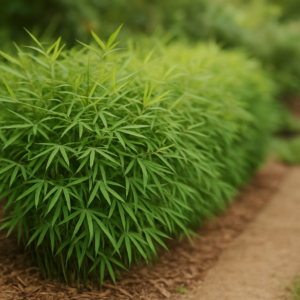
If you want bamboo for screening, privacy, or a dramatic landscape feature but you don’t want to sign up for a lifetime of rhizome management, clumping species are the answer. I grow several and they are genuinely not the same beast.
Bambusa multiplex varieties, Fargesia species, and Borinda are all far more manageable. For clients in warmer zones who want a hedge, I regularly recommend Alphonse Karr — it’s one of the most beautiful bamboos I grow, and it stays where you put it.
An Honest Caveat
I want to be clear about something: I have not found a containment system that is completely zero-maintenance for running bamboo. I’ve talked to researchers, I’ve read the University of Georgia Extension studies on rhizome behavior, I’ve tried everything on my own property. The closest thing to “set it and forget it” is not planting a runner in the first place. If you plant a running species, you are committing to an ongoing relationship with it. Some people are fine with that. Most people I meet are not, because they didn’t know what they were agreeing to.
That’s why I wrote this post. Not to scare you away from bamboo — I make my living from it — but to make sure you’re choosing with your eyes open.
Final Thoughts
The bamboo species to avoid planting aren’t always the most obvious ones. Some of the worst offenders are the most widely sold, most cold-hardy, and most aggressively marketed. Yellow Groove, Bisset, Black Bamboo, and Arrow Bamboo are all genuinely useful plants in the right context with the right management. They are not plants to put in a suburban yard without a serious containment plan and a willingness to maintain it every year.
If you take one thing from 15 years of doing this: the barrier you install matters, but the annual maintenance matters more. A great barrier with no follow-up is eventually a failed barrier. Do both, or choose a clumper.
The Root Barrier That Finally Stopped My Running Bamboo from Crossing the Property Line
Running bamboo rhizomes don’t respect fences or property lines—they’ll tunnel under both. I learned this the hard way after planting Phyllostachys species too close to my boundary, and watching the roots creep toward my neighbor’s shed. A quality root barrier installed at planting time (or dug in retroactively, though that’s messier) is the only real defense.
What works
- The 60mil thickness actually holds up to rhizome pressure over multiple seasons—thinner barriers (30-40mil) I’ve seen get punctured or lifted within 2-3 years.
- HDPE recycled material doesn’t degrade in acidic or alkaline soil the way some cheaper plastics do; I’ve excavated sections after 8+ years that still flex without cracking.
- The 17-inch depth catches most aggressive running varieties if you install it properly with a 2-inch lip above grade to prevent rhizomes from vaulting over the top.
What doesn’t
- Installation labor is brutal—you need to dig a trench deeper than the barrier itself, and backfilling around it takes a full day for even a modest 20-foot run.
- It won’t stop rhizomes that are already established outside the barrier zone; you have to install this at planting or do serious excavation work beforehand.
I hesitated the first time I used one—$200+ in materials felt expensive until I got a $3,000 estimate from a contractor to remove bamboo from under my neighbor’s deck. Get the Convivium Tree Root Barrier 17in x 20ft x 60mil, Deep Recycled HDPE Root & Rhizome Control Barrier before you plant any running varieties.
About This Article

Written by Marcus Chen. Marcus Chen has spent 15 years cultivating and studying bamboo across 14 different species, combining commercial growing operations with extensive hands-on experience in species selection and containment. As both a grower and consultant, he specializes in practical bamboo management, helping homeowners and landscapers understand the real-world requirements for responsible bamboo cultivation. Marcus brings tested knowledge of which species thrive reliably and which present containment challenges that go beyond standard recommendations. More about this site.
Verify this against a primary source
Specifics change, and your situation may differ from the one described here. These are the authorities worth checking directly:
- American Bamboo Society — species listings and cultivation guidance
- USDA PLANTS Database — species range and identification
- USDA Plant Hardiness Zone Map — cold hardiness verification for your location