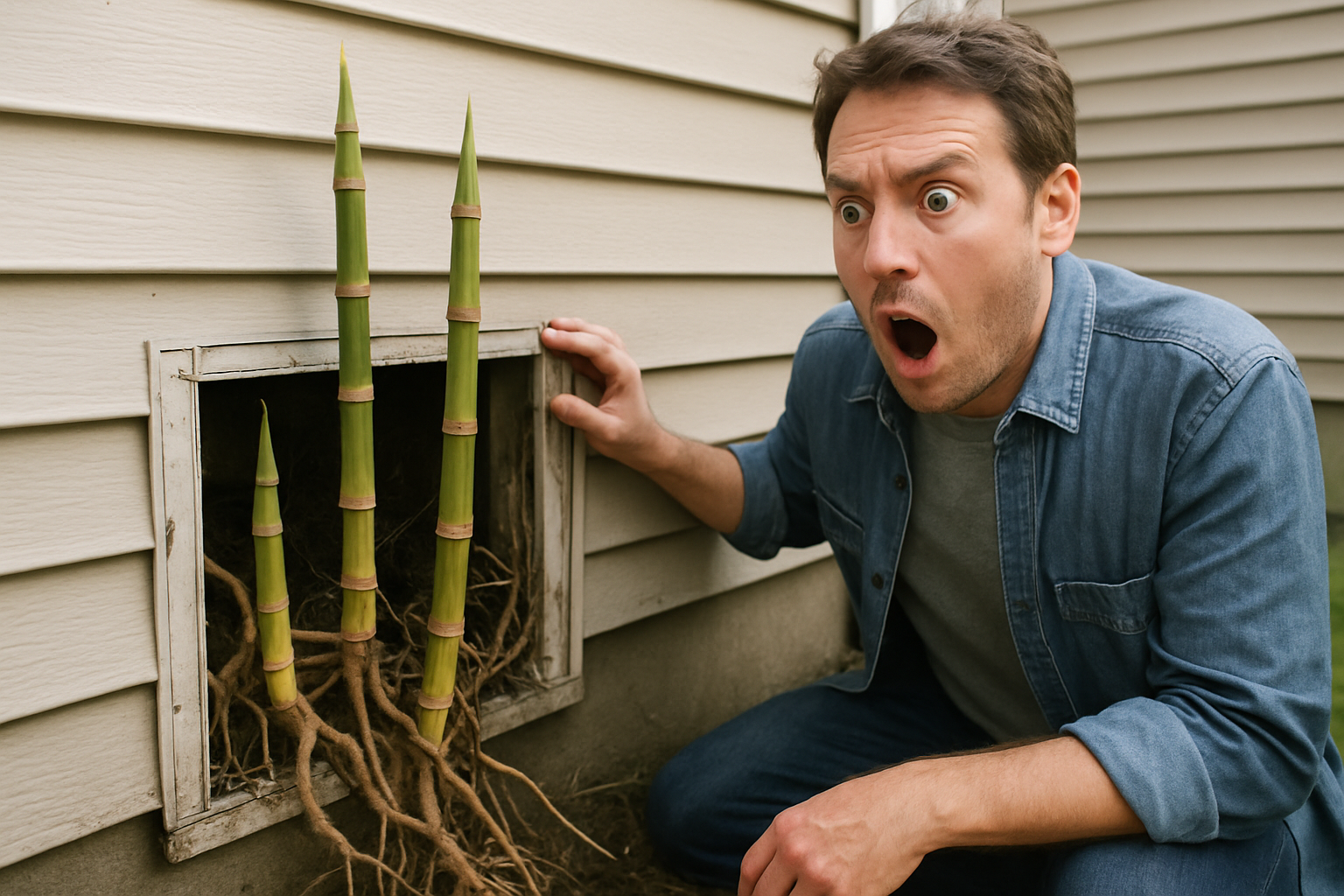
I still remember the morning I walked into my spare bedroom and noticed a thin green shoot poking up through a crack in the baseboard. At first I thought it was a weed that had somehow snuck in. Then it hit me — bamboo growing into house, my house, through the foundation wall. My stomach dropped. That little shoot was the beginning of a very expensive, very stressful few months that nearly cost me my friendship with the neighbor who had gifted me the “beautiful, fast-growing” bamboo plant three years earlier.
This post contains affiliate links. As an Amazon Associate, I earn from qualifying purchases.
If you’re here because you’re googling bamboo problems at midnight in a mild panic, first — breathe. Second — you’re not alone, and there is a way through this. I want to share what happened to me, what I learned the hard way, and the practical steps and tools that finally gave me my yard (and my sanity) back.
How a “Low-Maintenance” Plant Became a Full-Time Problem
My neighbor Diane meant well. She had a gorgeous stand of golden bamboo along her fence line and offered me a division for free. “It grows fast, it’s beautiful, and deer won’t touch it,” she said. All true. What she didn’t mention — probably because she didn’t know — was that running bamboo spreads through underground rhizomes that can travel 10 to 15 feet or more in a single season. Quietly. Invisibly. Until one day they’re not invisible anymore.
Within two years I had a lovely privacy screen. By year three, bamboo shoots were coming up through my lawn 20 feet from the original planting. And then came that morning in the spare bedroom. A contractor friend came over to take a look and confirmed my worst fear: a rhizome had followed the soil line along my foundation, found a small gap, and exploited it. The remediation cost me over $1,400 — demolition, patching, landscaping repair, and professional rhizome removal. Diane and I didn’t speak much that summer. It wasn’t her fault, but the tension was real.
Why Bamboo Growing Into Your House Is More Common Than You Think
Here’s the thing nobody tells you at the garden center: not all bamboo behaves the same way. There are two main types — clumping bamboo and running bamboo. Clumping varieties spread slowly outward from a central crown and are generally well-behaved neighbors. Running bamboo, on the other hand, sends out horizontal rhizomes that actively seek out new territory. Species like Phyllostachys aureosulcata (yellow groove bamboo) or the common golden bamboo (Phyllostachys aurea) are notorious runners.
Rhizomes don’t respect foundations, sidewalks, or driveways. They follow the path of least resistance through the soil, and when they encounter a crack — even a hairline fracture in a concrete footing — they will find it. Bamboo growing into house foundations is a documented problem, not a freak occurrence. And because the rhizomes travel underground, you often don’t know it’s happening until there’s already damage.
A few warning signs to watch for:
- New bamboo shoots appearing far from the original plant, especially near the house
- Shoots emerging through mulch beds directly adjacent to your foundation
- Cracks in concrete paths or patios near an established bamboo grove
- A spongy or uneven feeling under lawn areas between the bamboo and your home
What Actually Stops Bamboo Rhizomes (And What Doesn’t)
After my expensive lesson, I did a deep dive into bamboo containment. Here’s the honest truth: the only reliable long-term solution for running bamboo near structures is a physical root barrier installed correctly in the ground. Edging products, landscaping fabric, and repeated mowing will slow things down but will not stop determined rhizomes.
Effective root barriers need to be at least 24 inches deep (rhizomes rarely go deeper than 18 inches, but you want that margin), made of heavy-duty HDPE material at least 60 mil thick, and installed at a slight outward angle to redirect rhizomes upward where you can see and cut them. The barrier should also overlap at the seam by at least 6 inches and be sealed with the manufacturer’s recommended tape or connector.
Tools I Use and Recommend
After testing several options, these are the root barriers I trust and recommend. Choose the length that fits your situation — measure your planting perimeter before you order.
- For large established groves: Bamboo Shield – 50 feet x 24 inch x 60 mil — This is one of the most widely used barriers for serious bamboo containment. The 60-mil thickness gives you real stopping power against aggressive runners.
- For very large plantings or long fence lines: 75ft x 24in x 60mil Root Barrier — More linear footage so you can protect a longer perimeter without seams in the middle of a run.
- For smaller plantings or tight garden beds: 15ft x 24in x 60mil Root Barrier — Perfect if you’re installing a new clump and want to get containment right from day one.
- For foundation-adjacent protection: Convivium 12in x 20ft x 60mil Root Barrier — Compact and heavy-duty, made from recycled HDPE. Great for tight spaces between a planting and a structure.
- A solid all-around option: West Bay 20ft x 24in x 60mil Root Barrier — Well-reviewed and reliably thick. Works well for driveways, sidewalk edges, and general containment zones.
Installing a Root Barrier the Right Way
Even the best barrier fails if it’s installed poorly. Here’s the basic process I followed after my repair work was done:
- Dig a trench at least 24 inches deep around the bamboo on all sides facing your home or hardscape
- Remove any rhizomes you find during digging — do not skip this step