The morning I discovered my entire back fence line had disappeared under a wall of bamboo, I actually laughed — because what else do you do? Then I saw my vegetable garden. Or what used to be my vegetable garden. My neighbor’s bamboo had invaded my yard so completely that the raised beds I’d spent three weekends building were being lifted off the ground by rhizomes pushing up underneath them. I stopped laughing pretty quickly after that.
This post contains affiliate links. As an Amazon Associate, I earn from qualifying purchases.
That was two summers ago. I’m writing this now from a backyard that’s fully mine again — with a cold drink in hand and a clear view of my rebuilt raised beds — and I want to share everything I learned along the way. Because the solution that finally saved me wasn’t a herbicide or a landscaping crew. It was a conversation I wish someone had told me to have much, much earlier.
When Your Neighbor’s Bamboo Invaded Your Yard: Know Your Legal Standing First
Here’s the thing nobody tells you when you’re standing in your yard watching bamboo shoots pop up through your mulch like something out of a horror movie: you probably have legal recourse. In most U.S. states, encroaching plants are treated similarly to encroaching tree branches or roots. The general legal principle is that you have the right to remove any vegetation that crosses your property line — and in some states, your neighbor can actually be held liable for damages caused by their plant.
I had no idea. I spent the first few weeks just pulling shoots by hand, feeling increasingly hopeless and increasingly resentful toward my neighbor, a perfectly nice retired teacher named Gerald. I didn’t want to start a war. I just wanted my yard back.
What finally changed things was a conversation with a local attorney who specializes in property disputes. She told me that before going to court — which is expensive and relationship-ending — most neighbors will respond to a simple written notice. A friendly but formal letter explaining the encroachment, referencing your state’s nuisance vegetation laws, and requesting that they install a root barrier or share in removal costs. That’s it. That’s the legal solution nobody talks about.
I sent Gerald a letter. He called me that same evening, genuinely mortified. He had no idea how far his bamboo had spread. Within a week, we had agreed to split the cost of a professional root barrier installation along the property line, and he offered to help me clear the rhizomes on my side. Our relationship, which had gotten pretty chilly, actually ended up stronger for it.
Understanding What You’re Dealing With: Running Bamboo Is a Different Beast
Not all bamboo spreads aggressively. Clumping bamboo varieties stay relatively contained and are generally a responsible choice for home landscapes. The culprit in most neighbor disputes — and in my case — is running bamboo. Running bamboo spreads through horizontal underground stems called rhizomes, which can travel 15 feet or more in a single growing season. They don’t stop at fences. They don’t stop at concrete paths. They will find a way.
Understanding this is important because it shapes your removal strategy. You’re not just dealing with the visible culms (the tall canes you can see). You’re dealing with a massive underground network that can extend in every direction. Cutting down the canes above ground without addressing the rhizomes is like mowing a lawn — it’ll be back before you know it.
The most effective long-term approach combines three things: physical removal of existing rhizomes, prevention of new growth through barrier installation, and ongoing monitoring every spring when bamboo is most active.
The Practical Removal Process (What Actually Worked for Me)
Step 1: Cut Everything Down First
Before you can address the roots, you need to clear the canopy. Cut all the canes down to the ground. This is also a good time to assess the full extent of the spread by looking for new shoots and disturbed soil. Don’t compost the canes — bag them and send them out with yard waste, since some bamboo can re-root from cane segments.
Step 2: Extract the Rhizomes
This is the hard part, and it genuinely changed my life when I found the right tool for it. Rhizomes sit anywhere from 2 to 12 inches below the surface, and they’re tough, woody, and surprisingly resistant to being pulled out by hand. I tried a mattock, a garden fork, and sheer stubbornness before discovering sapling pullers, which are designed for exactly this kind of deep-rooted woody material.
The Pvirbravoo Sapling Puller Tool was a genuine game-changer for me. It handles stems from ¼ to 2 inches wide, uses high-leverage mechanics to fully uproot the root system, and the ergonomic design means you’re not destroying your back in the process. If you’re dealing with thicker, more established growth, the CGENWDCH Large Size Sapling Puller is built for larger root systems and gives you even more leverage on those deep, stubborn rhizome masses.
Work in sections, tracing rhizome runs as far as they go. It’s painstaking, but thoroughness here is what determines whether the bamboo comes back.
Step 3: Install a Root Barrier Along the Property Line
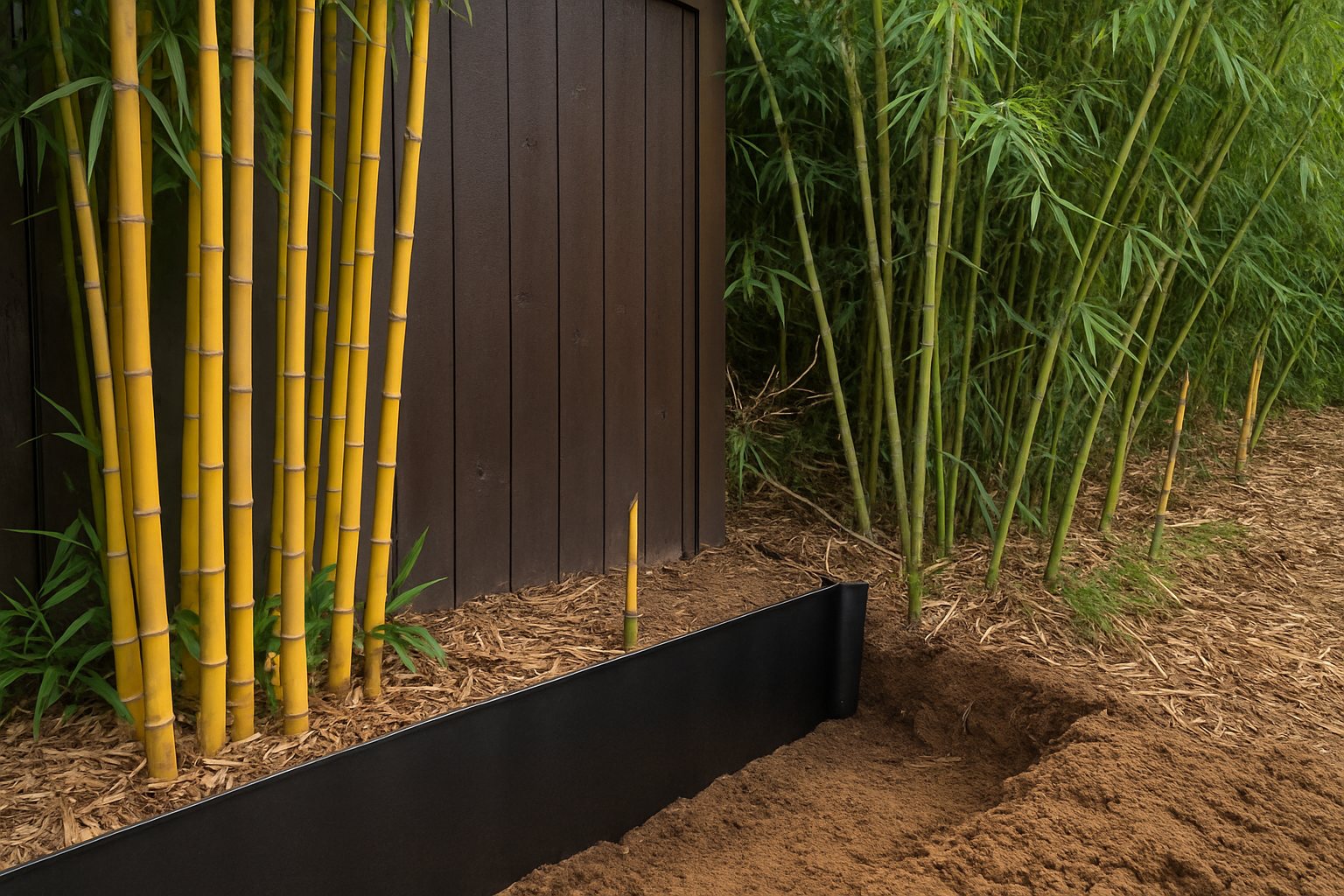
This is the step that keeps the peace long-term. A physical rhizome barrier installed along your property line — or ideally on both sides with your neighbor’s cooperation — prevents future encroachment. The barrier needs to be buried at least 28 to 30 inches deep and angled slightly outward at the top so rhizomes are directed upward rather than under the barrier.
For most residential fence lines, I’d recommend looking at these options depending on your footage:
- Bamboo Shield — 50 feet x 36 inch x 100 mil: The heavy-duty choice at 100 mil thickness, and the 36-inch depth gives you serious protection. Great for longer runs where you want maximum defense.
- 35ft x 24in x 60mil Root Barrier: A solid mid-range option for medium-length fence lines or garden bed protection.
- 15ft x 24in x 60mil Root Barrier: Perfect for smaller targeted areas or protecting a specific garden bed or structure.
Overlap the ends by at least 6 inches if you’re joining sections, and secure them with barrier staples or zip ties before backfilling. Check the top edge every spring — if you see rhizomes trying to curl over the top, prune them immediately.