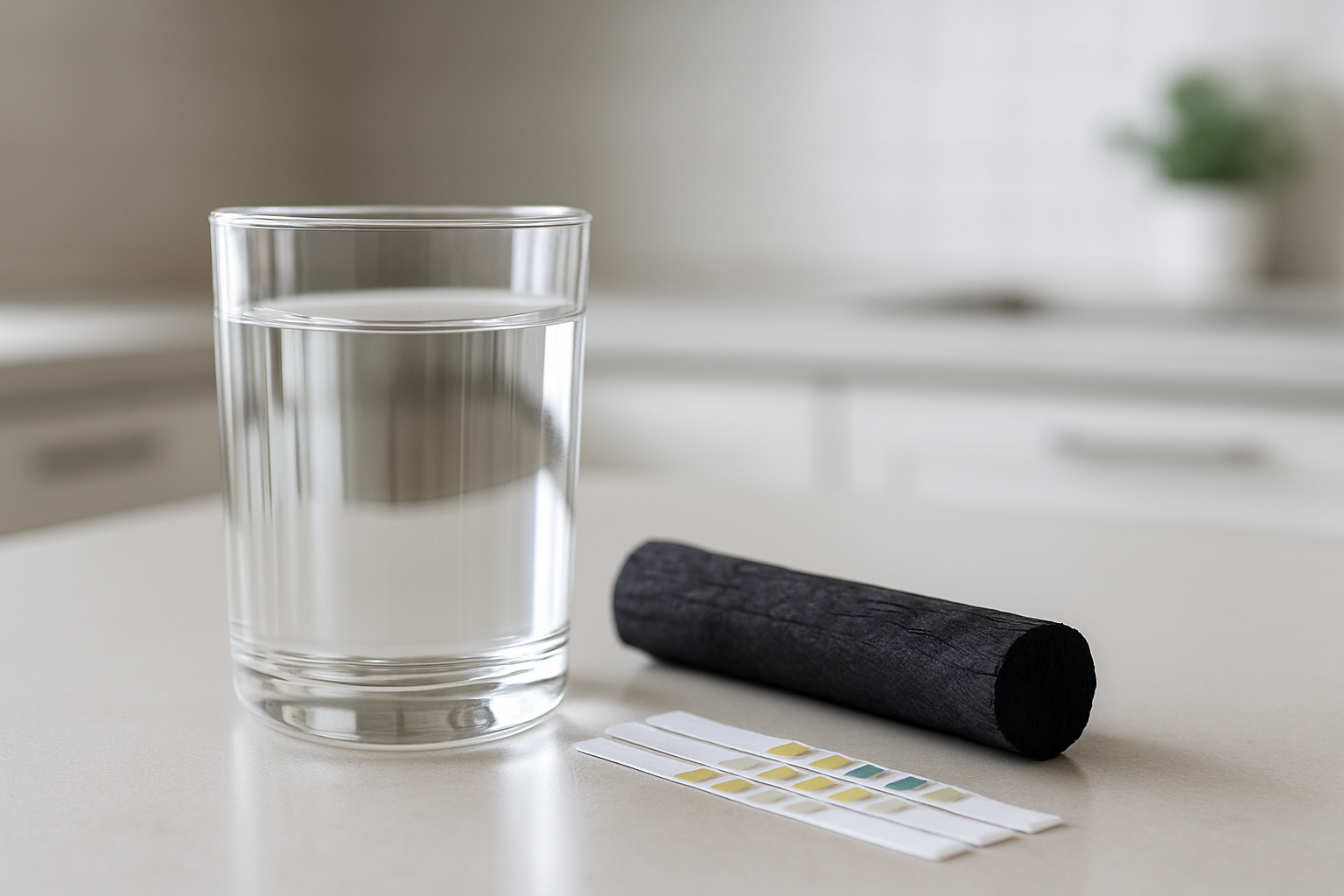
I want to tell you about the day I proudly served my dinner guests what I was absolutely convinced was the purest, most beautifully filtered water they had ever tasted — only to watch my friend Karen hold her glass up to the light, squint, and ask, “Why is it… gray?” That was month one of my bamboo charcoal water filtration experiment, and honestly, it could have gone worse. (It also got much, much better.)
This post contains affiliate links. As an Amazon Associate, I earn from qualifying purchases. This means if you click a link and make a purchase, I may earn a small commission at no extra cost to you. I only recommend products I’ve personally tested or genuinely believe in.
I’d been reading about bamboo charcoal water filtration for months before I finally committed to trying it at home. The concept is genuinely fascinating — activated bamboo charcoal is incredibly porous, and those millions of tiny surface pores act like a sponge for chlorine, heavy metals, and other impurities. It’s an old Japanese practice, deeply rooted in centuries of tradition, and I was completely sold. What I was not sold on, it turns out, was reading the prep instructions carefully enough. But we’ll get to that.
What Is Bamboo Activated Charcoal and Why Does It Work?
Before I get into my embarrassing gray-water situation, let me share what I actually learned over four months of experimentation, because it’s genuinely worth knowing.
Bamboo activated charcoal is made by burning bamboo at extremely high temperatures with limited oxygen — a process called pyrolysis. The result is a lightweight, ultra-porous material with an enormous surface area. We’re talking roughly 300 square meters of surface area per gram. That’s not a typo. That tiny stick sitting in your water pitcher is doing an astonishing amount of quiet, invisible work.
That vast surface area adsorbs (not absorbs — it traps particles on the surface rather than soaking them in) chlorine, volatile organic compounds, certain heavy metals, and the off-taste and odor that tap water often carries. It also releases beneficial minerals like calcium, potassium, and magnesium back into the water as it works. It’s essentially a two-way filter: pulling out the bad stuff, nudging in a little good.
The Japanese have been using binchotan charcoal — the white charcoal version — for water purification for hundreds of years. The bamboo variety is a more sustainable modern spin on that tradition, since bamboo grows so much faster than hardwood trees.
My Bamboo Charcoal Water Filtration Setup (And My First Spectacular Mistake)
Here’s where things went sideways in the most avoidable way possible. I ordered my first set of bamboo charcoal sticks, they arrived beautifully packaged, I unwrapped them with great ceremony, dropped them straight into my water pitcher, and served the results to guests within about six hours.
What I had somehow skimmed past in every single article I’d read was this: you must boil the charcoal sticks first. For about ten to fifteen minutes. This removes the fine charcoal dust that naturally coats the sticks and would otherwise — yes — turn your water a subtle, unsettling shade of gray.
Karen was very gracious about it. She did not drink the gray water. I did not blame her.
So, for the love of all things pure and clear, here is the correct prep process I now follow religiously:
- Rinse the sticks thoroughly under cool running water right out of the package.
- Boil them for 10–15 minutes in a pot of water. This purges the fine dust and reactivates the pores.
- Let them cool completely before placing them in your pitcher or vessel.
- Repeat this boiling process every 3–4 weeks to keep the charcoal working at full capacity. It flushes out accumulated impurities and refreshes the pores.
- Replace sticks every 3–6 months, depending on the product and your water quality.
Simple. Foolproof. Unless you’re me in month one, apparently.
What I Actually Noticed Over Four Months
Once I got my process sorted (post-Karen incident), the results were genuinely impressive. My tap water has always had a faint chlorine smell — nothing alarming, just that slightly municipal tang that makes you feel like you’re one sip away from a swimming pool. Within 24 hours of using properly prepped charcoal sticks, that smell was gone.
The taste difference was noticeable enough that my husband — who had been openly skeptical and referred to the whole project as “my bamboo water phase” — quietly started preferring the filtered water without saying anything about it. I chose not to make a big deal of this. I am the bigger person.
By month two, I was experimenting with different ratios (most products recommend one stick per liter), different soak times, and different vessels. I found that a clean glass pitcher worked better than plastic for taste, and that leaving the charcoal in the water for at least eight hours — ideally overnight — gave noticeably better results than a quick two-hour soak.
Months three and four were about maintenance and comparing products. Some sticks are denser and last longer; some are softer and work faster initially. I also started combining bamboo charcoal with a proper filter pitcher for a belt-and-suspenders approach, and I think that’s genuinely the best of both worlds.
Practical Tips for Getting the Best Results
- Use one stick per liter of water as a starting baseline. Most manufacturers recommend this ratio and it’s a solid rule of thumb.
- Patience matters. An overnight soak gives far better results than a few hours. I prep mine before bed and it’s ready for my morning coffee.
- Glass or stainless pitchers are ideal. Plastic can leach its own flavors and somewhat defeats the purpose.
- Don’t forget the refresh boil. Every three to four weeks, pull the sticks out and boil them again for ten minutes. This is what keeps them effective long-term.
- Bamboo charcoal is not a substitute for treating genuinely unsafe water. It’s excellent for improving taste, reducing chlorine, and softening water quality — it’s not a solution for bacterial contamination or seriously compromised water sources.
- After the sticks are retired from water duty, don’t throw them away. Place them in your refrigerator to absorb odors, tuck them in shoe storage, or add them to the soil of houseplants as a natural amendment. They keep giving.
Tools I Use: Recommended Products
After four months of testing, here are the products I actually recommend and still use. I’ve linked everything so you can check current pricing and reviews.