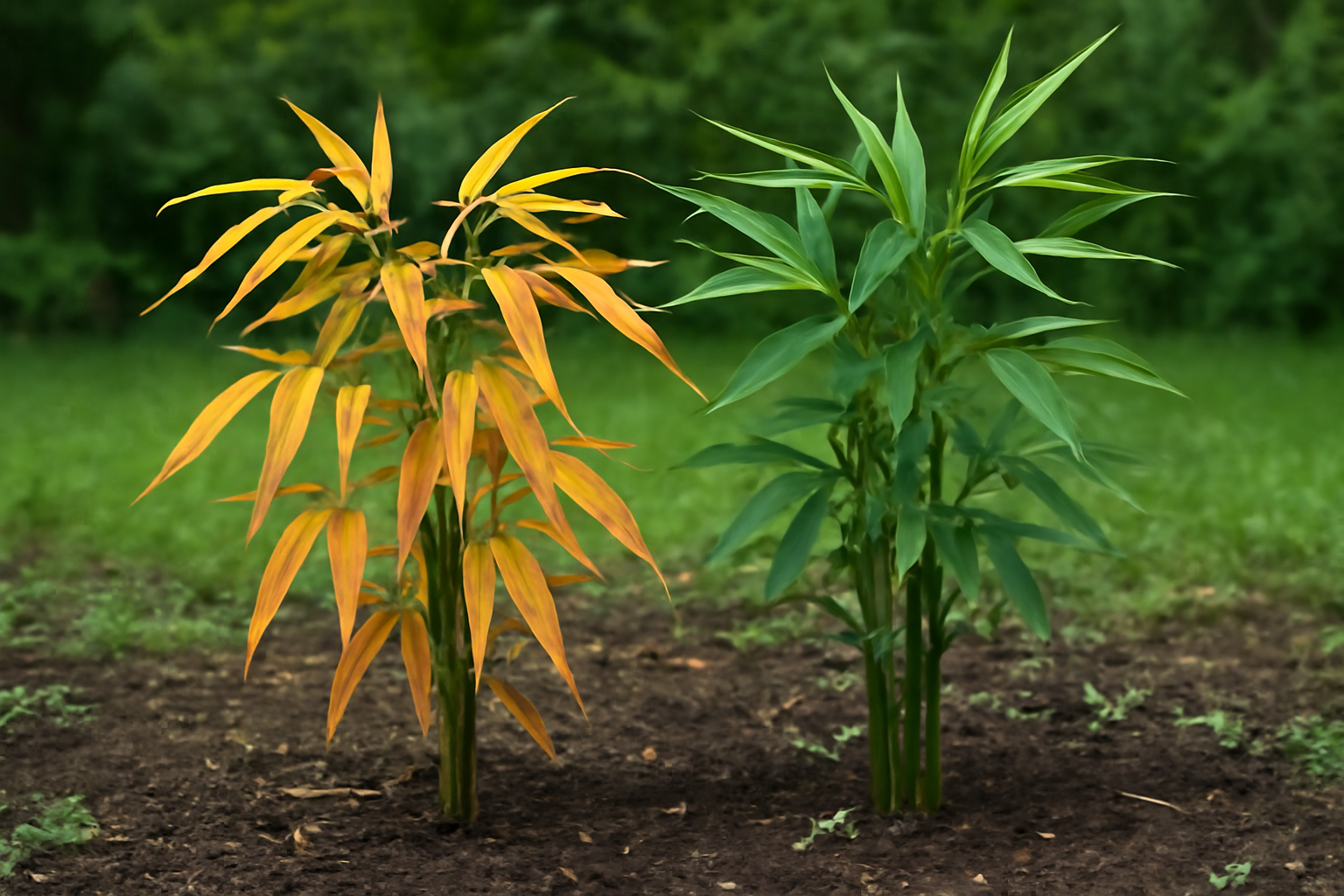
Seeing your bamboo turning yellow can be alarming, especially when your plant looked perfectly healthy just days before. The good news is that yellow bamboo leaves are one of the most common issues bamboo owners face, and in most cases, the problem is entirely fixable once you understand what’s causing it. Before you panic, take a closer look at your plant — yellowing bamboo is rarely a death sentence, and with the right diagnosis, you can have it looking lush and green again in no time.
If you’ve found yourself asking “why is my bamboo turning yellow,” the answer depends heavily on the pattern you’re seeing. Bamboo leaves turning yellow across the entire plant tells a very different story than yellowing that’s limited to the lower leaves, the inner canes, or fresh new growth. The location and spread of the yellowing are your biggest clues, and learning to read those signs is the first step toward solving the problem. It’s also worth noting that indoor lucky bamboo and outdoor garden bamboo operate in very different environments, which means they’re susceptible to different causes — from water quality and pot size indoors, to soil conditions and temperature stress outdoors.
This guide is designed to walk you through every possible cause of bamboo turning yellow, whether you’re growing a delicate indoor arrangement or a towering garden grove. For each cause, you’ll find clear symptoms to help you identify what’s going on, along with practical solutions to get your bamboo back on track. Work through the sections that match what you’re seeing, and you’ll have your answer — and a recovery plan — in just a few minutes.
The Short Answer: Yellow Bamboo Leaves Are Often Completely Normal
If your bamboo leaves are turning yellow, there is a good chance nothing is wrong. Bamboo naturally sheds its older inner and lower leaves — typically in late summer through early autumn — as part of a healthy growth cycle. The trick is knowing the difference between normal leaf drop and a genuine problem that needs your attention.
I learned this distinction the hard way during my first year growing Phyllostachys aurea. I spent three weeks adjusting watering schedules and adding fertilizer, convinced something was seriously wrong — only to watch the plant push out a flush of vigorous new growth a few weeks later. That experience taught me to diagnose before acting. Here is everything I now know about bamboo leaves turning yellow, organized by cause.
Normal Yellowing vs. Something Actually Wrong
Before running through the problem causes, it helps to understand what normal bamboo leaf drop looks like. Healthy bamboo replaces roughly one-third of its leaf mass each year. You will typically notice inner leaves — those shaded by the canopy — turning uniformly yellow and then falling off. The yellowing is clean and even, not blotchy or veined. New growth continues at the tips and on younger culms. The soil is not waterlogged, and the stems show no discoloration.
If that description matches what you are seeing, and if it is happening between July and October, relax. Sweep up the leaves (they make excellent mulch) and let the plant do its thing.
Everything below covers cases where the yellowing is a symptom of something that actually needs fixing.
The 8 Real Causes of Bamboo Leaves Turning Yellow
1. Natural Leaf Drop (Normal Seasonal Shedding)
Symptoms: Even yellow coloring on older inner leaves, primarily in late summer or early autumn. Lower leaves on established culms. No other distress signs.
Diagnosis test: Check the timing and location. If it is August through October, affecting shaded interior leaves only, and new tips are still green and active, this is normal.
Fix: None needed. Leave the fallen leaves as mulch around the base to return nutrients to the soil.
2. Overwatering and Root Rot
Symptoms: Yellowing spreads across multiple leaves simultaneously, often accompanied by a musty smell at the soil surface. The base of younger culms may appear dark or soft. Soil stays wet days after watering.
Diagnosis test: Push a finger 5–7 cm into the soil. If it feels soggy rather than moist, and drainage is poor, overwatering is the likely culprit. Check for soft, blackened roots if you can access them.
Fix: Reduce watering immediately. Improve drainage by working coarse grit or perlite into the soil. For container-grown bamboo, ensure drainage holes are unobstructed. In severe cases, lift the plant, trim rotted roots back to healthy white tissue, and replant in fresh, well-draining mix.
3. Drought Stress
Symptoms: Leaves curl inward lengthwise before yellowing — this is the plant conserving moisture. Wilting is most visible during midday heat. Soil is dry more than 3–4 cm below the surface.
Diagnosis test: Check soil moisture at 5 cm depth. If bone dry, drought stress is likely. Bamboo in fast-draining sandy soil or in containers is especially vulnerable during summer.
Fix: Water deeply rather than frequently — aim for 2–3 times per week during summer heat, enough to wet the full root zone. Apply a 7–10 cm layer of organic mulch around the base to retain moisture. Most established bamboos need about 2.5 cm of water per week.
4. Iron Deficiency (Interveinal Chlorosis)
Symptoms: Yellowing appears between the leaf veins while the veins themselves remain distinctly green. This pattern — called interveinal chlorosis — typically shows on younger, newer leaves first, which is a key distinguishing feature.
Diagnosis test: If the veined pattern is clear and concentrated on new growth, suspect iron deficiency. This is most common in alkaline soils (pH above 7.0), which lock up available iron even when it is present in the soil.
Fix: Test your soil pH. If alkaline, apply a soil acidifier such as elemental sulfur, and use chelated iron rather than standard iron sulfate (chelated forms remain available at higher pH). A foliar spray of chelated iron at 2–3 g per liter can provide quick relief while longer-term soil correction takes effect.
5. Nitrogen Deficiency
Symptoms: Uniform pale yellowing with no veinal pattern, starting on the oldest leaves at the bottom of the plant and moving upward. Overall growth is slow and stems appear thin.
Diagnosis test: If yellowing is even-toned and progresses from older to newer leaves, nitrogen is likely deficient. This is common in bamboo grown in poor soil or in containers without regular feeding.
Fix: Apply a balanced fertilizer with a high nitrogen component — a 20-5-10 ratio works well for bamboo. Feed every 6–8 weeks during the growing season (spring through late summer). Avoid fertilizing after late summer, as this encourages soft new growth vulnerable to cold damage.
6. Root Bound or Overcrowded Rhizomes
Symptoms: Progressive yellowing and reduced vigor in an established plant, particularly one that has not been divided in several years. Roots may be visibly emerging from drainage holes or lifting container edges.
Diagnosis test: For container bamboo, tip the pot and inspect. A mass of circling, densely packed roots with little soil visible confirms the plant is root bound. For garden-grown running bamboos, check whether rhizomes have exhausted the available space — a major reason why running bamboo varieties should be planted with a root barrier from the start to control spread and prevent rhizome stress.
Fix: Divide and repot container plants every 2–3 years. Use a sharp spade or pruning saw to section the root mass. For garden bamboo, divide clumps by cutting through the rhizome mass with a mattock and removing outer sections.
7. Cold Damage and Frost
Symptoms: Brown or straw-colored leaf tips that gradually extend inward, followed by yellowing of entire leaves. Often appears suddenly in late autumn or after an unseasonable frost. Species like Phyllostachys bambusoides are hardy to around -15°C, while tropical species like Bambusa vulgaris show damage below 0°C.
Diagnosis test: Check whether a frost event preceded the symptoms. Damage concentrated on tips and outer leaves facing prevailing wind is characteristic of cold injury.
Fix: Remove damaged foliage once all frost risk has passed. Do not cut back culms until spring — they may still be alive even with yellow leaves. Apply a thick mulch over the root zone to protect rhizomes. Choose species appropriate for your hardiness zone.
8. Spider Mites or Scale Insects
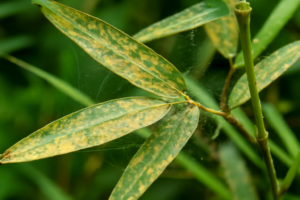
Symptoms: Fine yellow stippling across the leaf surface, as though the leaf has been lightly scratched with a pin. You may notice fine webbing on the undersides of leaves (spider mites) or small brown or white bumps on culms and leaf undersides (scale). Sticky residue on leaves or nearby surfaces indicates scale insect honeydew.
Diagnosis test: Hold a sheet of white paper under a branch and shake it. Spider mites will appear as tiny moving dots. Inspect the undersides of leaves with a magnifying glass.
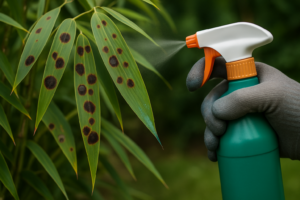
Fix: For spider mites, increase humidity around the plant and spray forcefully with water to dislodge colonies. Neem oil solution (5 ml per liter of water with a few drops of dish soap) applied weekly for three weeks is effective. For scale, scrub affected surfaces with a soft brush dipped in isopropyl alcohol, then follow with neem oil treatment.
Quick Diagnostic Table
| Symptom You See | Most Likely Cause | First Fix to Try |
|---|---|---|
| Even yellowing on inner/lower leaves, late summer | Normal seasonal leaf drop | No action needed |
| Soggy soil, musty smell, soft culm bases | Overwatering / root rot | Reduce watering, improve drainage |
| Leaves curling inward, dry soil, midday wilt | Drought stress | Deep water + mulch |
| Yellow between green veins, new leaves first | Iron deficiency (chlorosis) | Chelated iron + soil pH test |
| Uniform pale yellow, old leaves first, slow growth | Nitrogen deficiency | High-nitrogen fertilizer |
| Declining vigor, roots escaping container | Root bound / overcrowded | Divide and repot or transplant |
| Brown tips extending inward after cold weather | Frost / cold damage | Mulch roots, remove dead foliage in spring |
| Stippled yellow dots, webbing, sticky residue | Spider mites or scale insects | Neem oil spray, inspect undersides |
A Practical Approach to Diagnosis
When bamboo leaves start turning yellow, the single most useful thing you can do before reaching for fertilizer or the hose is to observe the pattern carefully. Where on the plant is the yellowing? What do the veins look like? Is the soil wet or dry? Did a frost pass through recently? Most causes have a distinct fingerprint once you know what to look for.
Start with the table above, match your symptoms, then work through the corresponding fix systematically. Bamboo is genuinely resilient — most causes of yellowing are reversible with early attention — and once you have grown it through one full seasonal cycle, you will find you can read its signals quickly and confidently.
🛒 Recommended Products
Chelated Liquid Iron — corrects iron chlorosis (yellowing from iron deficiency), the most common cause of yellow bamboo leaves
View on Amazon →Southern Ag Thiamethoxam Insecticide — treats spider mite and scale infestations that cause yellowing
View on Amazon →Super Green Lucky Bamboo Fertilizer — restores nitrogen to fix pale yellow leaves caused by nutrient deficiency
View on Amazon →As an Amazon Associate I earn from qualifying purchases. Prices and availability subject to change.
The Balanced Fertilizer That Brought My Yellowing Bamboo Back to Deep Green
Nutrient deficiency—particularly nitrogen, potassium, or magnesium—is one of the sneakiest causes of yellowing bamboo, and it’s easy to miss if you’re not regularly feeding your plants. A balanced, slow-release fertilizer formulated for ornamental grasses and bamboo can reverse yellowing caused by poor soil nutrition faster than you’d expect.
What works
- New growth emerges noticeably greener within 3–4 weeks of consistent application, especially if yellowing was nutrient-related rather than caused by overwatering or pests.
- Slow-release granules mean you’re not constantly mixing solutions or monitoring application rates—just top-dress around the base in spring and again mid-summer, and let rain do the work.
- The NPK balance (higher nitrogen for foliage) doesn’t push excessive culm growth that can weaken structural canes or make containment harder.
What doesn’t
- If yellowing is caused by overwatering or root rot, fertilizer won’t fix it—you’ll just be feeding a dying plant, which I learned the hard way with my running bamboo in soggy clay soil.
- Granules can wash away or scatter during heavy rain, so you’ll lose some product and may need to reapply sooner than the label suggests in wet climates.
I almost gave up on a severely yellowed specimen and nearly ripped it out—until I realized I’d been so focused on watering that I’d never actually amended the soil in three years. View on Amazon →
This post contains affiliate links. As an Amazon Associate, I earn from qualifying purchases at no extra cost to you.