- Layer your defenses. The most effective approach combines scent repellents at the
I came outside one morning in my pajamas, coffee in hand, ready to admire my beautiful bamboo grove — and found a deer standing inside it, staring at me like I was the one trespassing. We locked eyes. She chewed slowly, deliberately, like she was making a point. That was the moment I knew I had a deer eating bamboo prevention problem, and absolutely zero plan for solving it.
This post contains affiliate links. As an Amazon Associate, I earn from qualifying purchases.
What followed was about six weeks of increasingly unhinged experiments, one genuinely embarrassing incident involving a garden hose and my own face, and eventually — mercifully — a solution that actually works. If you’re battling deer in your bamboo garden right now, stick with me. I’ll walk you through what failed spectacularly and what finally sent those beautiful, infuriating animals packing.
Do Deer Actually Eat Bamboo?
Let’s clear this up, because I spent an embarrassing amount of time in denial about it. Yes, deer eat bamboo. They’re especially fond of the young, tender shoots that emerge in spring, but they’ll also graze on leaves and strip lower canes during leaner months. Running bamboo varieties with more delicate foliage tend to attract more attention, but clumping types aren’t immune either.
The frustrating part is that bamboo is actually pretty resilient. A healthy, established grove can handle some browsing without suffering permanent damage. But repeated deer visits — especially targeting the new shoots — can seriously stunt growth, thin your canopy, and turn a lush privacy screen into something that looks like it lost a fight. Which, to be fair, it did.
So prevention matters. The trick is figuring out which prevention method doesn’t also make you look like a complete fool in front of your neighbors. (Spoiler: I failed at this.)
Three Deer Eating Bamboo Prevention Methods I Tried (Ranked by Dignity Loss)
Method One: Scent-Based Repellents
I started here because it seemed the most sensible and the least likely to end in humiliation. Deer rely heavily on smell, and strong, unfamiliar scents — particularly anything that smells like predators or humans — are supposed to keep them at bay. I picked up some repellent stakes and gave them a shot.
The Safer Brand Deer-Off Repellent Stations are a solid starting point — six waterproof stakes you push into the ground around your garden perimeter. They’re discreet, all-season, and don’t require any batteries or setup beyond pushing them into the soil. I also tried a set of scent-based deer and rabbit repellent pouches that you hang or stake around the garden bed.
Did they work? Somewhat, and only at first. Deer are smart and adaptable. After a week or two, the same doe was back, calmly eating three feet from a repellent stake like it was garden décor. Scent repellents need to be rotated and refreshed regularly to stay effective, and on their own, they’re rarely enough for persistent deer pressure. Good as part of a layered strategy — not great as a solo act.
Method Two: Manual Water Deterrence (The Dark Chapter)
This is the part of the story I’m not proud of. After the repellent stakes underwhelmed me, I decided the problem was that I needed something more active. Something that would startle the deer in the moment. I didn’t have a motion-activated sprinkler yet, so I improvised.
I ran a garden hose out to the bamboo grove, left it in a position I was convinced would cover the entry point the deer used, and connected it to a timer I had from an old drip irrigation setup. My plan was to have the hose kick on at dawn when the deer typically visited.
What I had failed to account for was that I had pointed the hose roughly toward the patio. At 6:03 AM, I walked outside with my coffee to check if the system had worked, stepped directly into the activation zone, and received a full-pressure blast of cold water directly to the chest. I screamed. My neighbor two doors down later told me she heard it and assumed something terrible had happened. The deer, for the record, was not present and was almost certainly fine.
So. Motion-activated sprinklers are a great idea. Just let them be the actual products designed for this purpose.
Method Three: Motion-Activated Sprinklers (The Clear Winner)
After I dried off and salvaged what remained of my dignity, I ordered a proper motion-activated sprinkler. This is where things turned around completely.
Motion-activated sprinklers work by detecting movement via infrared sensor and triggering a sudden burst of water. For deer, this is genuinely startling and unpleasant — not harmful, just enough to associate your garden with an unpleasant surprise. Over time, they learn to avoid the area altogether. It’s humane, effective, and requires almost no effort on your part once it’s set up.
I tested a few options, and here are the three worth knowing about:
- Orbit 62100 Yard Enforcer — This is the gold standard and the one I ultimately kept in place long-term. It has day-only, night-only, and 24-hour modes, which is fantastic for targeting the specific times deer are most active without wasting water or batteries. The sensor range and arc are adjustable, and it connects to a standard hose. Highly reliable.
- G-Jyuncyou Solar Motion-Activated Sprinkler — A solar-powered option with the bonus of flashing LED lights, which adds a visual deterrent on top of the water burst. Great if you want to avoid dealing with batteries and want something that works in a more exposed area of your yard.
- Havahart Critter Ridder — A solid mid-range option from a trusted wildlife management brand. Covers a wide range of animals beyond deer, including smaller critters that might also be eyeing your garden. Good choice if you’re dealing with multiple types of visitors.
Tips for Making Your Deer Eating Bamboo Prevention Strategy Actually Stick
Even with the right tools, there are a few things I wish someone had told me before I wasted six weeks and one perfectly good cup of coffee.
- Layer your defenses. The most effective approach combines scent repellents at the
Tag: bamboo pests
-

Deer vs My Bamboo Garden: Three Deterrents, One Clear Winner
-

I Thought My Bamboo Had a Rare Disease. It Was Just Mealybugs in Disguise.
I stood in my backyard last spring, squinting at my golden bamboo like a detective who had absolutely no business being a detective. There was white stuff on it. Fluffy, cottony, suspicious white stuff. I did what any reasonable person does in this situation — I immediately convinced myself my bamboo had contracted some obscure, possibly bamboo-ending fungal plague. I even wrote out a list of symptoms to describe to… whom, exactly? The bamboo doctor? Spoiler: the bamboo doctor does not exist. What I actually had was a completely common case of mealybugs on bamboo, and I spent two weeks panicking over what any experienced gardener would have spotted in about thirty seconds.
This post contains affiliate links. As an Amazon Associate, I earn from qualifying purchases. If you click a product link and make a purchase, I may earn a small commission at no extra cost to you. I only recommend products I genuinely find useful for bamboo gardening.
If you’re out here doing the same frantic Google spiral I did, first of all — welcome, you’re in good company. Second, take a breath. Mealybugs are annoying, but they are absolutely manageable, and your bamboo is almost certainly going to be fine. Let me walk you through what actually happened to mine, and more importantly, what I did to fix it.
What Mealybugs on Bamboo Actually Look Like (And Why I Thought It Was Something Way Worse)
Here’s where I really embarrassed myself. Mealybugs look like tiny, soft-bodied insects coated in a white waxy powder. They cluster at leaf joints, along stems, and in the tight spaces where leaves meet the culm. The result is these little cottony white tufts that — to an anxious bamboo parent — can look like fungus, mold, powdery mildew, or, in my personal nightmare scenario, some kind of bamboo-specific blight I had somehow introduced to my garden.
I photographed the white patches from twelve different angles. I sent pictures to two friends, neither of whom garden. One said it looked like “some kind of foam.” The other said “just pull it off?” Reader, I should have listened to the second friend.
The actual telltale signs of mealybugs are pretty distinct once you know what you’re looking for:
- White, cottony or waxy residue concentrated at leaf joints and stem nodes
- Tiny oval-shaped bugs visible underneath the fluff (cream or pale yellow in color)
- Sticky residue on leaves or stems — this is honeydew, a byproduct mealybugs leave behind
- Yellowing or wilting leaves on otherwise healthy bamboo
- Sooty mold forming on honeydew deposits — this was the thing that made me truly spiral
That last one — the sooty mold — was what pushed me over the edge. When mealybugs excrete honeydew, a secondary black mold can grow on it, which makes your bamboo look like it’s suffering from two problems simultaneously. It’s alarming. It’s also secondary. Fix the mealybugs, and the mold stops getting new food and eventually clears up on its own.
How to Actually Get Rid of Mealybugs on Bamboo
Once I finally accepted that I had bugs and not a plague, I got to work. There’s a logical order to treating a mealybug infestation, starting with the least aggressive methods and escalating only if needed.
Step 1: Manual Removal First
Before you reach for any product, physically remove as many mealybugs as you can. A strong blast of water from your garden hose dislodges a surprising number of them. Follow that up with a cotton swab or soft cloth dipped in rubbing alcohol — dab it directly onto the bugs and their cotton nests. The alcohol dissolves their waxy protective coating and kills them on contact.
For this, I keep a spray bottle of high-concentration isopropyl alcohol on hand. I like the 99% Isopropyl Alcohol Spray in a 17 oz bottle — the spray format makes it easy to target specific clusters without soaking the whole plant, and the 99% concentration is fast-acting. If you’re treating a larger planting or want a bit more volume, the Volu-Sol 99% IPA in a 24 oz continuous mist spray bottle gives you a nice fine mist that’s great for getting into tight leaf joints. For a smaller, travel-sized option you can keep in a garden kit, the Safetec 70% Isopropyl Alcohol 2oz Spray Bottle works well for spot treatments on lighter infestations.
One important note: always test rubbing alcohol on a small area first. Most bamboo handles it well, but diluting your 99% solution with water (roughly 1:1) is a good idea if you’re treating young or delicate growth.
Step 2: Bioinsecticide for Persistent Infestations
If manual removal doesn’t fully knock things back — and with a well-established infestation, it often won’t — a bioinsecticide is your next move. I’ve had great results with Grandevo CG Bioinsecticide. It’s derived from a naturally occurring soil bacterium and is effective against mealybugs, aphids, mites, and several other common bamboo pests. Because it’s a biological pesticide, it’s gentler on beneficial insects than many conventional options, which matters a lot if you’ve got pollinators visiting your garden. Mix according to the label directions and apply as a foliar spray, making sure to coat the undersides of leaves and the stem nodes where mealybugs hide.
Step 3: Systemic Treatment for Serious or Recurring Problems
For persistent, large-scale infestations — or if you’ve had mealybugs return season after season — a systemic insecticide that the plant absorbs from the inside is worth considering. The AceCap Insecticide Systemic Tree Implants are designed to be inserted into the plant itself, delivering insecticide directly into the vascular system so insects feeding on plant tissue are exposed to it. This is more of a serious intervention than a first-response tool, but for bamboo groves dealing with ongoing pest pressure, it’s a legitimate option. Follow the manufacturer’s instructions carefully and use it as part of an integrated approach rather than a standalone fix.
Preventing Mealybugs From Coming Back
Here’s the part I wish someone had told me before I had a full
-
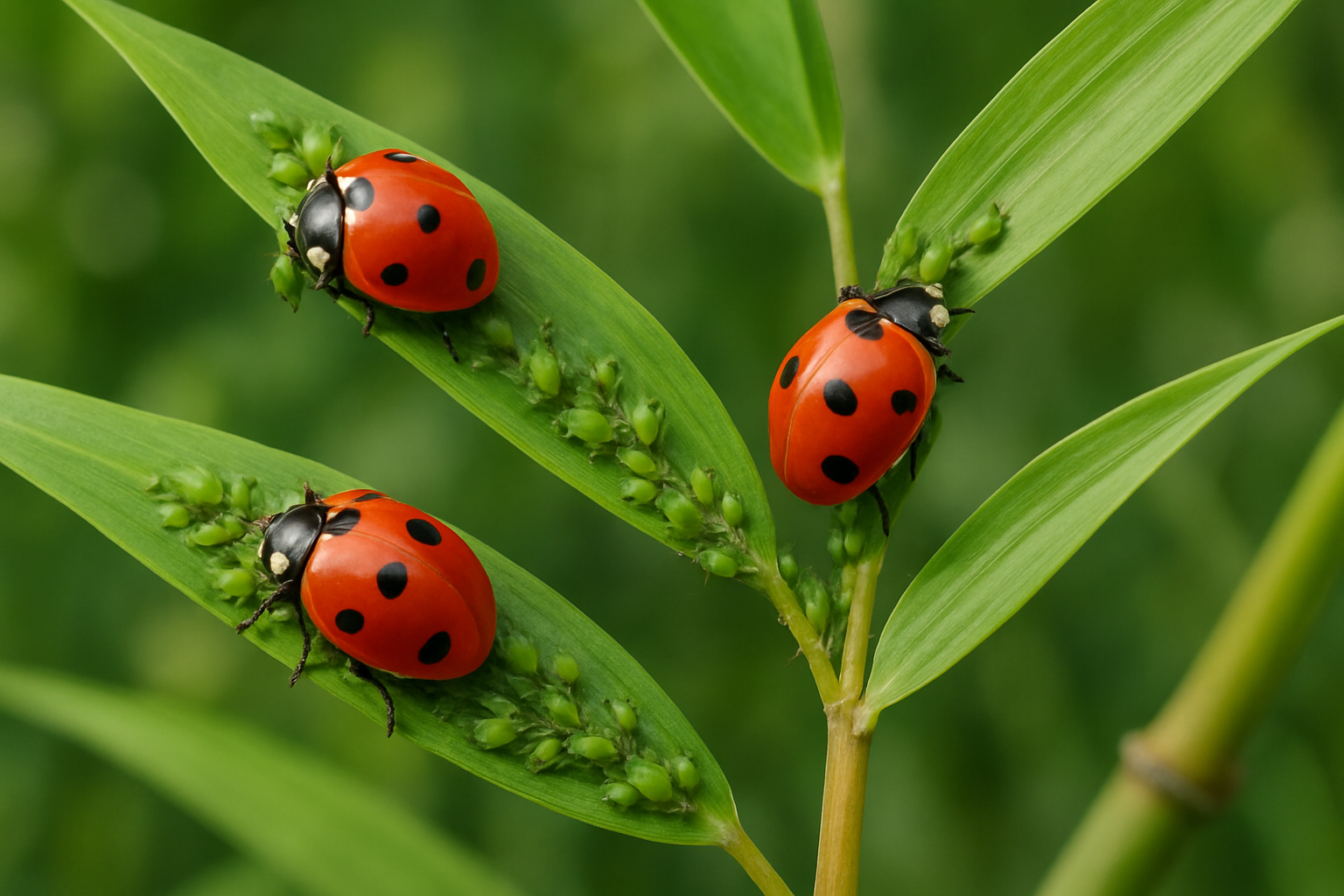
Aphids on Bamboo: The Infested Summer That Accidentally Created a Ladybug Paradise
- Bonide Captain Jack’s Neem Oil 32 oz Ready-to-Use Spray — great for spot treatments and small groves
How I Managed to Miss an Entire Aphid Colony for Three Weeks
It started innocently enough. I noticed a faint yellowish tinge on a few of my Phyllostachys aurea leaves in late June, but honestly? I blamed the heat. I told myself the bamboo was just “adjusting.” I maybe also told my husband it was “totally normal seasonal variation,” which is gardener-speak for “I have no idea what’s happening and I’m choosing optimism.” I carried on with my summer, blissfully ignorant, until the afternoon I decided to take a closer look and discovered that roughly half of one culm was absolutely coated in tiny green aphids. There were so many that the stem was visibly glistening. It was, in a word, a lot.
I may have screamed. My neighbor definitely looked over the fence. We don’t need to dwell on that part.
Understanding Aphids on Bamboo: What You’re Actually Dealing With
Once the screaming subsided and I got serious, I learned that aphids on bamboo are actually pretty common, especially during warm, dry stretches of summer. They’re soft-bodied insects that cluster on new growth, stems, and the undersides of leaves, feeding by piercing plant tissue and sucking out sap. A few aphids aren’t a crisis. A full-blown colony, however, can cause real problems.
Here’s what to look for when inspecting your bamboo:
- Yellowing or curling leaves, especially on newer growth
- Sticky residue on culms or leaves — this is called honeydew, and it’s aphid waste (yes, really)
- Black sooty mold developing on that honeydew residue
- Visible clusters of tiny soft-bodied insects, usually green, yellow, or black
- Ants running up and down your culms — ants actually farm aphids for their honeydew, so ants are often a tip-off
Bamboo is generally a tough, resilient plant, and a healthy established grove can tolerate a light infestation without serious long-term damage. But left untreated, a heavy aphid population will weaken new shoots, stunt growth, and invite fungal problems. So yes, you do want to act.
Aphids on Bamboo Treatment: What Actually Works
The good news is that treating aphids on bamboo is very manageable once you know what you’re doing. I tried a few different approaches that summer, with varying levels of dignity intact.
Start With a Strong Water Blast
Your first line of defense is genuinely just a garden hose with a strong spray nozzle. Get underneath the leaves and blast the aphids right off the plant. They’re not strong climbers and most won’t make it back. Do this in the morning so the foliage can dry before evening. It won’t eliminate a severe infestation on its own, but it knocks the numbers down fast and is completely free. I did this step while narrating it like a nature documentary, which made me feel better.
Insecticidal Soap for Direct Contact Killing
Insecticidal soap is one of the safest and most effective tools for aphid control. It works on contact by disrupting the insects’ cell membranes, so thorough coverage is key — you have to actually hit the aphids with the spray, not just mist the general area. The Garden Safe Brand Insecticidal Soap Insect Killer is a solid ready-to-use option that’s approved for organic gardening. Apply it every four to seven days and make sure you’re coating the undersides of leaves where aphids love to hide.
Neem Oil: The Heavy Hitter
Neem oil is where I really turned the corner on my infestation. It works both as a contact insecticide and as a systemic disruptor — meaning it interferes with aphids’ ability to feed and reproduce even after the spray dries. I’ve used the Bonide Captain Jack’s Neem Oil Ready-to-Use Spray and found it really convenient for quick treatments on smaller areas. For a larger grove or if you want better value over time, the Bonide Captain Jack’s Neem Max 64 oz Spray is excellent and goes further. If you prefer to mix your own and customize your concentration, the Bonide Neem Max 8 oz Concentrate is the most economical route. Apply neem oil in the early morning or evening — never in direct hot sun, which can cause leaf burn.
A Gentle All-in-One Option
If you want something that handles insects, fungal issues, and mites all at once — which honestly is often what’s going on at the same time — the Earth’s Ally 3-in-1 Plant Spray is a wonderful OMRI-listed option that’s safe around kids, pets, and pollinators. I appreciate that it smells like a spa instead of a chemistry lab.
Tools I Use for Aphid Control on Bamboo
- Bonide Captain Jack’s Neem Oil 32 oz Ready-to-Use Spray — great for spot treatments and small groves
-
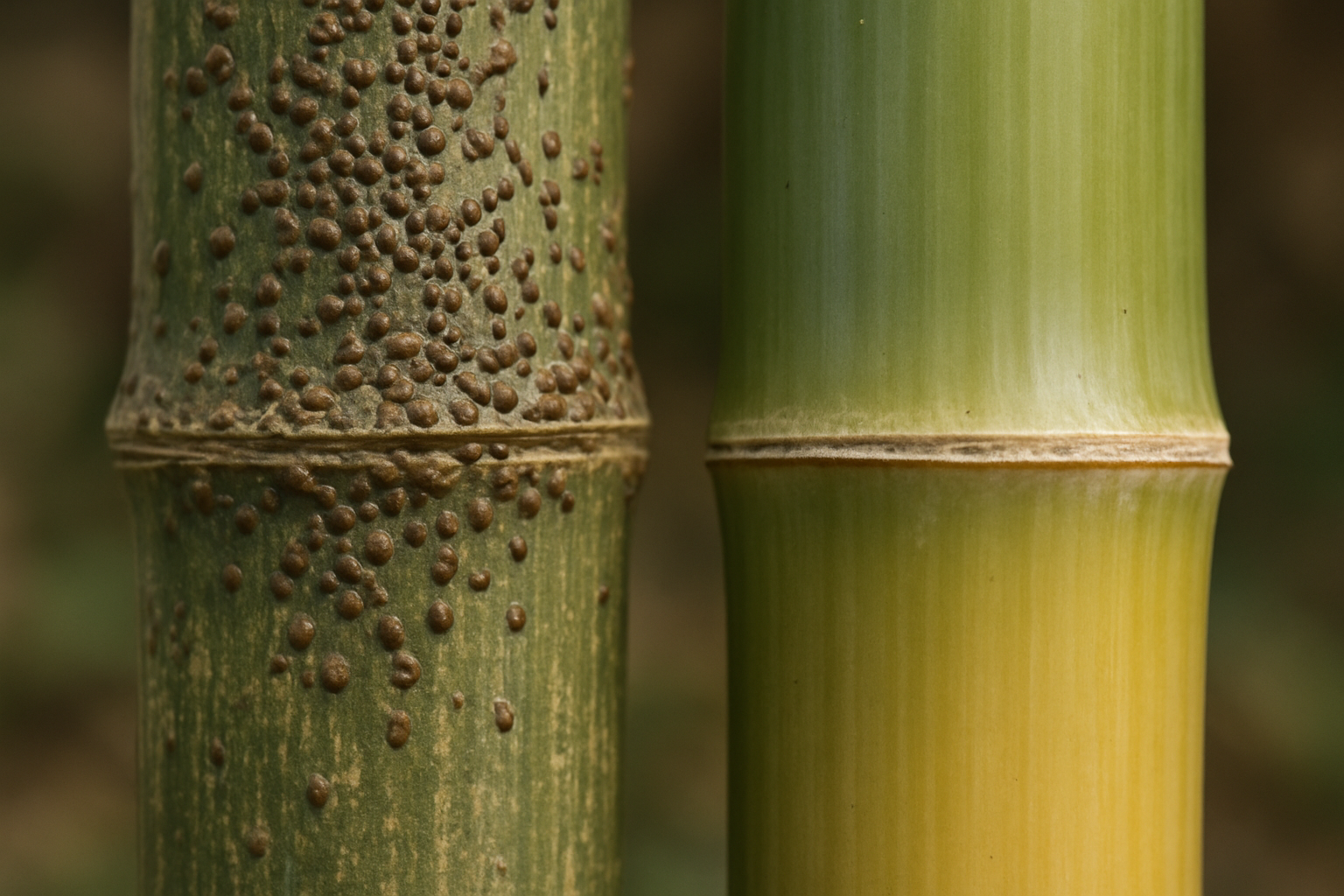
Scale Insects on Bamboo: My 3-Month Battle and the Moment I Finally Won
I still remember the morning I walked out to my bamboo grove and felt my stomach drop. What I thought were harmless little bumps on the culms were absolutely everywhere — and my prized Phyllostachys aureosulcata, the one I’d nursed from a small division for four years, was looking pale, stunted, and just… wrong. It took me another two weeks to finally diagnose what I was dealing with: scale insects on bamboo. By that point, I’d already lost a season of growth, spent money on the wrong treatments, and had a full-blown argument with my husband about whether we should just “rip it all out and start over.” This is the story of how I nearly lost my bamboo — and how I finally won.
This post contains affiliate links. As an Amazon Associate, I earn from qualifying purchases. This means I may earn a small commission if you click through and buy something, at no extra cost to you. I only recommend products I’ve personally used or researched thoroughly.
How I Missed the Early Signs of Scale Insects on Bamboo
Here’s the thing about scale insects — they don’t look like bugs at first glance. They look like tiny, waxy lumps. Some look like little oyster shells. Some look like flat brown discs. For weeks, I genuinely thought I was seeing some kind of natural growth variation on my culms. By the time I got close enough with a magnifying glass and did my research, the infestation had spread from one clump to three.
Scale insects feed by inserting their mouthparts into plant tissue and sucking out the sap. On bamboo, this shows up as yellowing or dropping leaves, weak new shoots, and a general decline in vigor. You might also notice a sticky residue on the culms or leaves — that’s honeydew, a byproduct of their feeding — which can then attract sooty mold, turning your beautiful bamboo a grimy black. It’s a cascading disaster, and it happens quietly.
The two most common types you’ll encounter are armored scale and soft scale. Armored scale (like oystershell scale) creates a hard, detachable waxy covering and is generally harder to kill with contact sprays. Soft scale produces a waxy coating that’s part of its body, and while it sounds less intimidating, it can spread honeydew more aggressively. Both are bad news for bamboo.
What Actually Works: My Treatment Protocol
I’ll be honest — my first two months of fighting this were a mess. I tried neem oil sprays I mixed myself (inconsistent results), I tried dish soap solutions (helped a little, not enough), and I spent one genuinely miserable afternoon scrubbing individual culms with a soft brush and rubbing alcohol. That last part actually does help on isolated infestations, but when scale has spread across multiple clumps, you need something more systematic.
The turning point came when I switched to a proper horticultural oil — specifically, a refined paraffinic oil that smothers scale insects by blocking their breathing pores. Unlike neem oil, which can degrade quickly and smells absolutely terrible, horticultural oil is lightweight, effective, and breaks down cleanly in the environment. The key is thorough, repeat application — you have to coat every surface, including the undersides of leaves and the joints of culms, where scale loves to hide.
For a severe or stubborn infestation, I also added a systemic soil drench to my protocol. Systemics work differently — the plant absorbs the active ingredient through its roots, and when scale insects feed, they ingest it. This is especially useful for bamboo because the dense culm structure makes it genuinely hard to get full spray coverage. A systemic approach means you’re treating from the inside out.
Treatment Tips That Made the Difference
- Treat in the crawler stage when possible — newly hatched crawlers are the most vulnerable because they haven’t yet formed their protective covering
- Spray in the early morning or evening to avoid leaf scorch and to protect beneficial insects
- Apply horticultural oil at 7–14 day intervals for at least three treatment cycles
- Don’t forget the soil surface and the base of culms — scale can overwinter in debris
- After treatment, rake and remove fallen leaves and debris to reduce reinfestation sites
- Avoid over-fertilizing with nitrogen during an infestation — lush new growth attracts scale
The Products That Finally Turned Things Around
After a lot of trial and error, these are the specific products I used in my recovery protocol. I’m sharing the exact ones because details matter — not all horticultural oils are equal, and the concentration and formulation make a real difference.
For Spray Treatment
I started with the Monterey Horticultural Oil Ready to Spray (32 oz) for my initial applications because I wanted something I could grab and use immediately without measuring or mixing. It’s OMRI Listed for organic gardening and comes bundled with a measuring spoon, which I appreciated. Once I confirmed it was working, I upgraded to the concentrate for better value — the Monterey Horticultural Oil 1 Quart concentrate is perfect if you have a small to medium grove, and the 1 Gallon version is the better buy if you’re dealing with a large planting or want to stay stocked for the season. All three are the same trusted formula — it just comes down to how much bamboo you’re treating.
For Systemic Treatment
For my worst-affected clumps, I used the Monterey Fruit Tree & Vegetable Systemic Soil Drench (1 gallon) as a soil application. This uses imidacloprid, which the plant absorbs systemically — meaning scale insects are exposed to it when they feed on plant tissue. I’ll note that systemics should be used thoughtfully; avoid applying them when bamboo is in active bloom (rare, but it happens) since pollinators could be affected. For a stubborn, widespread infestation, though, this was the tool that finally broke the cycle for me. There’s also a 1 Quart spray version available if you prefer foliar systemic application or have a smaller area to treat.
Preventing Scale From Coming Back
Once you’ve beaten an infestation, prevention becomes your new obsession — at least it did for me. Scale insects often arrive on new plants, so I now quarantine any new bamboo division for a few weeks before planting it near my established grove. I also do a visual inspection of my culms every spring when I’m doing general cleanup, and I keep horticultural oil on hand year-round.
I still remember the morning I walked out to my bamboo grove and noticed something was terribly wrong. The leaves that had always been a deep, glossy green were pale, stippled, and lifeless — like someone had dusted them with ash overnight. I had no idea then that I was looking at a bamboo spider mites infestation, and I certainly had no idea how bad things were about to get. If you’re here searching for bamboo spider mites treatment options, I want you to know: I’ve been exactly where you are, and there is a way through this.
This post contains affiliate links. As an Amazon Associate, I earn from qualifying purchases. This means I may earn a small commission if you click through and make a purchase — at no extra cost to you. I only recommend products I’ve personally used or would confidently use in my own garden.
How a “Little Yellowing” Turned Into a Full-Blown Crisis
It started in late July during one of the hottest, driest summers our area had seen in years. I noticed a few yellow leaves on my Phyllostachys aurea — my beautiful golden bamboo that I’d been growing for nearly six years. I chalked it up to heat stress and made a mental note to water more. That was my first mistake.
Two weeks later, the yellowing had spread to nearly a third of the canes. Leaves were curling, dropping, and that strange pale stippling had moved across the entire eastern edge of my grove. My neighbor — a retired horticulturalist — came over, took one look, and said quietly, “You’ve got mites. Bad ones.” He handed me a magnifying glass and told me to look at the underside of a leaf. I did, and what I saw made my stomach drop. Tiny, almost invisible creatures were moving across a fine web of silk. Spider mites. Hundreds of them on a single leaf.
I spent that night reading everything I could find. What I learned scared me. Spider mites — particularly the two-spotted spider mite (Tetranychus urticae) — thrive in hot, dry conditions, reproduce at an explosive rate, and can devastate a bamboo grove in a matter of weeks if left unchecked. And I had left them unchecked for nearly a month.
Understanding Bamboo Spider Mites: What You’re Actually Dealing With
Spider mites aren’t insects — they’re arachnids, which is part of why many common insecticides do nothing to stop them. They pierce leaf tissue and suck out the contents of individual cells, which causes that telltale bronze or silver stippling pattern. As the damage accumulates, leaves yellow, dry out, and fall. In severe infestations, you’ll see fine webbing on the undersides of leaves and between stems.
Bamboo is particularly vulnerable during periods of drought stress. When a plant is already struggling to maintain moisture, its natural defenses are weakened, and spider mites move in fast. A few key things that make infestations worse:
- Hot, dry, dusty conditions — mites hate humidity
- Overuse of nitrogen-heavy fertilizers, which creates lush, tender growth mites love
- Killing off beneficial predatory insects with broad-spectrum pesticides
- Crowded plantings with poor air circulation
- Ignoring early warning signs like minor leaf stippling or faint webbing
I had checked nearly every box on that list. The summer heat, a recent fertilizer application, and my own delayed response had created perfect conditions for the mites to explode.
Bamboo Spider Mites Treatment: What Actually Worked for Me
Once I understood what I was dealing with, I attacked the problem from multiple angles. Here’s the honest, step-by-step approach that saved my grove.
Step 1: Water Blast First
Before reaching for any product, I used a strong jet of water from my garden hose to blast the undersides of as many leaves as I could reach. This physically dislodges mites and disrupts their colonies. It won’t eliminate them, but it knocks the population back immediately and makes your treatments more effective. I did this every other day throughout the treatment period.
Step 2: Neem Oil — My First Line of Chemical Defense
Neem oil is the gold standard for organic mite control, and for good reason. It disrupts the mites’ hormonal systems, suffocates eggs and adults on contact, and leaves minimal chemical residue. I used Bonide Captain Jack’s Neem Oil Ready-to-Use Spray because I needed something I could grab and deploy immediately across a large area. It’s also approved for organic gardening, which matters to me since my grove is close to a vegetable bed.
I alternated it with BioAdvanced Organics Neem Oil Ready-to-Use to prevent the mites from building resistance to any single formulation. I applied both products in the early morning or evening — never in direct midday sun, which can cause leaf burn — and made sure to coat the undersides of leaves thoroughly. That’s where the mites live and breed.
Step 3: Systemic Protection for Heavy Infestations
Because my infestation had gone so far, I also added Bonide Systemic Houseplant Insect Control Granules to the soil around the base of my most affected canes. Systemic products are absorbed through the roots and distributed throughout the plant tissue, providing longer-lasting protection from within. This is especially helpful when you can’t reach every leaf with a spray bottle. I used this as a complement to, not a replacement for, my surface treatments.
Step 4: Broad-Spectrum Backup When Things Were at Their Worst
At the peak of my infestation, I brought in BioAdvanced 3-in-1 Insecticide and Fungicide Ready-to-Spray. This product combines insect, mite, and disease control in a single application — which was useful because a secondary fungal issue had developed on some of the weakened canes. I used this sparingly and only on the most heavily affected sections of the grove.
Step 5: Environmental Changes to Stop the Cycle
Chemical treatment alone won’t work if you don’t address the conditions that allowed mites to thrive in the first place. I made these changes alongside my spray schedule:
- Deep watered every 3–4 days instead of light daily watering, encouraging roots to reach deeper moisture