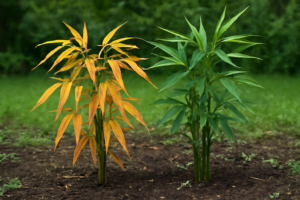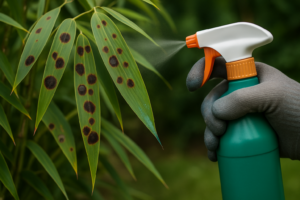
Bamboo spider mites are tiny arachnid pests — most commonly Tetranychus urticae (the two-spotted spider mite) and Schizotetranychus celarius (the bamboo spider mite specifically) — that feed on bamboo leaves by piercing cells and sucking out their contents, causing visible damage and, in severe cases, significant defoliation. The good news is that with early identification and the right response, most bamboo plants recover fully without aggressive chemical intervention.
How to Identify Bamboo Spider Mites
Spider mite damage on bamboo follows a predictable pattern. Knowing what to look for early saves you from losing entire culms of leaves later in the season.
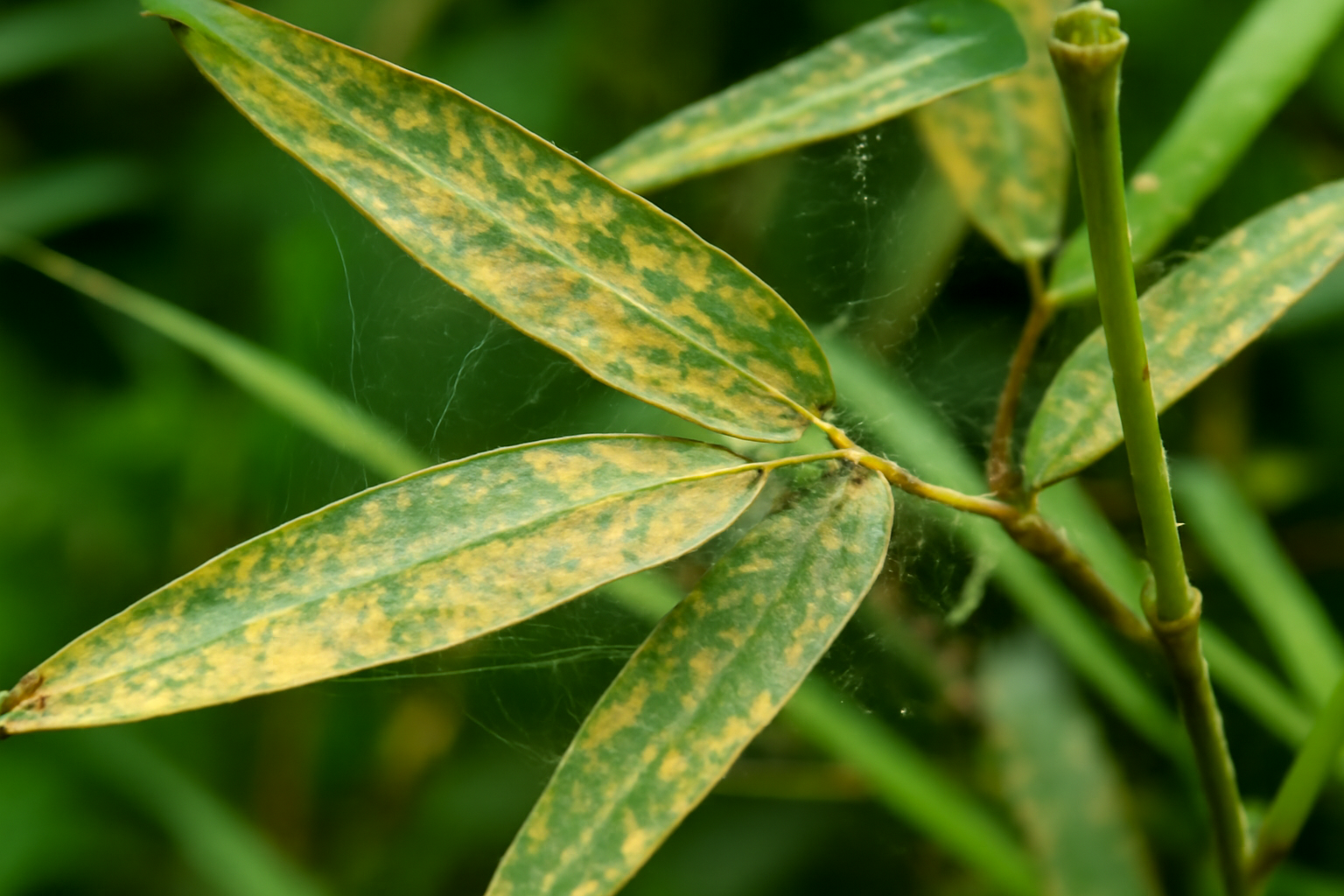
- Stippled or speckled upper leaf surface: The first sign is a scattering of tiny yellow or pale green dots across the top side of the leaf. These dots are individual feeding wounds where mites have pierced the leaf cells.
- Fine webbing on leaf undersides: Turn the leaf over. Spider mites produce delicate silk webbing that collects dust and makes the underside look dull or dusty. Heavy infestations produce thick, visible webs.
- Bronzing or grayish discoloration: As feeding intensifies, leaves shift from yellow stippling to a dull bronze or silvery-gray cast. At this stage, cell damage is extensive.
- Visible mites under magnification: Use a 10x hand lens or magnifying glass and examine the leaf underside in good light. You’ll see tiny red, brown, or pale moving dots — roughly 0.5 mm in diameter. Schizotetranychus celarius tends to appear slightly darker than the ubiquitous T. urticae.
A quick field test: hold a sheet of white paper under a suspect leaf and tap it firmly. If mites are present, tiny specks will fall onto the paper and begin moving.
Is It Spider Mites — Or Something Else?
Several problems mimic spider mite damage on bamboo. Use this comparison to narrow down the cause before you treat.
| Problem | Leaf Appearance | Key Diagnostic Clue |
|---|---|---|
| Spider mites | Yellow stippling, bronzing, webbing | Moving dots visible under magnification; webbing on leaf undersides |
| Scale insects | Yellowing, sticky residue (honeydew), sooty mold | Stationary bumps on stems and leaf undersides; no webbing |
| Normal seasonal leaf drop | Uniform yellowing starting from inside of grove | Occurs in spring; no stippling, no webbing, no pests visible |
| Iron chlorosis | Yellowing between leaf veins; veins remain green | Interveinal pattern; typically affects new growth first; no webbing |
When and Why Infestations Occur
Spider mite populations explode under specific conditions. Understanding the triggers helps you get ahead of outbreaks before they become serious problems.
- Hot, dry summer weather: Mites reproduce rapidly when temperatures climb above 85°F (29°C) and humidity stays low. A single female T. urticae can produce up to 20 eggs per day under ideal conditions, with generations cycling every 5–7 days.
- Drought-stressed plants: Bamboo weakened by insufficient water is far more vulnerable. Mites preferentially colonize stressed tissue, and stressed plants have less capacity to recover from feeding damage.
- Dusty conditions: Dust on leaves suppresses the predatory mites and insects that naturally keep T. urticae and Schizotetranychus celarius populations in check.
- Overcrowded groves: Dense plantings with poor air circulation create microclimates that favor mite establishment and make it harder to treat effectively.
- Overfertilization with nitrogen: Excessive nitrogen pushes lush, soft new growth that mites find highly palatable.
Bamboo in USDA Hardiness Zones 7–10 — where summers are hot and dry periods are common — tend to see the most persistent mite pressure. Growers in Zone 5–6 deal with mites less frequently but are not immune, particularly during heat waves.
How to Treat a Spider Mite Infestation on Bamboo
Match your response to the severity of the infestation. Over-treating is one of the most common mistakes bamboo growers make — broad-spectrum pesticides can kill the beneficial predatory insects that would otherwise keep mites in check naturally, making future outbreaks worse.
Mild Infestation: Water Knockdown
For early or light infestations, a forceful spray of water is often all you need. Use a garden hose with a jet nozzle and thoroughly drench the undersides of affected leaves. Do this in the morning so foliage dries before nightfall. Repeat every 2–3 days for two weeks. Mites that are knocked off rarely make it back onto the plant, and this method causes zero harm to beneficial insects.
Moderate Infestation: Insecticidal Soap or Neem Oil
When stippling is widespread and webbing is visible across multiple culms, apply insecticidal soap solution (2–3% concentration) or neem oil mixed at the label rate. Coverage of leaf undersides is critical — mites living under webbing are protected from surface contact. Apply during cooler parts of the day to avoid leaf burn and repeat every 5–7 days for 3 applications. Neem oil also has some residual repellent effect that discourages reinfestation.
Severe Infestation: Targeted Miticide
If significant bronzing covers more than 30–40% of the canopy and populations are still climbing, a targeted miticide may be warranted. Products containing bifenazate or abamectin are effective against spider mites with lower toxicity to most beneficial insects compared to older broad-spectrum options. Rotate active ingredients between applications to prevent resistance development in mite populations.
Prevention: The Most Effective Long-Term Strategy
Healthy, well-managed bamboo is genuinely resistant to severe mite damage. Prevention is worth far more than any treatment after the fact.
- Water consistently: Maintain adequate soil moisture during dry spells. Deep watering 1–2 times per week during summer is generally preferable to frequent shallow watering. Drought-stressed bamboo is a mite magnet.
- Avoid excessive nitrogen fertilization: Lush, nitrogen-driven soft growth is the mites’ preferred food source. A balanced, moderate fertility program produces tougher leaf tissue that’s less vulnerable.
- Encourage predatory insects: Ladybugs (Coccinella septempunctata and related species), lacewings (Chrysoperla carnea), and predatory mites (Phytoseiulus persimilis) are natural mite predators. Avoid broad-spectrum sprays that harm them.
- Hose down foliage periodically: Even when mites aren’t a problem, periodic overhead watering washes off dust and keeps incipient populations from establishing.
- Thin overcrowded groves: Improving air circulation and light penetration reduces the humid, sheltered conditions that favor mite buildup.
It bears repeating: bamboo is a resilient plant that can tolerate and recover from mild to moderate mite pressure without intervention beyond a strong spray of water and improved growing conditions. If you catch the problem at the stippling stage, maintain consistent irrigation, and avoid killing off the beneficial insects doing the work for you, most spider mite outbreaks resolve on their own before they cause lasting damage. Observe carefully, respond proportionally, and your bamboo will come through fine.
The Miticide Spray That Stops Spider Mites Before They Strip Your Bamboo Bare
Once spider mites establish a foothold on bamboo foliage, they multiply fast enough to cause visible stippling and yellowing within days. A targeted miticide spray catches infestations early and prevents the kind of wholesale defoliation that sets back new growth by months.
What works
- Covers both leaf surfaces thoroughly when applied in early morning or late afternoon, hitting mites that hide on the undersides where you can’t see them until damage is already spreading.
- Works fast enough that you see mite populations decline within 48 hours, which is critical because even a few survivors can rebuild a full colony in a week of warm weather.
- Safe enough to reapply every 3–5 days without harming your bamboo, unlike some harsher chemicals that can burn delicate new shoots or discolor canes.
What doesn’t
- Won’t prevent reinfestation if you stop spraying; spider mites blow in on wind or hitchhike on neighboring plants, so you’re locked into a 2–3 week spray cycle once you’ve had an outbreak.
- Effectiveness drops noticeably in temperatures below 60°F, which can leave you vulnerable in spring or fall when spider mites are still active but the spray moves slower.
I almost gave up on this product after the first application seemed to have no impact, only to realize I’d sprayed at midday when the mites were already sheltering deep in the leaf folds—a second early-morning application changed everything.
About This Article

Written by Marcus Chen. Marcus Chen has spent 15 years cultivating and studying bamboo across 14 different species, combining commercial growing operations with extensive hands-on experience in species selection and containment. As both a grower and consultant, he specializes in practical bamboo management, helping homeowners and landscapers understand the real-world requirements for responsible bamboo cultivation. Marcus brings tested knowledge of which species thrive reliably and which present containment challenges that go beyond standard recommendations. More about this site.
Verify this against a primary source
Specifics change, and your situation may differ from the one described here. These are the authorities worth checking directly:
- American Bamboo Society — species listings and cultivation guidance
- USDA PLANTS Database — species range and identification
- USDA Plant Hardiness Zone Map — cold hardiness verification for your location