Bamboo charcoal has taken the wellness and industrial worlds by storm. You see it in whitening toothpaste, high-end face masks, and powerful water filters. However, few people understand the complex science behind this black powder. It is not simply burnt wood. Instead, it results from a rigorous engineering process. Specifically, manufacturers transform fast-growing grass into a highly porous material capable of trapping toxins.
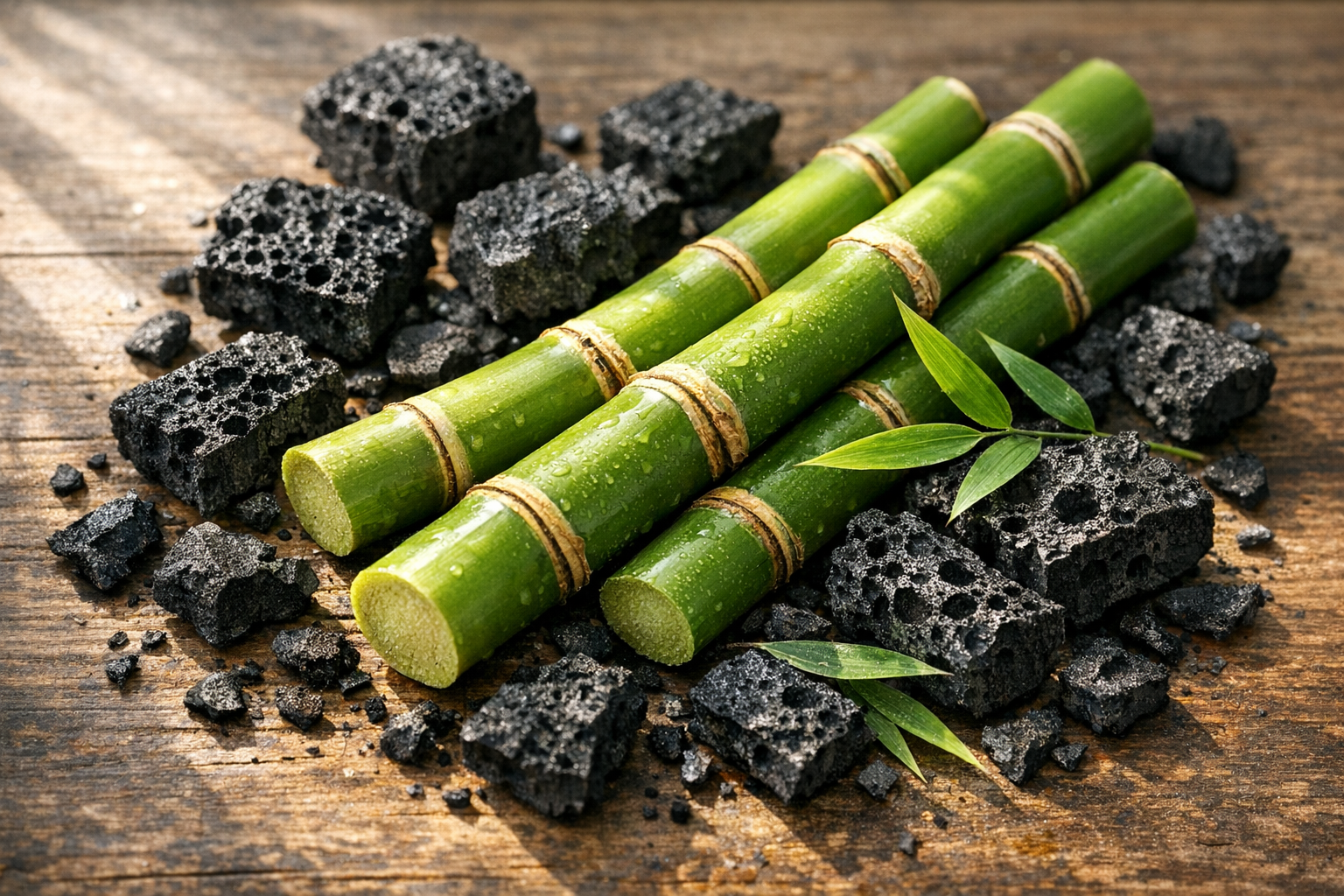
This transformation requires extreme heat and precise timing. Furthermore, the difference between regular charcoal and “activated” charcoal lies entirely in the processing method. Regular charcoal burns as fuel. In contrast, activated charcoal acts as a magnet for impurities. Therefore, understanding this production cycle reveals why this material is so effective. Let’s explore the step-by-step journey from the forest to the final product.
If you’re intrigued by the science of bamboo charcoal and want to experience its benefits firsthand, there are numerous products available that harness this remarkable material’s purifying properties. For daily oral care, consider trying a bamboo charcoal toothpaste pack that uses the natural whitening power of activated charcoal to gently remove stains and freshen breath. Your skin can also benefit from bamboo charcoal’s detoxifying abilities with an overnight hydration face mask that nourishes and protects your skin barrier while you sleep. To improve your drinking water quality, a bamboo charcoal water purifier pack can naturally filter impurities and enhance taste without requiring electricity or complicated installation. For those interested in culinary or wellness applications, Viva Doria activated charcoal powder offers food-grade quality that’s versatile enough for various DIY projects and health routines. If you’re dealing with persistent odors in your home, a large bamboo charcoal odor absorber bag can naturally eliminate smells in bedrooms, basements, or kitchens without harsh chemicals or artificial fragrances. For internal wellness support, NaturaLife Labs activated charcoal capsules provide a convenient way to incorporate this natural detoxifier into your daily supplement routine. Your skincare regimen can be elevated with a bamboo charcoal soap pack that offers gentle exfoliation and deep cleansing for both face and body. For comprehensive water purification throughout your home, an advanced reverse osmosis water filtration system can remove contaminants while remineralizing your water for optimal health benefits. Finally, if you need odor control in multiple areas like cars, closets, and shoes, a multi-pack of activated charcoal odor absorber bags provides an eco-friendly solution that can be recharged in sunlight and reused for years. These diverse applications demonstrate how the ancient wisdom of bamboo charcoal has been adapted into modern products that make it easy to incorporate this powerful natural material into every aspect of your daily life.
Step 1: Harvesting and Preparation
The Ideal Species
Choosing the right botanical source is the foundation of quality. Consequently, manufacturers almost exclusively rely on Moso bamboo (Phyllostachys edulis). This giant timber bamboo offers distinct advantages over other varieties. For instance, it achieves a massive diameter suitable for various products. Furthermore, its thick walls provide substantial biomass for the kiln. This natural density is crucial for creating long-burning fuel or effective filtration. Without this robust starting material, the final charcoal would be brittle.
The Science of Maturity
Patience is a virtue in charcoal production. Therefore, the five-year waiting period is a strict scientific requirement. Young bamboo contains excessive moisture and soluble sugars. Burning these immature stalks leads to significant shrinkage. Additionally, the resulting charcoal often crumbles into useless dust.
However, waiting allows the plant to undergo lignification. This biological process hardens the cell walls significantly. As a result, the bamboo develops a steel-like structure. This maturity ensures the final charcoal retains its shape and porosity.
Optimal Harvesting Conditions
Beyond age, the specific timing of the cut is vital. Experienced harvesters usually work during the cold winter months. During this dormant season, the bamboo holds significantly less sap. This naturally low moisture content is beneficial for several reasons:
- Reduced cracking: Less internal pressure builds up during heating.
- Faster drying: The raw material requires less time to cure.
- Higher yield: The carbon structure remains denser and heavier.
Consequently, winter harvesting ensures a superior final product. It also prevents insect damage, as pests are less active in cold weather.
Sustainable Collection Methods
Finally, the harvest supports the forest’s overall health. Because bamboo is a grass, it regenerates from its rhizome root system. Thus, cutting mature stalks actually stimulates new growth. Farmers selectively harvest only the oldest stalks. Meanwhile, younger shoots are left to develop further.
This selective method maintains a continuous supply chain. Moreover, it eliminates the need for replanting seeds after every harvest. This cycle makes bamboo charcoal a highly renewable resource.
Farmers harvest the bamboo stalks carefully. Then, they cut the long poles into uniform segments. This uniformity ensures even heating later in the kiln. After cutting, the bamboo needs to dry. Workers stack the segments in open-air sheds for several weeks. This air-drying phase reduces moisture content significantly. Consequently, the bamboo requires less energy to carbonize during the heating stage. Proper drying prevents the stalks from cracking or exploding under intense heat.
Step 2: The Carbonization Process
Once the bamboo is dry, the carbonization phase begins. This stage turns organic wood into pure carbon. Technicians place the dried bamboo segments into a specialized kiln. Then, they seal the kiln to limit oxygen flow. This oxygen restriction is crucial. If oxygen enters freely, the bamboo will simply burn to ash. Instead, the goal is pyrolysis. Pyrolysis is the thermal decomposition of materials at elevated temperatures in an inert atmosphere.
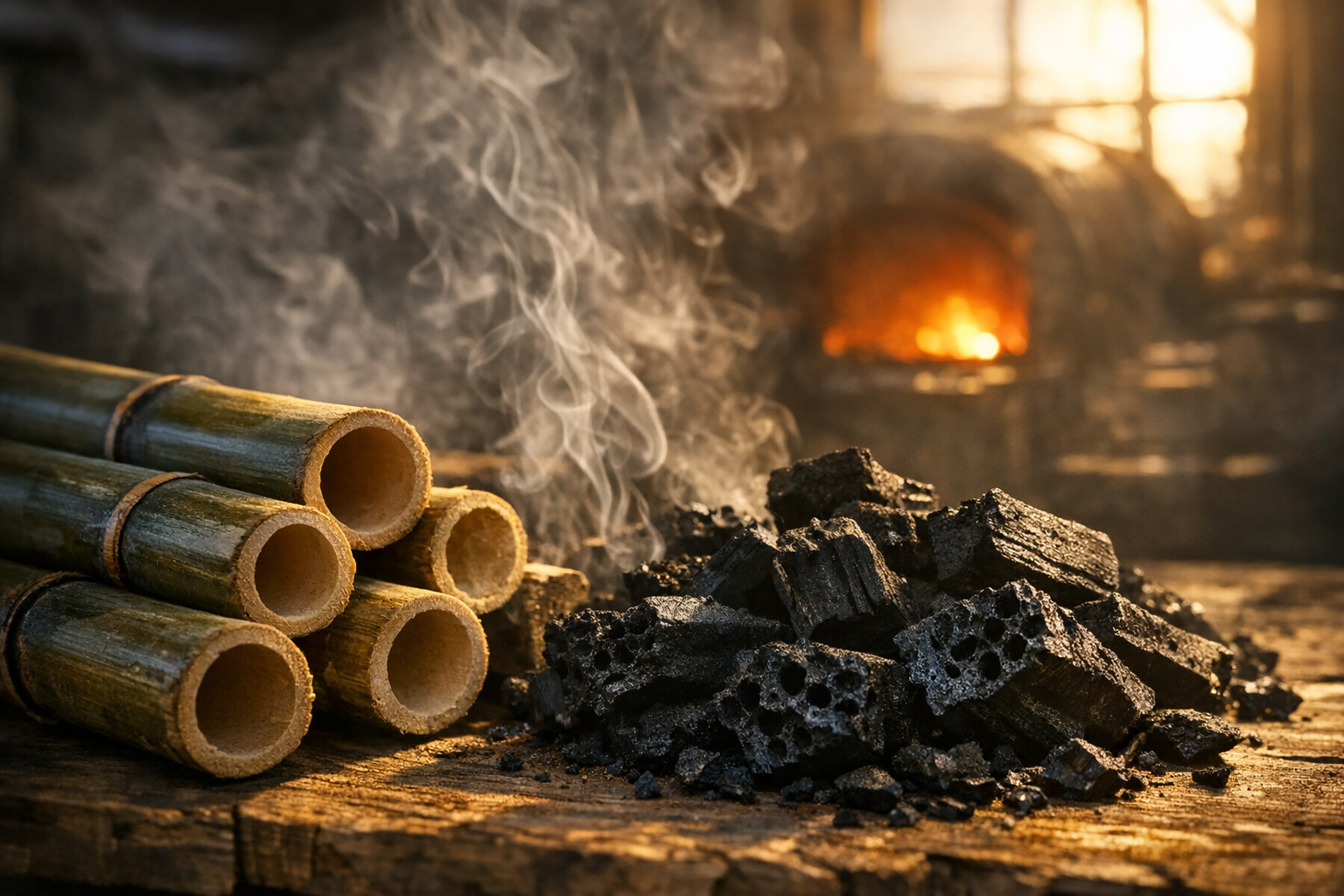
The kiln temperature rises slowly. It eventually reaches approximately 800 degrees Celsius (1472 degrees Fahrenheit). As the heat intensifies, volatile compounds inside the bamboo vaporize. Smoke billows out, carrying away tars and resins. Meanwhile, the bamboo structure hardens and shrinks. It turns jet black. This process leaves behind a carbon skeleton. However, this material is not yet “activated.” It is merely charcoal. The pores are currently clogged with tar residues. Therefore, it lacks the massive surface area required for filtration.
Step 3: The Critical Activation Phase
Activation is the most important step in the production line. Source This phase distinguishes standard fuel charcoal from filtration-grade activated charcoal. The goal here is to scour the carbon structure clean. Manufacturers must remove the remaining tars that clog the microscopic pores. To achieve this, they use a process called physical activation. Alternatively, some use chemical activation, but physical activation is more common for bamboo.
Physical Activation Using Steam
In physical activation, the carbonized bamboo re-enters a furnace. This time, the temperature climbs even higher. It often exceeds 900 degrees Celsius. While the charcoal heats up, technicians inject steam into the kiln. This steam acts as a powerful cleaning agent. It eats away the internal carbon structure. Consequently, it creates a vast network of tiny tunnels and holes.
This erosion process effectively expands the surface area. Imagine a solid block of swiss cheese turning into a sponge. The steam blasts open millions of microscopic pores. These pores are what trap toxins and chemicals later. Without this steam treatment, the charcoal would have very little adsorption power. Thus, the steam activation transforms the material into a super-absorbent tool.
Chemical Activation Alternatives
Some manufacturers choose chemical activation instead of steam. In this method, they soak the bamboo charcoal in strong chemicals. Typically, they use phosphoric acid or potassium hydroxide. These chemicals penetrate the carbon structure. Then, the manufacturer heats the mixture. The chemicals cause the carbon structure to open up at lower temperatures than steam activation requires.
However, this method has a downside. The final product requires extensive washing. Producers must remove all traces of the activating chemicals. If they fail to wash it thoroughly, chemical residue remains. Therefore, many eco-friendly brands prefer steam activation. Steam yields a purer product without the risk of chemical contamination. Nevertheless, both methods successfully increase the charcoal’s porosity.
Step 4: Washing and Drying
After activation, the charcoal is extremely porous but also dirty. It contains ash and mineral residue from the burning process. Therefore, the next step involves thorough cleaning. Workers transfer the activated carbon to large washing tanks. They rinse the material with diluted acid solutions to remove mineral ash. Then, they wash it repeatedly with pure water.
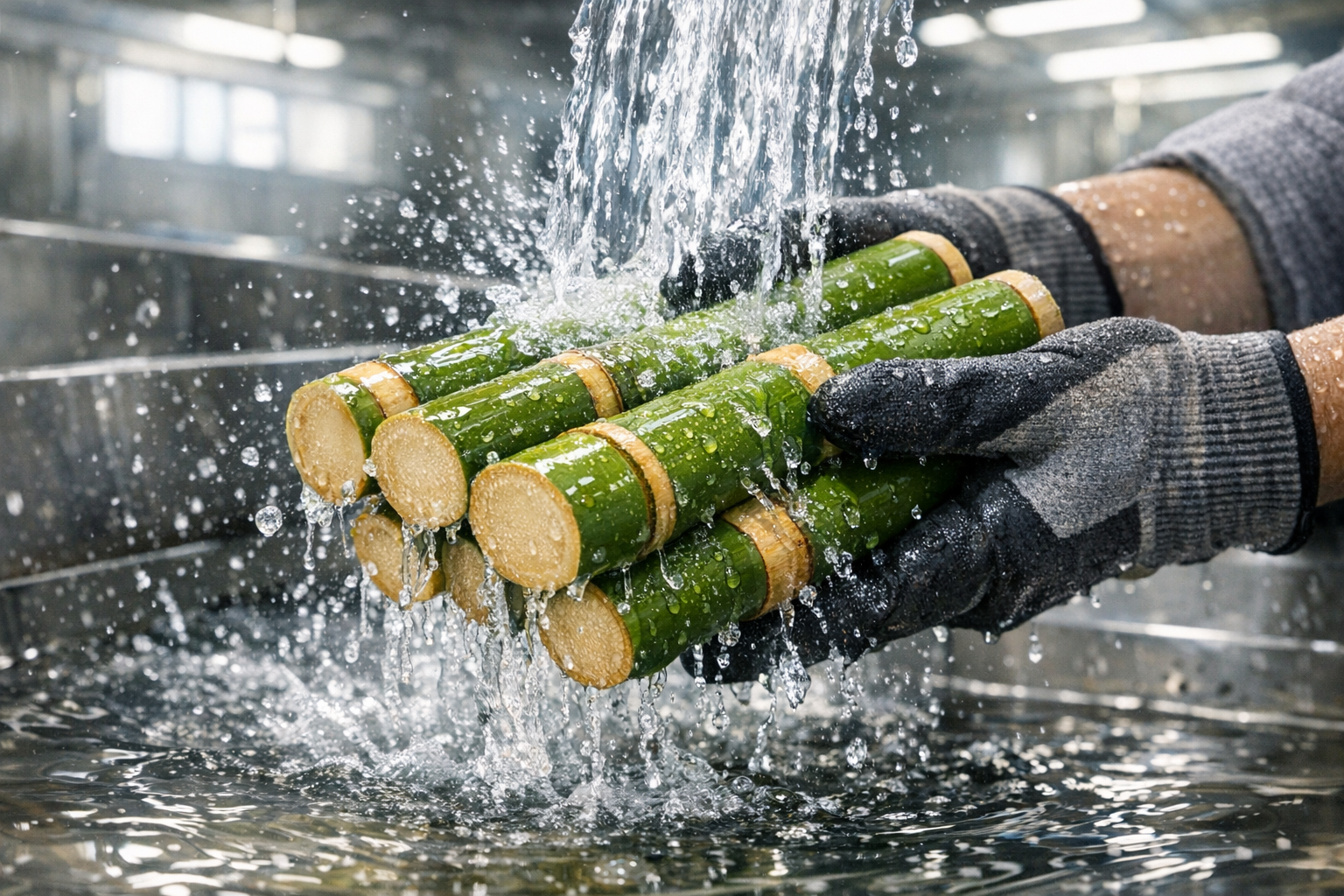
This washing cycle continues until the water runs clear. It ensures the pH level stabilizes. Once clean, the wet charcoal must dry again. Industrial dryers blast the material with hot air. This removes all moisture absorbed during the washing phase. Moisture control is vital here. If the charcoal remains damp, mold could grow. Additionally, wet charcoal weighs more, which increases shipping costs. Thus, producers ensure the product is bone-dry before the final step.
Step 5: Grinding and Sizing
The final production stage focuses on form and function. The dried activated charcoal usually exists as chunks or granules. However, different applications require different sizes. For example, water filters use granular charcoal. Conversely, toothpaste and face masks require a fine powder. Therefore, the manufacturer feeds the charcoal into crushing machines.
These machines grind the material into specific particle sizes. Technicians use sieves to sort the particles. They separate the fine dust from the larger granules. This sorting process ensures consistency. A face mask manufacturer does not want gritty chunks in their cream. Similarly, a water filter company avoids dust that could clog the system. Finally, workers package the sorted charcoal into airtight bags. These bags protect the product from moisture and contaminants during shipping.
Why Surface Area Matters
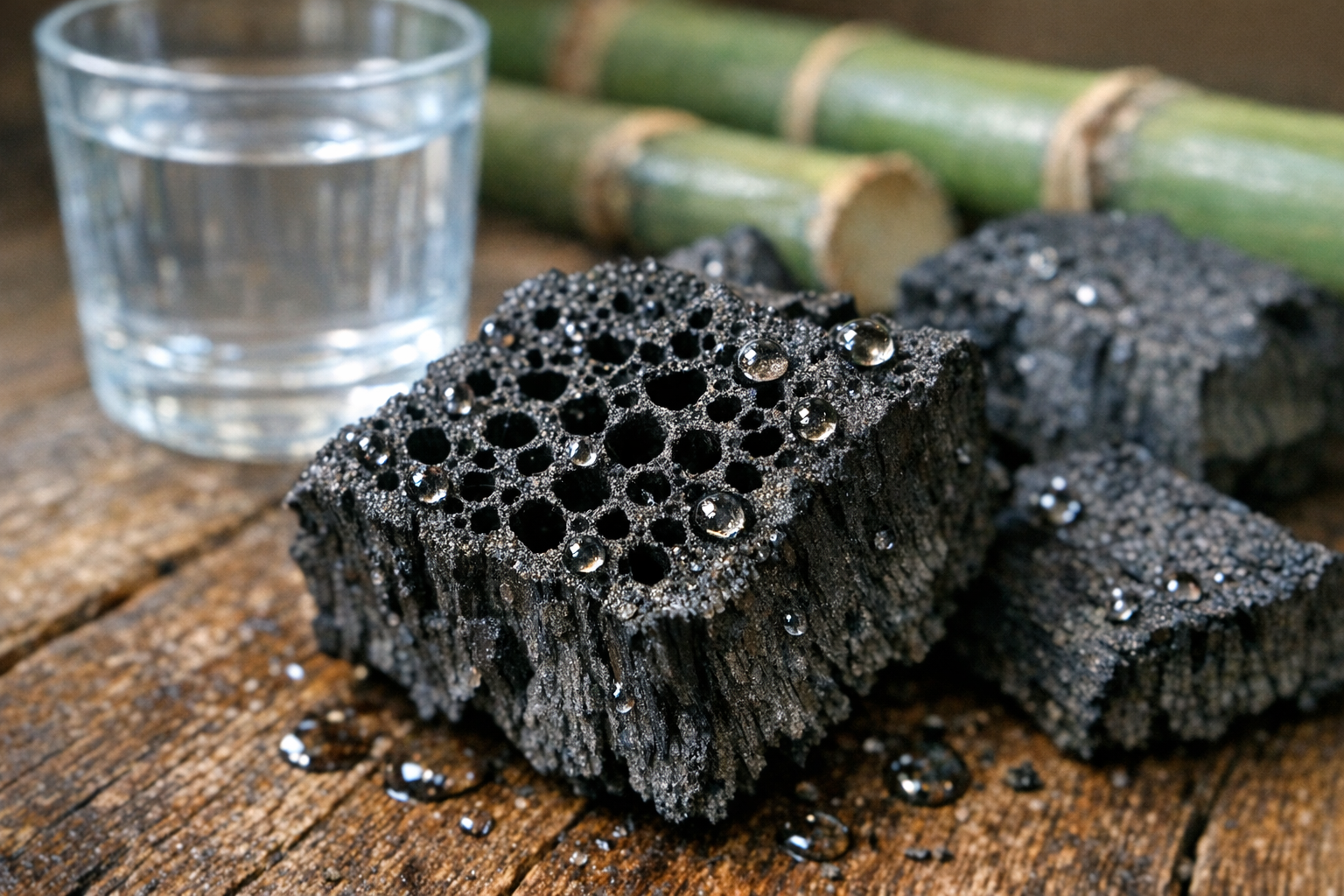
The entire production process aims to maximize surface area. But why is this so important? The answer lies in adsorption. Note the “d” in adsorption. Absorption involves soaking up a liquid, like a sponge. Adsorption, however, involves adhesion. Molecules stick to the surface of the charcoal. Therefore, more surface area equals more sticking power.
Because the activation process creates millions of pores, the surface area is immense. A single gram of activated bamboo charcoal can have a surface area larger than a football field. This incredible statistic explains its efficiency. When water passes through the charcoal, contaminants get trapped in the pores. They stick to the carbon walls. Consequently, the water exits the filter clean and safe.
Conclusion
The transformation begins deep in the bamboo forest. Although bamboo grows incredibly fast, patience remains essential. Farmers must wait for the perfect maturity level. Usually, this means waiting at least five years. At this age, the stalk possesses the necessary density. Consequently, the resulting charcoal will be hard and durable. Younger bamboo is simply too soft for high-quality production. Therefore, careful selection is the first critical step in the manufacturing chain.
Sustainable Harvesting and Preparation
Expert harvesters cut the stalks at the base. This specific method allows the root system to remain intact. As a result, new shoots can sprout immediately without replanting. This rapid regeneration cycle makes bamboo a highly renewable resource. Once harvested, the stalks require seasoning. Workers air-dry the wood for several weeks to prepare it.
Furthermore, this drying step effectively reduces internal moisture content. If the wood is too wet, it might crack inside the kiln. Thus, proper drying ensures structural integrity during the heating phase. The stalks are then cut into uniform lengths. This uniformity ensures they cook evenly during the next stage.
The Art of Carbonization
Next, the dried bamboo enters a specialized kiln. This stage is known as carbonization. The temperature management here creates a distinct difference in final quality. For instance, temperatures rise slowly to roughly 800 degrees Celsius or higher. This intense heat occurs in a low-oxygen environment.
Consequently, the organic material does not burn to ash. Instead, it undergoes a process called pyrolysis. This chemical change strips away volatile impurities. Eventually, only pure carbon remains in a solid form. The smoke produced during this time is often condensed. This byproduct becomes bamboo vinegar, another useful substance.
Steam Activation and Finishing
The final phase is perhaps the most scientific. Manufacturers use steam activation to drastically enhance the charcoal. They inject hot steam into the carbonized material. This process eats away internal structures. Therefore, it creates a vast network of microscopic pores. These tiny holes act like a sponge for impurities.
Specifically, the benefits of activation include:
- Surface Area: Activation drastically increases the internal surface area.
- Absorption: The new pores trap toxins and odors effectively.
- Filtration: The material becomes ideal for water and air purification.
Finally, the charcoal is processed for specific commercial uses. Machines might grind it into a fine powder for cosmetics. Alternatively, workers cut it into solid blocks for dehumidifiers. Ultimately, this rigorous sequence creates a versatile, eco-friendly product.
By understanding this method, consumers can appreciate the value of activated charcoal. It is not just burnt wood. It is a highly engineered material. Whether it filters your water or whitens your teeth, bamboo charcoal proves that nature, when refined by science, offers powerful solutions. Next time you use a charcoal product, remember the heat, steam, and precision that made it possible.
If you’re intrigued by the science of bamboo charcoal and want to experience its benefits firsthand, there are numerous products available that harness this remarkable material’s purifying properties. For daily oral care, consider trying a bamboo charcoal toothpaste pack that uses the natural whitening power of activated charcoal to gently remove stains and freshen breath. Your skin can also benefit from bamboo charcoal’s detoxifying abilities with an overnight hydration face mask that nourishes and protects your skin barrier while you sleep. To improve your drinking water quality, a bamboo charcoal water purifier pack can naturally filter impurities and enhance taste without requiring electricity or complicated installation. For those interested in culinary or wellness applications, Viva Doria activated charcoal powder offers food-grade quality that’s versatile enough for various DIY projects and health routines. If you’re dealing with persistent odors in your home, a large bamboo charcoal odor absorber bag can naturally eliminate smells in bedrooms, basements, or kitchens without harsh chemicals or artificial fragrances. For internal wellness support, NaturaLife Labs activated charcoal capsules provide a convenient way to incorporate this natural detoxifier into your daily supplement routine. Your skincare regimen can be elevated with a bamboo charcoal soap pack that offers gentle exfoliation and deep cleansing for both face and body. For comprehensive water purification throughout your home, an advanced reverse osmosis water filtration system can remove contaminants while remineralizing your water for optimal health benefits. Finally, if you need odor control in multiple areas like cars, closets, and shoes, a multi-pack of activated charcoal odor absorber bags provides an eco-friendly solution that can be recharged in sunlight and reused for years. These diverse applications demonstrate how the ancient wisdom of bamboo charcoal has been adapted into modern products that make it easy to incorporate this powerful natural material into every aspect of your daily life.
*As an Amazon Associate, I earn from qualifying purchases.