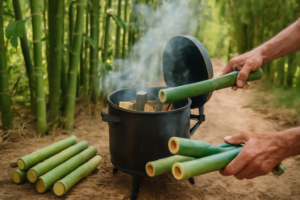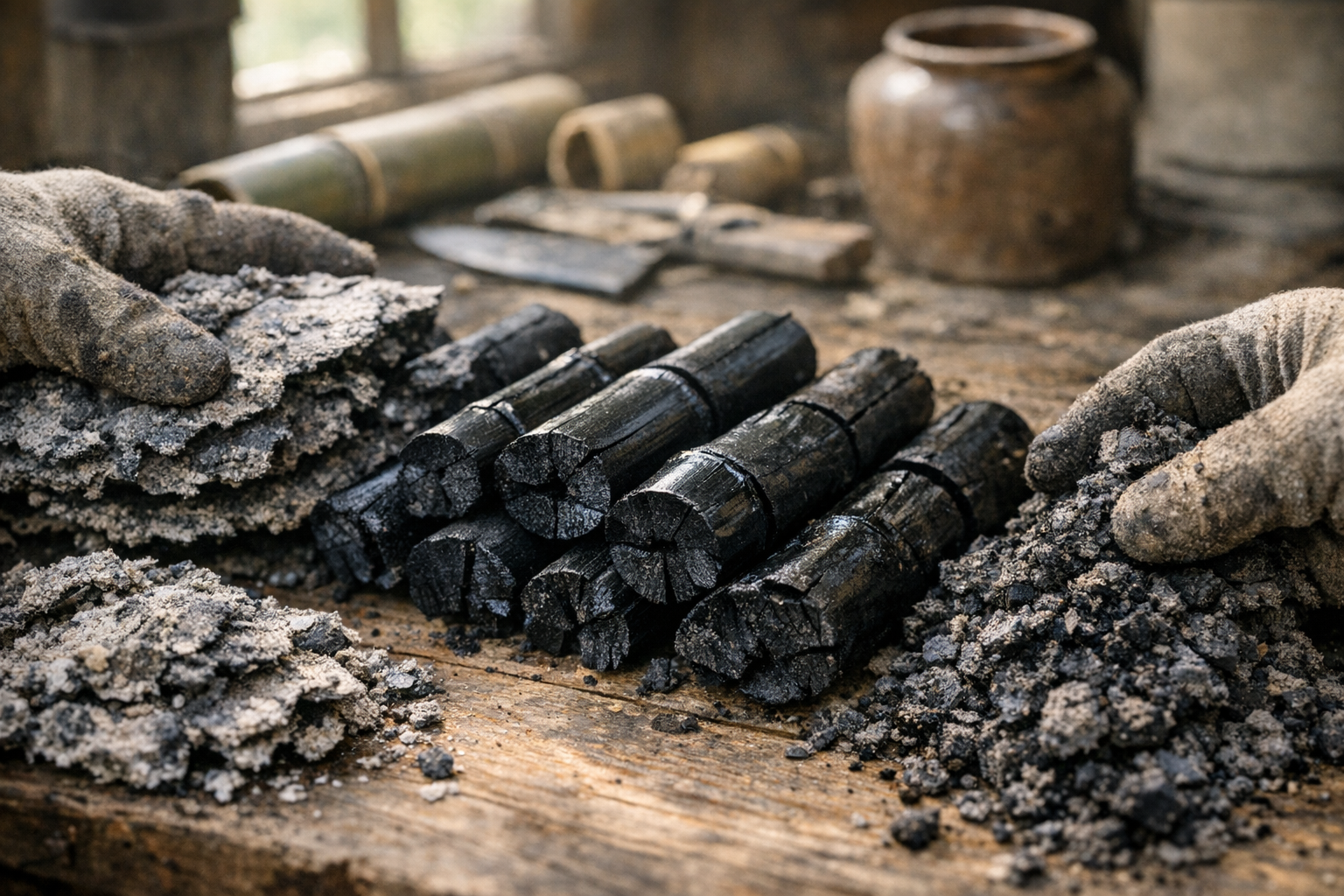
The traditional kiln method for making artisan bamboo charcoal is nothing like the industrial furnaces churning out commodity briquettes. I spent time observing this centuries-old craft in rural East Asia, watching how craftspeople use sealed earthen kilns to transform Phyllostachys edulis and Dendrocalamus latiflorus into the dense, lustrous charcoal prized for everything from water filtration to ceremonial tea preparation. What fascinated me most wasn’t the final product—it was the precision hidden inside what looks like a simple brick oven. The traditional bamboo charcoal kiln method relies on slow, multi-day firing cycles and careful oxygen control that modern industrial methods have largely abandoned, and understanding how this works explains why artisan charcoal costs more and performs differently.
The Kiln Structure: Built for Control, Not Speed
A traditional charcoal kiln is deceptively simple to look at—usually a barrel-shaped or dome-shaped chamber made from fired brick or sun-dried earthen blocks, standing between 1.5 and 3 meters tall. What matters isn’t the exterior; it’s the internal design that enables craftspeople to manage oxygen levels with minimal equipment.
The kiln has a single firebox opening at the base, usually 30–50 centimeters wide, and a chimney vent at the top that can be partially or fully sealed with clay plugs. This seemingly crude setup is actually a finely calibrated system. Bamboo charcoal makers learned centuries ago that controlling the air supply controls the temperature, the burn rate, and—most crucially—the degree of carbonization. Too much oxygen, and the bamboo burns completely to ash. Too little, and you get incomplete charring. The traditional method sits in that narrow middle ground through constant attention.
Before any firing begins, the interior is lined with a layer of sand or fine ash—typically 5–10 centimeters thick. This insulating bed protects the kiln walls and creates a buffer zone that helps regulate heat distribution. I watched craftspeople prepare kilns with the same care a baker might prep an oven, because temperature consistency over hours determines charcoal quality more than any other single factor.
Loading and Layering: Preparation for the Multi-Day Burn
Before the bamboo enters the kiln, it must be split, dried, and cut to consistent sizes. This is where a quality bamboo splitter becomes essential—uneven pieces burn at different rates and create temperature dead zones inside the kiln. I’ve seen craftspeople use tools like the VEVOR Bamboo Splitter (manual hydraulic model) to achieve uniform 8–12 centimeter thick pieces that pack efficiently and burn predictably.
The actual loading follows a precise architecture. Bamboo culms are laid horizontally in alternating directions, much like stacking firewood, but with much tighter spacing. Each layer is separated by thinner bamboo strips or small kindling that creates air channels without allowing heat to escape unevenly. The craftspeople I observed typically built loads 1.2–1.5 meters high, leaving just enough headroom to seal the kiln’s top opening with a clay cap studded with vents.
The layering strategy directly affects the final charcoal’s hardness and density. Denser packing and slower burn produce harder charcoal with fewer internal fractures—exactly what traditional makers aimed for. Industrial methods skip this careful stacking; they tumble-load fuel into rotating drums, sacrificing quality for throughput.
The Multi-Day Firing Cycle: Oxygen Control as Craft
Once the kiln is loaded and sealed, the real work begins. A traditional firing cycle takes 5–8 days from ignition to cool-down, compared to 12–18 hours in an industrial retort. This extended timeframe is not inefficiency—it’s intentional design.
The first day focuses on ignition and temperature ramp-up. A small fire is lit in the firebox, and the kiln master gradually increases the flame by feeding kindling through the firebox opening. Temperature rises slowly, reaching around 200°C by the end of day one. This gradual warm-up prevents thermal shock that could crack the kiln or cause the bamboo to split explosively.
Days two through four are where oxygen control becomes critical. As the bamboo begins to gasify and carbonize, the kiln master adjusts the chimney vents—plugging them partially with clay, opening them, or closing them entirely depending on visible smoke color and temperature readings taken through small observation ports. The goal is to maintain a temperature between 400–600°C while managing volatile gases escaping from the carbonizing bamboo.
I watched one master craftsperson use nothing but a stick to adjust clay plugs in the chimney, checking them every 2–3 hours around the clock. He described the color of smoke coming from the vents—thick white meant too much oxygen was escaping; thin gray meant the burn was settling into the right rhythm. There were no thermometers, no digital readouts. This knowledge comes from apprenticeship spanning years.
By day five, the interior burn has stabilized. The firebox can be fed less frequently, and the kiln enters a holding phase where the craftsperson’s main job is preventing the temperature from climbing above 700°C, which would produce ash rather than charcoal. Days six and seven involve gradually reducing the firebox feed and letting the interior cool incrementally while the vents remain partially sealed—this “annealing” phase is unique to traditional methods and gives the charcoal its characteristic hardness and glossy black finish.
Why Traditional Charcoal Performs Differently
The difference between traditional kiln charcoal and industrial charcoal shows up in measurable ways. Artisan charcoal made using the traditional method typically achieves a surface area of 300–500 m²/g, compared to 100–250 m²/g for fast-fired industrial charcoal. This difference matters enormously for water filtration, where higher surface area means more adsorption capacity.
The slow, oxygen-controlled burn also produces fewer internal fractures. Industrial charcoal, made by rapid heating and rapid cooling, is more brittle and fragments into dust more easily. Traditional charcoal, because it cooled slowly while still under kiln control, stays intact longer and is preferred for applications like incense production and ceremonial use where appearance and burn consistency matter.
The carbon structure itself differs at a molecular level. Slow carbonization at moderate temperatures produces more stable crystalline structures than flash heating does. This is partly why traditional charcoal water filters last longer and why traditional charcoal absorbs odors more effectively in closed spaces.
Understanding What You’re Buying
If you’ve ever purchased “artisan bamboo charcoal” online and found it costs three to five times more than regular charcoal briquettes, the traditional kiln method explains the price difference. Real artisan charcoal represents days of skilled labor, constant attention, fuel costs for an extended burn, and inevitable loss from pieces that don’t achieve proper carbonization.
Most commercial “bamboo charcoal” sold globally is produced industrially in metal retorts or rotary kilns, where the entire cycle takes less than a day. That charcoal is useful and fine for many purposes, but it’s not the same product that East Asian craftspeople have refined over centuries. The traditional method produces a genuinely different material with measurably different properties.
Understanding how the traditional bamboo charcoal kiln method works—the slow burn, the oxygen control, the multi-day investment of human attention—shifts your appreciation for what artisan charcoal actually is. It’s not just a slower version of industrial production. It’s a craft technique that produces distinct material qualities that industrial speed simply cannot replicate.
About This Article

Written by Marcus Chen. Marcus Chen has spent 15 years cultivating and studying bamboo across 14 different species, combining commercial growing operations with extensive hands-on experience in species selection and containment. As both a grower and consultant, he specializes in practical bamboo management, helping homeowners and landscapers understand the real-world requirements for responsible bamboo cultivation. Marcus brings tested knowledge of which species thrive reliably and which present containment challenges that go beyond standard recommendations. More about this site.
Verify this against a primary source
Specifics change, and your situation may differ from the one described here. These are the authorities worth checking directly:
- American Bamboo Society — species listings and cultivation guidance
- USDA PLANTS Database — species range and identification
- USDA Plant Hardiness Zone Map — cold hardiness verification for your location