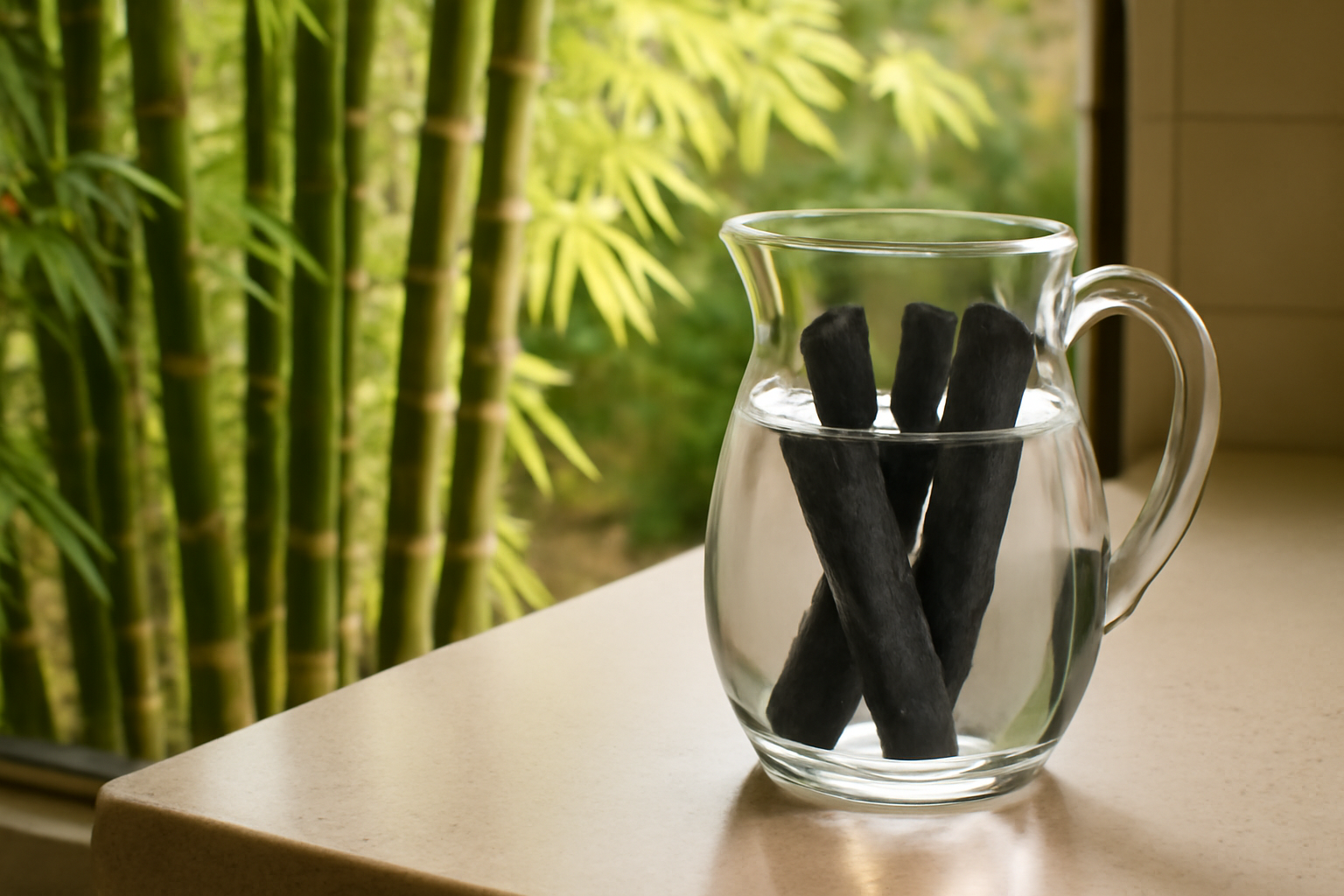
I spent $87 a month on bottled water. That’s $1,044 a year—a number that hit different when I finally did the math on my credit card statement. I live in a rental apartment in Portland with tap water that tastes like it came from a swimming pool, and I’d resigned myself to the weekly Costco runs, the plastic bottles stacking up in my recycling bin, and the guilt that came with both. Then I tried bamboo charcoal water sticks, and I actually tracked what happened to my wallet over six months. Here’s what the real numbers showed.
What I Was Actually Spending on Bottled Water
Before I get into the comparison, let me be honest about my baseline spend. I wasn’t buying fancy imported mineral water—just mid-range bottled water from Costco, around $5 for a 40-pack of 16.9 oz bottles. I’d go through roughly three to four packs per month depending on the season. That’s about $17.50 per week, or roughly $87 monthly.
Breaking that down further: I also occasionally grabbed individual bottles at convenience stores ($2 each, maybe twice a week when I was out), which added another $16 monthly. So my true monthly spend was closer to $103, not including the environmental cost or the time hauling bottles in and out of my apartment.
By month six, I’d spent $618 on bottled water alone—before sales tax in some weeks, which pushed it higher. That became my baseline for comparison.
The Upfront Bamboo Charcoal Stick Investment
I started with two packs of All-Natural Water Purifying Japanese Bamboo Charcoals for Great-Tasting Water – 6 Charcoal Sticks – Good for 2 Liters – Made in Miyazaki, Japan. The first pack was $18.99, the second was $19.47 (prices fluctuate slightly). Total upfront cost for my initial setup: just under $39.
Here’s why I bought two: the sticks need 24 hours to activate (you boil them for 10 minutes), and you’re supposed to have at least one stick per half-gallon or one-liter pitcher. I have three pitchers in my apartment, so I wanted rotation built in from day one. One stick sits actively filtering while another dry-activates or rests.
The sticks themselves are from activated Phyllostachys pubescens, a timber bamboo species that’s been burned at specific temperatures to create a porous structure. Each stick lasts about three months under normal use, which matters for the six-month math.
Monthly Replacement Costs Over Six Months
Here’s where the real economics come into focus. My initial two packs got me through months one and two (technically three and a half if I rotate them right, but I’m being conservative). In month three, both sets were aging past their prime filtering capacity, so I bought a replacement two-pack.
- Month 1: Initial purchase (2 packs, $39) — divided across months 1 and 2, effectively $19.50/month
- Month 3: Replacement two-pack, $38.50
- Month 6: Final replacement (since month 3 sticks were still viable through month 5 with rotation), $37.99
My total six-month cost: $39 + $38.50 + $37.99 = $115.49
That’s an average of $19.25 per month. A full $83.75 less than my bottled water habit—and that’s without even accounting for the convenience of not buying Costco multi-packs or the time saved.
The Apartment Renter Advantage
I need to be clear about why this works so well for someone like me. I’m renting, so I can’t install a whole-house filter system or even a permanent faucet-mounted filter. Those require landlord approval or modifications I’m not willing to risk my deposit over. Bamboo charcoal sticks require exactly nothing: they sit in a pitcher on my kitchen counter or in my fridge. They’re not infrastructure. They’re not permanent.
That also means I can take them with me if I move, which is not nothing when you’re a renter. A $40 investment in pitcher filters isn’t sunk cost the way a whole filtration system is.
What the $502.51 Savings Actually Means
After six months, I’d have spent $618 on bottled water versus $115.49 on charcoal sticks. That’s a net savings of $502.51—not including the fact that I’m no longer making weekly trips to Costco, not dealing with recycling logistics, and not storing 120+ empty plastic bottles in my apartment.
Annualized, that’s roughly $1,005 saved per year. My initial skepticism about whether the sticks would actually work has been replaced by the harder math: they filter decently enough (my tap water does taste better), and the economics are undeniable.
The tipping point happens fast. By month two, the charcoal sticks have paid for themselves. Everything after that is pure savings.
Real Caveats: What This Setup Doesn’t Replace
I want to be honest about the limits. Bamboo charcoal sticks are excellent at improving taste and filtering sediment, but they’re not a replacement for systems that handle serious water quality issues like heavy metal contamination or bacterial concerns. If your tap water has documented safety problems, sticks won’t solve that.
My apartment’s water is perfectly safe—it just tastes off. That’s where charcoal excels, and where the cost comparison becomes genuinely useful.
The sticks also require discipline: boiling them at activation, remembering to rotate them out every three months, keeping them dry when not in use. If you’re someone who forgets to maintain systems, factor in the cost of replacement cycles when they degrade faster from neglect.
The Bottom Line for Your Budget
If you’re an apartment renter spending over $80 monthly on bottled water and can’t install permanent filtration, bamboo charcoal water sticks deliver the single clearest cost win I’ve found. The upfront commitment is genuinely low, the monthly spend is stable and predictable, and the math is hard to argue with.
Your mileage will vary based on your tap water quality and how many people are in your apartment, but the economics work because charcoal sticks are cheap to replace, require no installation, and solve the specific problem that keeps most renters buying bottled water: taste.
Six months in, I’m still using them, still saving money, and I’ve stopped feeling guilty about plastic waste. That’s worth more than the $502 in savings.
About This Article

Written by Marcus Chen. Marcus Chen has spent 15 years cultivating and studying bamboo across 14 different species, combining commercial growing operations with extensive hands-on experience in species selection and containment. As both a grower and consultant, he specializes in practical bamboo management, helping homeowners and landscapers understand the real-world requirements for responsible bamboo cultivation. Marcus brings tested knowledge of which species thrive reliably and which present containment challenges that go beyond standard recommendations. More about this site.
Verify this against a primary source
Specifics change, and your situation may differ from the one described here. These are the authorities worth checking directly:
- American Bamboo Society — species listings and cultivation guidance
- USDA PLANTS Database — species range and identification
- USDA Plant Hardiness Zone Map — cold hardiness verification for your location