I spent a day walking through a mid-sized bamboo charcoal factory in Anhui Province that produces roughly 500 tonnes of finished charcoal annually—enough to supply toothpaste brands, activated charcoal supplement companies, and industrial water filtration systems across three continents. What struck me wasn’t the scale (though the facility spans two hectares); it was how different commercial bamboo charcoal production is from the small-batch kilns and DIY methods most gardeners assume make the stuff. The gap between artisanal and factory production isn’t just about volume—it’s about continuous kilns, automated temperature control within fractions of a degree, rigorous grading systems, and separate production lines for consumer-grade versus industrial applications. If you’ve ever wondered how the charcoal in your toothpaste or water filter actually gets made, and why it’s so different from what you might make in your backyard, this is where the real work happens.
Why Commercial Bamboo Charcoal Production Demands Continuous Kilns
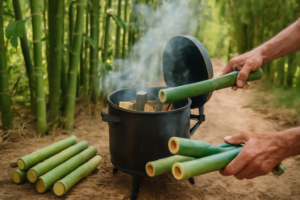
The factory I visited uses three large continuous kilns—essentially long, insulated tunnels about 15 metres long and 2 metres in diameter. Unlike the batch kilns you might build yourself (heat material for 48 hours, cool for 48 hours, repeat), continuous kilns operate 24/7, 365 days a year. Raw bamboo material enters one end on a slow-moving conveyor system; finished charcoal emerges from the other in a continuous stream.
The bamboo feedstock is almost always Phyllostachys edulis (moso bamboo)—the species dominates because of its size, carbon density, and predictable burn characteristics. Material arrives as prepared chips or rough-cut segments, dried to approximately 12–15% moisture content. Anything wetter clogs the system; anything drier burns too fast and produces inferior product consistency.
Why continuous over batch? Volume, first. A single continuous kiln producing 1.5–2 tonnes per day beats any batch operation. But more important: consistency. When you’re making charcoal for medical-grade activated products or toothpaste, buyers need identical carbon microstructure batch after batch. A continuous kiln, properly tuned, delivers that.
Temperature Control at Industrial Scale
Here’s where I learned something that changes how I think about charcoal making entirely: the factory doesn’t just rely on “heat the kiln hotly.” There are thermocouples positioned every 1.5 metres along the kiln’s length, feeding real-time data to a PLC (programmable logic controller) system. The goal is to raise the internal temperature to 300–400°C over the first third of the kiln (carbonization zone), hold it steady in the middle section (stabilization), and cool it gradually in the final third.
The precision is absurd compared to backyard methods. When I asked the production manager how tight the tolerance was, he said: “We target ±10°C across the entire kiln length. Miss that, and the activation potential of the final product changes.” For premium activated charcoal destined for supplements or water filtration, that variation matters enormously—it affects pore size distribution and surface area.
Temperature control is maintained by automated fuel injection (usually a mix of charcoal dust and biomass waste from earlier production runs) and air inflow regulation. Operators monitor dashboards constantly, adjusting fans and burners based on sensor feedback. The whole operation is designed to reduce human decision-making—not from lack of skill, but because even small judgment errors compound over hours and create batches that miss specifications.
Quality Control and Grading Separates Consumer Products from Industrial Bulk
Once charcoal exits the kiln’s cooling zone, it enters the post-production phase where commercial operations diverge sharply from small-batch work. The factory has a dedicated grading and quality control section occupying nearly a quarter of the facility.
First stop: a vibratory screener that separates charcoal into size fractions (fine powder under 0.1 mm, granular 0.1–1 mm, chunks 1–5 mm, oversized material). This is automated and runs continuously, sorting material by particle size with precision a hand-sieve operation cannot match.
Next comes testing. The factory lab runs daily samples through:
- Moisture analysis — must be under 8% for finished product
- Ash content — typically 3–6% for food-grade, up to 10% for industrial
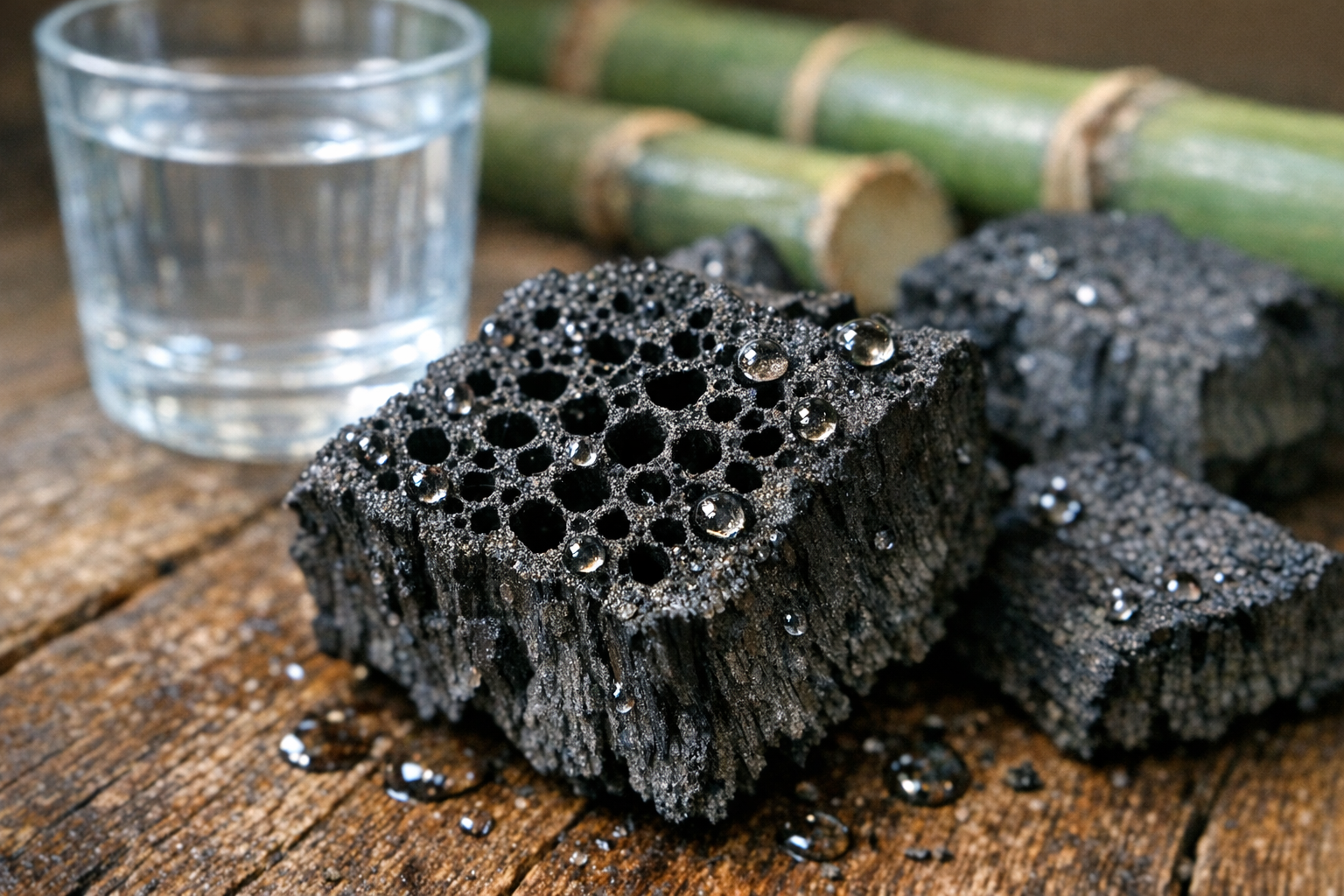
- Iodine adsorption testing — determines surface area and activation quality, measured in mg/g (higher = better activated)
- Bulk density — checked to specification, usually 0.4–0.5 g/cm³ for activated grades
Then comes the critical split: product intended for consumer use (toothpaste, supplements, cosmetics) is routed to one packaging area; industrial-grade charcoal (water treatment, air purification, industrial solvents) goes to another. This separation is strict—regulatory requirements differ entirely. A batch of toothpaste-grade charcoal must pass food-contact material standards and heavy metal testing (lead, cadmium, etc. all below detectable limits). Industrial grades face different specs but are graded far less stringently.
Packaging for Retail versus Bulk Shipping
The final distinction between what you’d make at home and what lands on store shelves is the packaging operation. Consumer-grade charcoal (like the powders found in activated charcoal supplements or toothpastes) is packaged in climate-controlled rooms with humidity maintained below 60%. Any moisture reabsorption degrades product efficacy. The factory uses multi-layer packaging: inner food-grade plastic, outer kraft paper, with desiccant packets for premium products. Individual containers are weighed to ±2 grams and sealed automatically.
Industrial bulk shipments skip the fancy packaging. The same charcoal goes into 25-kg bags or loose into shipping containers destined for water treatment plants or manufacturing partners. Quality specs are maintained, but presentation doesn’t matter.
A practical note: if you’re shopping for activated charcoal powder for personal use—say, for a DIY detox project or water filtration—products like Viva Doria activated charcoal powder come from exactly this kind of factory operation. The charcoal went through continuous kiln carbonization, automated grading, lab testing for iodine adsorption, and careful moisture-controlled packaging. That’s why it performs consistently—and why it costs more than raw charcoal you might make yourself.
The Economics That Make Commercial Production Viable
What surprised me most was how thin the margins are. A 500-tonne-per-year facility, running continuously, has enormous fixed costs: the kilns themselves (roughly 2 million USD each), the testing lab equipment, automation systems, skilled operators, regulatory compliance. That’s a burden that only makes sense if you’re moving serious volume.
The factory sells bulk charcoal at roughly 800–1200 USD per tonne depending on activation grade. After transport, utilities, labor, and equipment amortization, the actual profit per tonne is surprisingly small. Scale is everything—which is why artisanal charcoal makers can’t compete on price but can compete on story or niche applications.
If you’re thinking about producing charcoal yourself (even as a side business), this visit crystallized why factory operations exist: the capital outlay for consistent, food-contact-compliant, reliably graded charcoal is genuinely enormous. The DIY kiln stays attractive for gardening amendments or very small-scale specialty applications. But the moment you need consistent product for retail sale, you’re looking at factory infrastructure.
Commercial bamboo charcoal production isn’t mysterious—it’s just relentlessly engineered toward consistency and volume. Continuous kilns eliminate batch variation. Automated temperature control removes guesswork. Rigorous grading and testing catch issues before packaging. Separate lines for consumer and industrial products ensure regulatory compliance. It’s all extremely logical once you see it in operation, and it explains exactly why the charcoal in your toothpaste or water filter is so dependably uniform, and why making equivalent product at home would require investments most small producers can’t justify.
About This Article

Written by Marcus Chen. Marcus Chen has spent 15 years cultivating and studying bamboo across 14 different species, combining commercial growing operations with extensive hands-on experience in species selection and containment. As both a grower and consultant, he specializes in practical bamboo management, helping homeowners and landscapers understand the real-world requirements for responsible bamboo cultivation. Marcus brings tested knowledge of which species thrive reliably and which present containment challenges that go beyond standard recommendations. More about this site.
Verify this against a primary source
Specifics change, and your situation may differ from the one described here. These are the authorities worth checking directly:
- American Bamboo Society — species listings and cultivation guidance
- USDA PLANTS Database — species range and identification
- USDA Plant Hardiness Zone Map — cold hardiness verification for your location