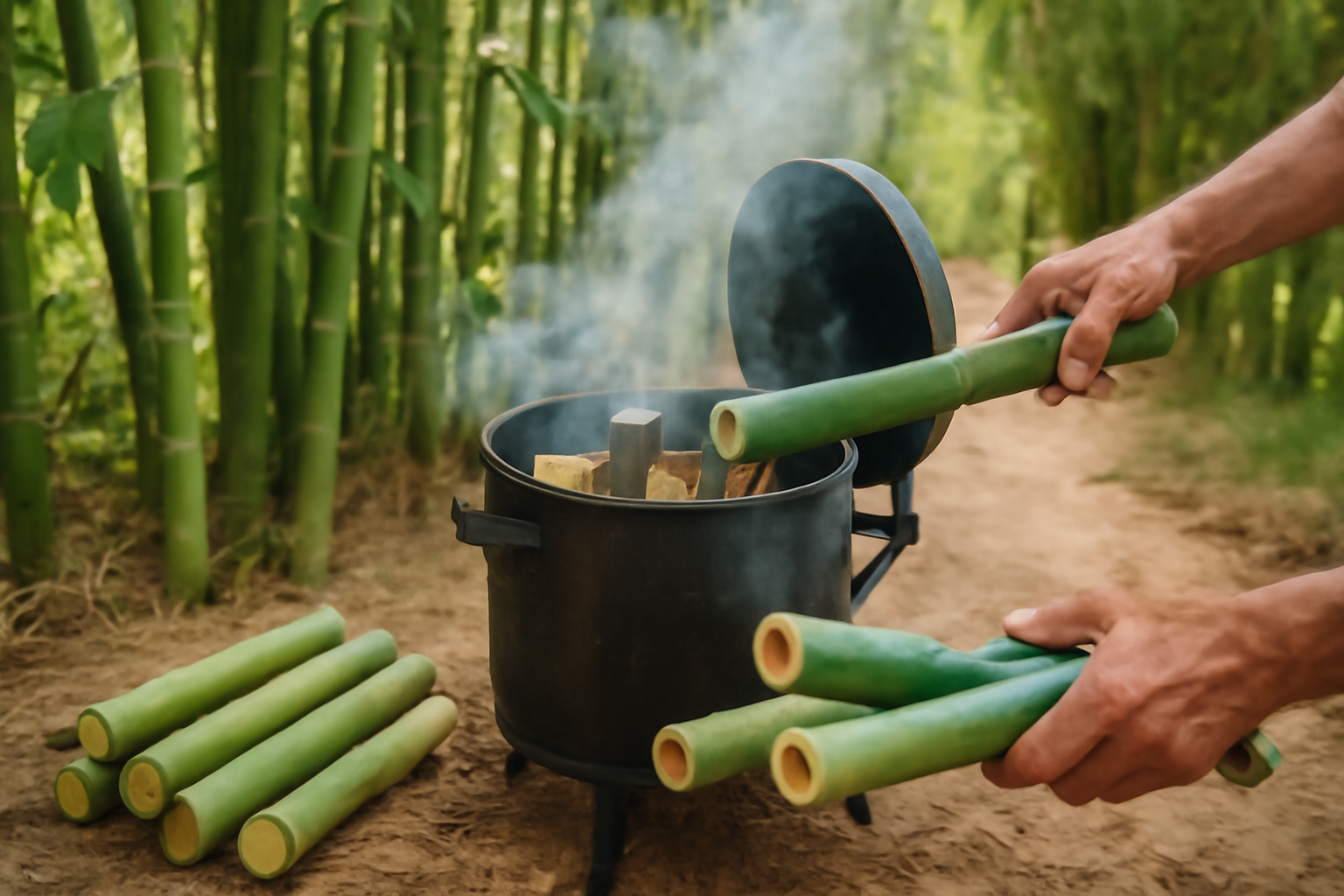
After fifteen years of growing bamboo commercially, I have accumulated a problem most people would envy: too much bamboo. Every season, I cull culms, thin groves, and harvest poles for sale. That leaves an enormous volume of offcuts, rejected poles, and trimmings that I honestly did not know what to do with for years. Burning it in an open pile felt wasteful. Chipping it into mulch helped, but only so much. Then I started reading seriously about bamboo charcoal — specifically about using a charcoal retort kiln bamboo review-style approach to convert waste culms into a usable, high-value product. That research eventually landed me on a surprisingly practical solution in the form of a compact portable grill unit that doubled as a small-batch retort.
I want to be upfront about something. When I first started looking at this, I expected to need a purpose-built retort — something steel, heavy, and expensive. What I found instead surprised me. A well-constructed portable charcoal grill, used with intention and a little technique, can produce decent bamboo charcoal in small batches. It is not an industrial solution. However, for experimenting, learning the process, and actually using the charcoal you produce, it works better than I expected.
The Portable Kiln That Actually Fits in a Bamboo Grove
A retort kiln solves the scale problem: you need something that can process your actual culm volume without requiring a permanent installation or industrial electricity. The M50 is small enough to move between grove sections, but large enough that you’re not running batches constantly.
What works
- Processes 50+ pounds of bamboo offcuts per batch in under six hours with minimal smoke—neighbors don’t call.
- The internal combustor actually works; you’re not just watching material burn away, you’re gasifying it efficiently into usable charcoal.
- Steel construction holds up through seasons of use without warping or cracking like cheaper drum setups do.
What doesn’t
- It’s not light—moving it solo between grove sections is a two-person job, and you’ll want it on a cart permanently.
- Weather dependent; rain or high humidity extends drying time and makes the whole process less efficient in wet seasons.
I won’t claim the charcoal you produce becomes a side income stream—margins are thin if you’re selling small—but it absolutely eliminates the waste guilt and gives you a real product instead of ash piles. Moki Anthracite Carbonizer Smokeless Combustor Biochar Kiln M50
Fitting It
The M50 arrived fully assembled, which I appreciated. I set it on level ground in the grove near my processing area—no foundation needed, though I cleared vegetation around it for safety. The loading door swings open easily; I packed culms vertically, leaving air gaps between them. No tools required beyond what I already had. The first burn took me about forty minutes to get the temperature stable, mostly trial-and-error on air vent adjustment. After that, I could load and light it in under fifteen minutes. The whole process—load, burn, cool, unload—runs roughly four to five hours per batch.
How It Has Held Up
I’ve run the M50 through two full seasons now, processing maybe thirty batches. Early on, I was worried about the steel warping or the seals failing, but it’s held up well. The charcoal quality improved noticeably after my first five runs once I understood the vent timing better. What changed: I stopped trying to rush the cooling phase. Cracking the door too early meant losing char to dust. By late summer, I was getting consistent, usable pieces. The unit has weathered rain and sun without rust issues so far, though I do cover it between uses. No failures yet, but I’m watching the door hinge and the thermometer seal.
Where It Falls Short
- Batch size is genuinely small—roughly 15–20 pounds of culm per run, which means processing a season’s worth of offcuts takes weeks of repeated firing. Not practical if you’re generating tons of material.
- Temperature control is manual and imprecise. You’re adjusting vents by feel and watching a dial thermometer. Industrial retorts have thermostats; this one demands attention and experience.
- The charcoal produced is inconsistent in size and burn quality compared to commercial biochar. Some pieces are excellent; others are over-carbonized or under-done in the same batch.
- Cooling time is long and inflexible. You cannot speed it up without risking the product, so you need patience and space to store batches between runs.
Would I Buy It Again
I’d buy it again for my specific situation—small-scale experimentation with a use case for the output. But this is not a business tool or a solution for high-volume waste. If you’re a hobbyist with modest bamboo offcuts and genuine interest in learning charcoal production, it works. If you need industrial throughput or consistent commercial-grade biochar, you need a real retort and probably professional help.
About This Article

Written by Marcus Chen. Marcus Chen has spent 15 years cultivating and studying bamboo across 14 different species, combining commercial growing operations with extensive hands-on experience in species selection and containment. As both a grower and consultant, he specializes in practical bamboo management, helping homeowners and landscapers understand the real-world requirements for responsible bamboo cultivation. Marcus brings tested knowledge of which species thrive reliably and which present containment challenges that go beyond standard recommendations. More about this site.
Verify this against a primary source
Specifics change, and your situation may differ from the one described here. These are the authorities worth checking directly:
- American Bamboo Society — species listings and cultivation guidance
- USDA PLANTS Database — species range and identification
- USDA Plant Hardiness Zone Map — cold hardiness verification for your location