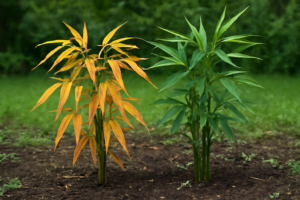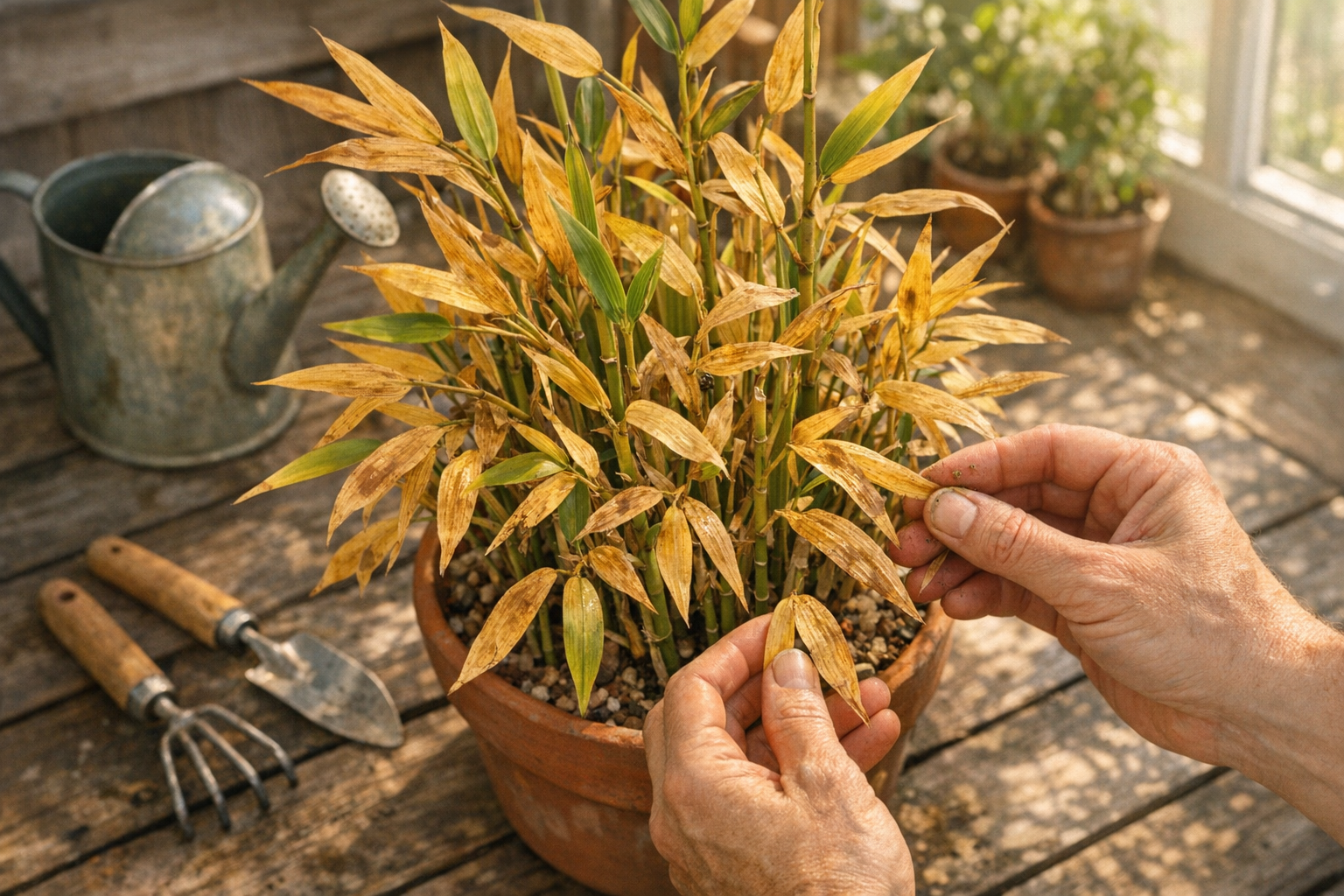
I was staring at my potted Phyllostachys aurea last Tuesday when I noticed the first wave of yellowing leaves. My instinct was to panic and reach for fertilizer, but I stopped myself. This wasn’t the same yellowing I see in field-grown bamboo. The causes were completely different, and treating it like an in-ground problem would’ve made things worse.
Here’s what I’ve learned after five years of keeping bamboo in containers indoors and on patios: potted bamboo turns yellow for reasons that barely touch ground-planted specimens. The closed environment of a pot creates its own specific stressors. Root-bound conditions, trapped moisture, weak indoor light, and mineral salt buildup—these are the real culprits nine times out of ten. And the fix for each one is completely different from what you’d do in the garden.
Root-Bound Bamboo Runs Out of Nutrients Faster Than You’d Expect
This is the most common cause I see, and it sneaks up on people. A bamboo in a 10-inch pot can deplete its available nutrients and reach its root ceiling in 18 to 24 months. After that, even if you’re watering and feeding regularly, the roots are circling against the container wall instead of accessing fresh soil.
I learned this the hard way with a Fargesia robusta a client kept on their balcony. It started throwing yellow leaves after about two years. The plant looked stunted—new culms were thinner than before, and the foliage lost that vibrant green. When they finally unpotted it out of desperation, they found a solid knot of roots with almost no loose soil between them.
The fix isn’t dramatic, but it takes patience: upsizing the container by only 2 to 3 inches in diameter at a time. Move a 10-inch pot to a 12 or 13-inch pot. Use fresh, well-draining bamboo potting mix—not garden soil or old recycled potting media. Within 4 to 6 weeks, you’ll see new growth come in greener. Don’t jump from a small pot straight to a massive one; you’ll invite root rot and mineral buildup in all that unused soil.
Drainage Holes That Trap Water Create a Slow Death Spiral
This is where potted bamboo yellowing diverges most sharply from field problems. In-ground bamboo rarely suffers from standing water unless your garden naturally floods. In a pot, especially a decorative container without adequate drainage, water pools and kills roots in days, not weeks.
I made this mistake with an ornamental pot that looked beautiful but had only one small drainage hole. I watered on schedule—seemed fine. After three weeks, the leaves started turning yellow from the bottom up, starting with that dull, almost papery quality. When I checked the soil, it smelled sour. The roots in the lower two inches of the pot were mushy and black.
Here’s what I do now: any container for potted bamboo needs a minimum of three quarter-inch drainage holes in the bottom, or four if the pot is wider than 12 inches. If you love a decorative pot without drainage, use it as a cachepot—plant the bamboo in a drainage-equipped nursery pot and nest it inside the pretty container. You get the look without suffocating the plant.
To prevent standing water, I also place a bamboo stake or pencil in the soil after watering, wait 60 seconds, then pull it out. If it comes up wet at more than 2 inches depth, the pot isn’t draining properly. Either add more drainage holes (carefully, with a drill and ceramic bit if it’s ceramic) or repot into something with better drainage.
Indoor Low Light Causes Nutritional Yellowing That Seems Like a Mystery
This one is subtle and maddening. Bamboo kept indoors away from direct light—say, 8 to 10 feet from a north-facing window—starts yellowing even when roots are healthy and drainage is perfect. The plant isn’t getting enough light energy to manufacture chlorophyll efficiently, so the leaves fade to pale yellow or yellowish-green.
Unlike nutrient deficiency yellowing (which shows up on older leaves first), light-stress yellowing tends to affect new growth too. You get a generally washed-out appearance rather than a sharp pattern.
I tested this by moving a declining Phyllostachys nigra from an interior corner to a spot 3 feet from an east-facing window with filtered morning sun. Within three weeks, the new shoots came in dark green and the older yellowed foliage dropped naturally. The plant didn’t recover to perfect in that timeframe, but the trajectory shifted.
For indoor potted bamboo, aim for at least 4 to 6 hours of bright, indirect light daily. If your space truly can’t provide that, a basic full-spectrum LED grow light on a 10-hour timer makes a measurable difference. Position it 12 to 18 inches above the canopy. This alone won’t fix a root-bound plant, but it removes one major stressor from the equation.
Mineral Buildup From Tap Water Is a Silent Accumulator
This cause is almost exclusive to containers. When bamboo lives in a closed pot system and you water with chlorinated tap water, minerals—calcium, magnesium, and chlorine salts—accumulate in the soil and on the root surface over months. In-ground bamboo benefits from natural leaching and rain; potted bamboo has nowhere for these minerals to go.
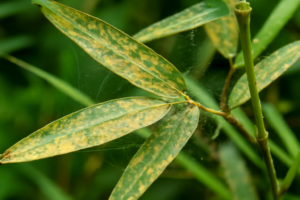
The symptoms look like nutritional deficiency: interveinal yellowing where the leaf veins stay green but the tissue between them turns pale yellow. It usually starts on lower, older leaves. The plant often looks nutrient-starved despite regular feeding because the mineral crust on the roots actually blocks nutrient absorption.
To diagnose this, grab a soil moisture meter—I use the XLUX Soil Moisture Meter, which is inexpensive and lets you check both moisture and the soil’s electrical conductivity (a proxy for salt buildup). If conductivity reads above 2000 ppm on the meter and your leaves are yellowing, mineral accumulation is likely at play.
The fix: flush the pot thoroughly with distilled water. Water until it runs freely from the drainage holes for 30 seconds, then repeat. Do this once every 6 to 8 weeks as preventative maintenance. Going forward, use distilled water or rainwater for at least half your waterings. If you’re in a hard-water area and want to keep using tap water, let it sit in an open container for 24 hours before watering—this reduces chlorine and slightly improves the balance.
Putting It All Together: A Potted Bamboo Recovery Checklist
When I see yellow on a containerized bamboo, I work through this sequence:
- Check drainage first. Unpot the plant and look at the roots. Mushy, black roots and sour-smelling soil = immediate repot with drainage-heavy mix.
- Assess the root system. If roots are dense and circling, upsize the pot by 2 to 3 inches with fresh potting media.
- Evaluate light conditions. Be honest—can the plant see natural light for 4+ hours daily? If not, add a grow light or relocate it.
- Flush for mineral salts. Water with distilled water until it runs clear from drainage holes. Plan to rotate to distilled or rainwater for half your future waterings.
- Wait before feeding. Most potted bamboo doesn’t need fertilizer until 4 to 6 weeks after repotting. Resist the urge to add more nutrients—the new soil already has a full complement.
Potted bamboo yellowing almost always traces back to one of these four container-specific problems. Once you eliminate them systematically, you’ll have healthy, vibrant foliage again—and you’ll understand why potted bamboo care is genuinely different from growing it in the ground.
About This Article

Written by Marcus Chen. Marcus Chen has spent 15 years cultivating and studying bamboo across 14 different species, combining commercial growing operations with extensive hands-on experience in species selection and containment. As both a grower and consultant, he specializes in practical bamboo management, helping homeowners and landscapers understand the real-world requirements for responsible bamboo cultivation. Marcus brings tested knowledge of which species thrive reliably and which present containment challenges that go beyond standard recommendations. More about this site.
Verify this against a primary source
Specifics change, and your situation may differ from the one described here. These are the authorities worth checking directly:
- American Bamboo Society — species listings and cultivation guidance
- USDA PLANTS Database — species range and identification
- USDA Plant Hardiness Zone Map — cold hardiness verification for your location