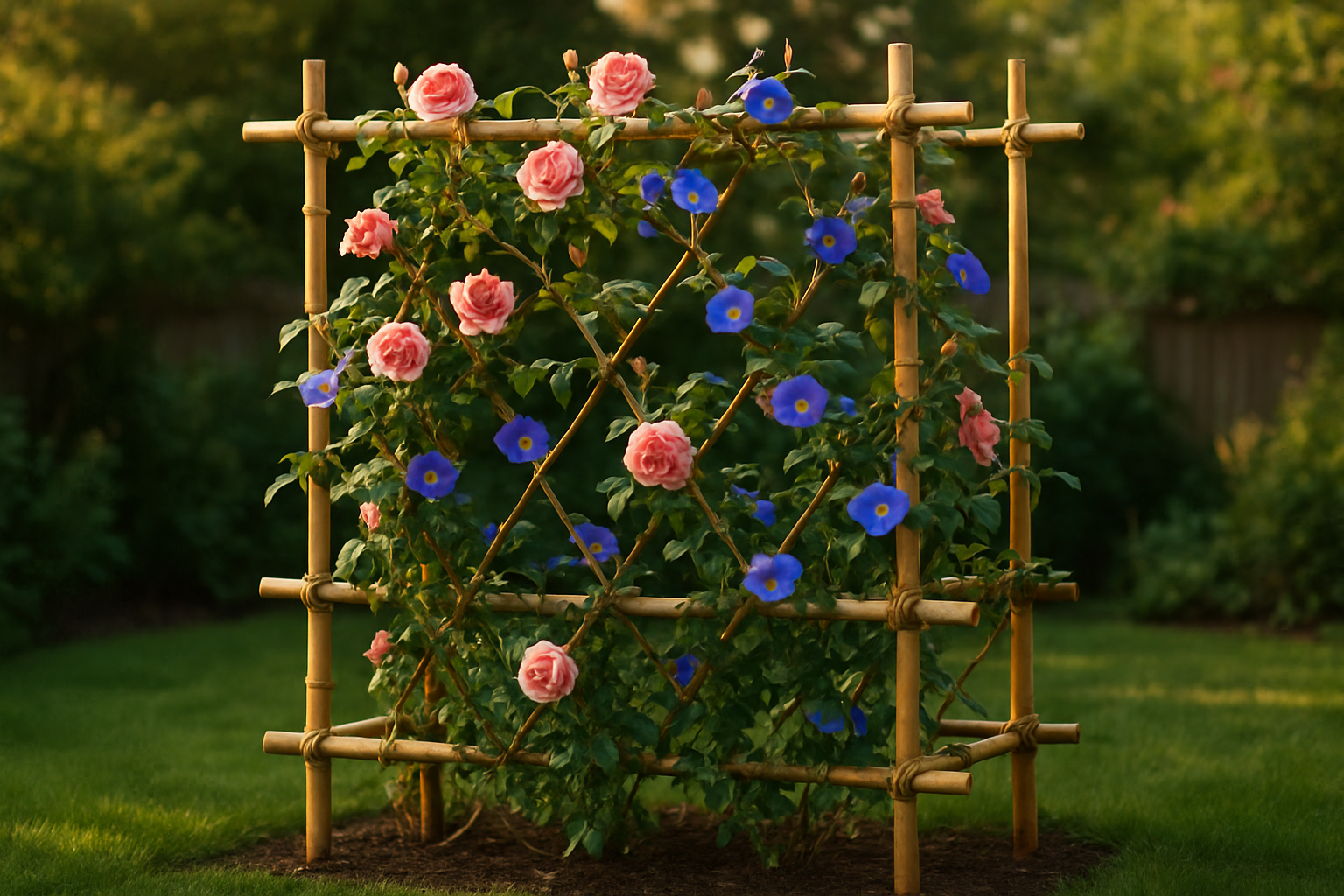
- Mark your layout first. Use stakes and string to mark where your uprights will go before you touch a single bamboo pole. For a basic A-frame or flat grid trellis, two to four uprights are all you need. Spacing them evenly — typically 18 to 24 inches apart — will make the whole thing look intentional and professional.
- Drive uprights in at least 12 inches deep. For an 8-foot stake, that means you’ll have about 6.5 feet of usable height above ground. Use a mallet rather than a hammer to avoid splitting the bamboo at the top.
- Lash your crosspieces with a square lashing technique. Start by wrapping the twine around the vertical pole just below where the horizontal pole will rest, then bring it up and around both poles in a figure-eight pattern, pulling firmly after each wrap. Finish with two or three tight frapping wraps between the poles to cinch everything together, then tie off with a square knot. It sounds more complicated than it is — watch one two-minute video and you’ll have it down.
- Use the thicker 3mm jute at structural joints and the thinner
I want to tell you about the afternoon I accidentally glued my hand to a bamboo pole in front of my entire neighborhood. It was a Tuesday. My garden looked like a sad tangle of tomato plants leaning against each other like tired commuters on a subway, and I had decided — with exactly zero woodworking experience — that I was going to build a DIY bamboo garden trellis before sundown. Reader, I did not finish before sundown. But I did end up with 47 new Instagram followers and a story I will never live down.
This post contains affiliate links. As an Amazon Associate, I earn from qualifying purchases.
If you’ve been eyeing those gorgeous bamboo trellises in garden magazines and thinking there’s no way you could pull that off, I’m here to tell you: you absolutely can. And if I can do it — a person who once spent twenty minutes trying to figure out which end of a hand saw does the cutting — you are going to be just fine. Let me walk you through exactly how I built mine for under $25, complete with the hard-won wisdom that only comes from publicly embarrassing yourself in your front yard.
Why Bamboo Is the Perfect Trellis Material
Before we get to the tools and the technique, let’s talk about why bamboo is genuinely wonderful for this project and not just trendy. Bamboo is one of the strongest natural materials you can use in a garden setting, with a tensile strength that rivals steel relative to its weight. It’s also naturally resistant to moisture, which means it won’t rot out on you after one rainy season the way cheap wooden dowels tend to do. It’s lightweight, easy to work with, and — this is the part that keeps getting me — it looks absolutely beautiful in a garden. There’s a warmth and an organic elegance to bamboo that plastic or wire trellis panels simply cannot replicate.
For a trellis project, you’ll want to think about the scale of what you’re growing. Lighter climbers like sweet peas, beans, or small cucumbers can be supported beautifully by thinner stakes arranged in a fan or grid pattern. Heavier plants like tomatoes, grape vines, or large squash need something with more girth and a sturdier base. The good news is that bamboo stakes come in a range of sizes, so you can match the material to the job.
Tools and Materials for Your DIY Bamboo Garden Trellis
Here’s everything I used to build my trellis. The total came in right around $25, and I had leftover materials for two more smaller projects. I’ve linked everything I actually bought so you can grab the same stuff without having to guess.
Recommended Products
- For lighter climbers and the vertical uprights of a fan trellis: COLOtime Bamboo Stakes 58 Inch, 20 Pack — These are a great mid-height stake for beans, sweet peas, and shorter flowering vines. The 20-pack gives you plenty to work with for a full trellis panel.
- For the main structural uprights if you’re supporting tomatoes or heavier vines: Cambaverd Bamboo Stakes 8 Feet, 1 Inch Diameter, 10 Pack — These thicker, taller poles are what I used for the main frame of my trellis. The one-inch diameter makes a real difference in stability, and eight feet gives you plenty of height above ground after you sink them in.
- For filling in the grid work or a smaller project: Mininfa Natural Bamboo Stakes 4 Feet, 25 Pack — The 25-pack at four feet is ideal for the horizontal crosspieces of your trellis grid, or for building a shorter trellis for a container garden.
- For tying everything together (and this is where I nearly went wrong — more on that in a moment): Vivifying Garden Twine, 656 Feet, 2mm Green — The thinner 2mm twine is perfect for lashing joints and tying plant stems to the trellis without cutting into them.
- For a sturdier lash at the main structural joints: Vivifying Jute Twine, 328 Feet, 3mm Brown — The thicker jute is what you want where two poles cross and need to hold real weight. It’s also beautiful — the brown color looks completely natural against the bamboo.
Beyond these, you’ll need a mallet or rubber hammer to drive the uprights into the ground, and a pair of garden snips or a small hand saw for trimming any stakes to length. That’s genuinely it.
How to Build the Trellis: Step by Step
Okay, so here’s where things went sideways for me — and where they can go beautifully right for you if you learn from my disaster. I decided to skip the planning phase entirely because I am, at heart, an impulsive person who finds measuring deeply boring. I jammed my uprights into the ground with great enthusiasm, approximately eyeballed the spacing, and then realized I had built a parallelogram instead of a rectangle. My trellis leaned to the left like it was listening to something happening next door.
My neighbor Carl watched this entire process from his driveway. He said nothing. He just nodded slowly, the way you nod at something you’ve decided not to comment on.
Here is what I should have done — and what you should do:
- Mark your layout first. Use stakes and string to mark where your uprights will go before you touch a single bamboo pole. For a basic A-frame or flat grid trellis, two to four uprights are all you need. Spacing them evenly — typically 18 to 24 inches apart — will make the whole thing look intentional and professional.
- Drive uprights in at least 12 inches deep. For an 8-foot stake, that means you’ll have about 6.5 feet of usable height above ground. Use a mallet rather than a hammer to avoid splitting the bamboo at the top.
- Lash your crosspieces with a square lashing technique. Start by wrapping the twine around the vertical pole just below where the horizontal pole will rest, then bring it up and around both poles in a figure-eight pattern, pulling firmly after each wrap. Finish with two or three tight frapping wraps between the poles to cinch everything together, then tie off with a square knot. It sounds more complicated than it is — watch one two-minute video and you’ll have it down.
- Use the thicker 3mm jute at structural joints and the thinner
Building a DIY Bamboo Garden Trellis: The $25 Project That Made My Garden Instagram-Famous