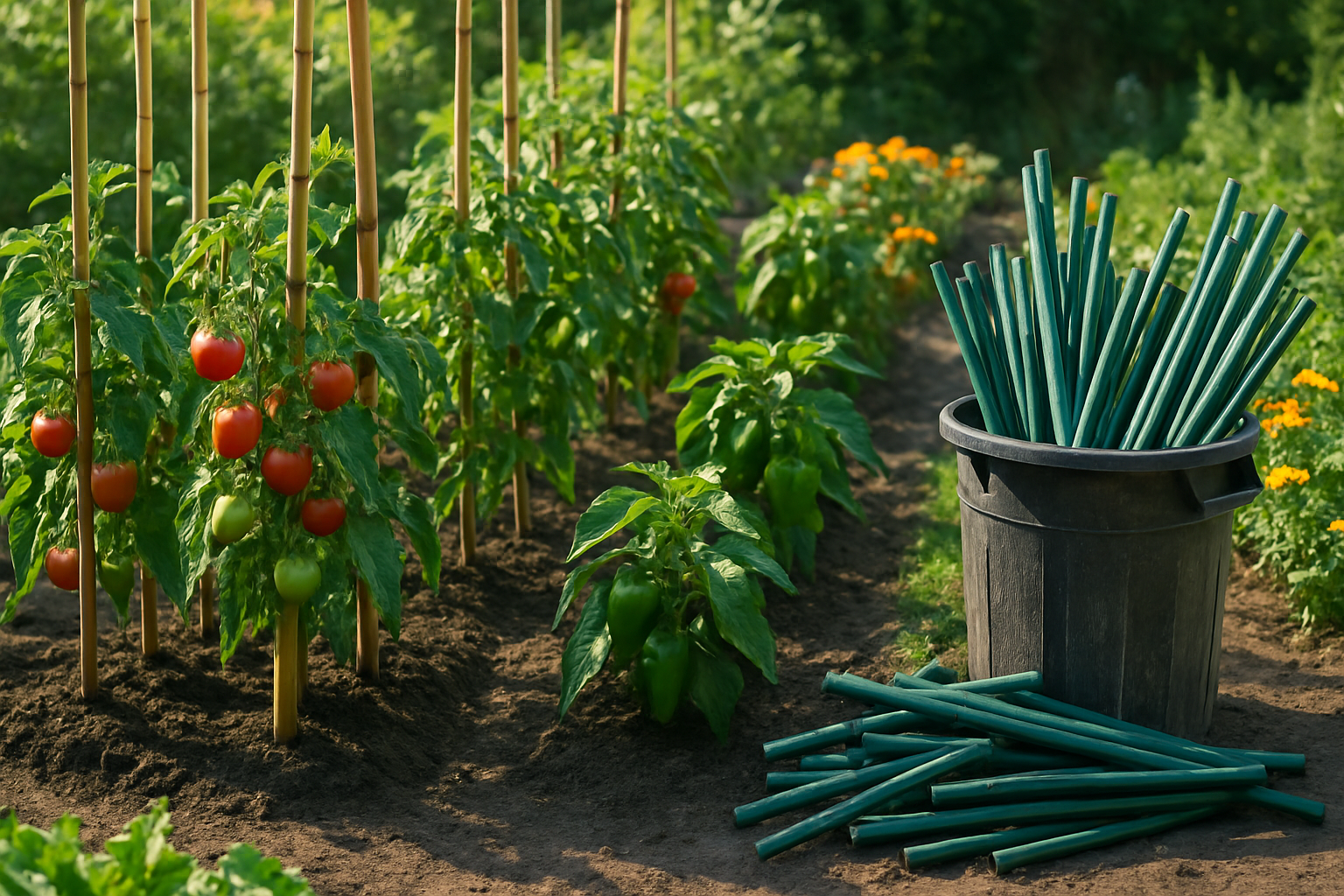
I want to tell you about the day I accidentally staked an entire raised bed with what turned out to be decorative cocktail skewers. Not garden stakes. Cocktail skewers. My Roma tomatoes were practically laughing at me by July.
It was my third year gardening, and I’d grabbed what I thought was a fresh pack of plastic garden stakes from the garage shelf. They looked right. They were roughly the right length. They were, I later discovered while puzzling over a collapsed tomato cage, rated to hold approximately four olives and a maraschino cherry. My plants hit the dirt like tired toddlers. I hit rock bottom as a gardener. And that humiliating afternoon is exactly why I started doing real research into bamboo garden stakes vs plastic — and why I have never once regretted the switch I made the following weekend.
The Problem With Plastic Stakes (Beyond My Cocktail Skewer Incident)
Once I started paying attention, I realized the cocktail skewer disaster was just the most embarrassing symptom of a bigger problem. I had a garden full of plastic stakes in various states of defeat. Some had snapped clean in half mid-season. A few had cracked along the sides and were held together mostly by the twist ties wrapped around them. And every single fall, when I finally pulled them out to clean up the beds, I’d find another one had shattered into sharp little shards I had to hunt through the soil like a miserable Easter egg hunt.
Here’s what I didn’t fully appreciate until I made the switch: plastic garden stakes are often made from low-grade polypropylene or fiberglass composites that degrade with UV exposure. The sun basically slowly destroys them all summer long, which is a remarkable design flaw for something intended to be used outdoors in the summer. They get brittle, they snap, they leave microplastic fragments in your garden beds. For anyone growing food, that last part is genuinely worth thinking about.
Bamboo, on the other hand, is naturally strong along its grain, flexible enough to absorb wind stress without snapping, and it breaks down at the end of its life in the most garden-appropriate way possible: it becomes compost. Not confetti. Not shards. Compost.
Bamboo Garden Stakes vs Plastic: What Actually Matters When You’re Choosing
Not all bamboo stakes are created equal, and I say that as someone who now owns an embarrassing quantity of them. Here’s what I’ve learned actually matters when you’re shopping:
Length Is Everything
Match your stake length to your plant’s mature height, not its current height. A tomato plant that looks politely small in May will absolutely be towering over your fence by August. For determinate tomatoes and most peppers, 4-foot stakes work beautifully. For indeterminate tomato varieties, climbing beans, or cucumbers trained on a single stem, go longer — 48 inches or more.
Thickness Determines Load
Thin stakes (around 6-8mm) are perfect for indoor plants, seedlings, or flowers that just need a little guidance. Thicker stakes (10mm and up) are what you want when you’re asking bamboo to hold up a full-grown vegetable plant in a windstorm. Most product listings will tell you the diameter — actually read that number.
Treated vs. Natural
Some bamboo stakes are kiln-dried or heat-treated for extra durability and to prevent mold. For stakes that will be in contact with moist soil all season, this matters. Look for stakes that are described as natural or kiln-dried — both are fine, just understand that untreated bamboo in perpetually wet soil will break down faster.
Bamboo Stakes That Won’t Rot or Splinter After One Season
Plastic stakes degrade in UV light, crack in freeze-thaw cycles, and leach microplastics into your soil—I learned that the hard way after five years of replacing broken stakes every spring. Bamboo stakes are stronger, naturally antimicrobial, and they actually improve soil structure as they eventually decompose, instead of persisting as garden pollution.
What works
- 8-inch length is perfect for young herbaceous perennials and shallow-rooted ornamentals without being so tall they create wind leverage problems.
- The naturally tapered end drives into compacted soil without splitting or requiring a mallet—you can push them in by hand even in clay-heavy beds.
- They remain structurally sound through at least two full growing seasons before any softening appears, giving you actual durability without the plastic guilt.
What doesn’t
- The 8-inch size is limiting if you’re staking taller specimens or perennials that need support deeper than 6 inches of soil anchoring—you’ll end up wanting the 48-inch variety for half your garden.
- Bamboo can develop a slick algae coating in high-humidity or frequently-misted areas, making ties slip slightly if you don’t use the figure-eight method with tension.
I almost abandoned bamboo stakes after a windstorm flattened three tomatoes in year two—then I realized I’d anchored them too loosely and hadn’t angled them against prevailing wind. Once I fixed my technique, they outperformed every plastic stake I’d ever bought. Grab the HOPELF 50 Pack 8″ Bamboo Plant Stakes and get them in the ground at planting time.
About This Article

Written by Marcus Chen. Marcus Chen has spent 15 years cultivating and studying bamboo across 14 different species, combining commercial growing operations with extensive hands-on experience in species selection and containment. As both a grower and consultant, he specializes in practical bamboo management, helping homeowners and landscapers understand the real-world requirements for responsible bamboo cultivation. Marcus brings tested knowledge of which species thrive reliably and which present containment challenges that go beyond standard recommendations. More about this site.
Verify this against a primary source
Specifics change, and your situation may differ from the one described here. These are the authorities worth checking directly:
- American Bamboo Society — species listings and cultivation guidance
- USDA PLANTS Database — species range and identification
- USDA Plant Hardiness Zone Map — cold hardiness verification for your location