Affiliate Disclosure: This article contains affiliate links. As an Amazon Associate, TerraBamboo earns from qualifying purchases. This does not affect the accuracy or independence of our recommendations.
Key Takeaways
- Harvest only 2–5 year old culms for garden poles — new shoots (year 1) contain high sugar and starch, making them prone to rot and insect damage within months.
- The best time to harvest is late autumn through winter (November–February in the Northern Hemisphere), when sap levels are lowest and fiber is strongest.
- Identify harvest-age culms by color change — mature culms shift from bright green to mellow, matte green or yellowish-green with fading white bloom.
- Proper curing requires 4–8 weeks of vertical drying in a sheltered, well-ventilated space, followed by sealing with linseed or tung oil to prevent moisture infiltration.
- Species like Phyllostachys aurea, Ph. nigra, and Ph. bissetii produce superior straight poles ideal for garden stakes, trellises, and structural supports.
- Properly cured and sealed bamboo garden poles last 5–10 years outdoors when used for stakes, teepees, and support structures.
Harvesting bamboo for garden poles is one of the most rewarding uses of a home bamboo grove. Whether you’re staking tomatoes, building bean teepees, or creating elegant trellis frames, homegrown bamboo garden stakes offer unmatched durability, sustainability, and cost savings compared to commercially treated wood. However, successful bamboo harvesting for garden poles requires precise timing, species selection, and post-harvest curing techniques. TerraBamboo’s horticultural team has compiled this comprehensive guide to help you harvest, cure, and deploy bamboo poles that will serve your garden for years to come.
When to Cut Bamboo: The Critical Age Rule for Durability
The single most important rule in bamboo harvesting for garden poles is this: always harvest 2–5 year old culms, never first-year shoots. This distinction is the difference between poles that last a decade and stakes that rot within a season.
New bamboo shoots (year 1 culms) emerge from the rhizome with exceptionally high sugar and starch content. These carbohydrates serve the young culm as energy for growth and structural development. However, from a material perspective, high sugar content is a liability outdoors. Sugar and starch attract wood-boring insects, fungi, and mold. Without proper treatment (which home gardeners typically don’t apply to stakes), first-year culms are heavily colonized by rot organisms within weeks of exposure to moisture.
During years 2–5, bamboo undergoes a critical biochemical transformation. The plant converts much of that stored starch and sugar into lignin, the tough polymer that gives woody tissue its strength, hardness, and rot resistance. By age three, a culm has developed maximum rot resistance among living culms. The interior density increases, fiber integrity strengthens, and the material naturally resists insect invasion and fungal attack. This is the optimal window for harvesting bamboo poles for outdoor use.
Culms older than 5–7 years are still usable but become increasingly hollow and brittle, particularly in their lower sections. They also shed their outer waxy protective layer more readily. For garden poles, the sweet spot is reliably the 3–4 year old culm: strong, dense, fully rot-resistant, and still with intact protective coating.
How to Identify Harvest-Ready Culms in Your Grove
Knowing the theory is one thing; spotting the right culms in your grove is another. TerraBamboo’s cultivation specialists rely on three visual markers to confirm that a culm is ready for harvesting as a garden pole:
1. Color Transformation
New bamboo culms emerge bright, almost luminous green. This vibrant color is a reliable indicator of youth and high sugar content. As culms age through years 2–4, this bright green gradually mutes to a deeper, more matte green or yellowish-green tone. The change is subtle but visible once you’ve seen it a few times. If you run your hand along the culm, the texture also becomes less waxy and glossy, and more matte.
2. Bloom Fade
Young culms are often coated with a white or grey powdery waxy bloom—a natural protective coating. On mature 3–4 year old culms in species like Phyllostachys aurea, this bloom fades significantly or disappears entirely, replaced by a more weathered-looking, uniform surface. This fade is a reliable age indicator.
3. Base Girth and Node Stability
Mature culms have achieved their full diameter. The base of the culm (lowest 2–3 feet) should feel rigid and hard when tapped with a mallet. Young culms still have flexibility in the base nodes. Additionally, the sheath scars (horizontal rings where leaf sheaths have fallen away) are sharper and more defined on older culms, whereas new culms have fresh sheaths still attached or recently shed with softer edges.
Mark your culms with a permanent marker or paint pen as they emerge in spring. This simple step lets you track age visually and ensures you never accidentally harvest anything younger than two years old when you return to the grove in autumn.
What Is the Best Bamboo Pole Harvesting Season?
Timing your bamboo harvesting for garden poles matters as much as culm age. The optimal window for bamboo pole harvesting season is late autumn through winter: November through February in the Northern Hemisphere, May through August in the Southern Hemisphere.
Why Winter Harvesting Produces Superior Poles
During winter dormancy, sap flow in bamboo drops dramatically. The plant is in a semi-dormant state, redirecting energy inward to the rhizome and lower culm sections. This low-sap condition offers several advantages:
- Minimal sugar content in the culm tissue — the remaining carbohydrates are concentrated in the rhizome, not the harvestable culm, reducing mold and insect attraction during storage and curing.
- Hardened fiber structure — after a full growing season, fiber has cross-linked and densified, making winter culms significantly harder than spring culms.
- Lower moisture content — dormant culms contain less water, which reduces drying time during the curing phase and lowers fungal colonization risk.
- Reduced bleeding and staining — winter harvest avoids the sticky sap flow that can attract insects to fresh cut ends and discolor the culm surface.
Conversely, spring and summer harvesting of bamboo poles is actively discouraged. Spring culms are full of rising sap, high in sugar, and prone to rapid insect infestation and mold during storage. Summer culms are still actively growing and lack the hardened lignin structure that comes from dormancy.
Best Bamboo Species for Garden Poles and Stakes
Not all bamboo species produce equally suitable poles for garden use. TerraBamboo’s team recommends a handful of Phyllostachys species (hardy clumping and running bamboos) based on culm straightness, hardness, and natural rot resistance.
| Species | Culm Diameter | Best Uses | Hardness | Cold Hardiness |
|---|---|---|---|---|
| Phyllostachys aurea (Golden Bamboo) | 0.75–1.25″ | Tomato stakes, small bean poles, garden markers, light trellises | Excellent | Zone 5–10 |
| Phyllostachys nigra (Black Bamboo) | 0.75–1.5″ | Ornamental stakes, medium bean/pea poles, elegant trellis frames | Excellent | Zone 6–10 |
| Phyllostachys bissetii (David Bisset Bamboo) | 0.5–1.0″ | Northern garden stakes, lightweight supports, stakes for tender perennials | Very Good | Zone 4–10 |
| Phyllostachys vivax (Vivax Bamboo) | 1.5–2.25″ | Heavy bean teepees, large trellises, structural frames, robust supports | Excellent | Zone 5–10 |
| Phyllostachys edulis (Moso Bamboo) | 2.0–4.0″ | Large structural poles, heavy pergolas, commercial-scale trellises | Superior | Zone 6–10 |
Phyllostachys aurea (Golden Bamboo) is the most popular choice for home gardeners harvesting bamboo for garden poles. Its culms are naturally straight, hard, and exceptionally rot-resistant even with minimal treatment. Golden Bamboo thrives in Zones 5–10 and produces poles of ideal diameter for tomato cages, bean poles, and small trellises within 3–4 years.
Phyllostachys nigra (Black Bamboo) offers the added appeal of developing dark, nearly black culms as they age—strikingly beautiful in ornamental settings. The poles are equally durable and slightly larger in diameter than Golden Bamboo, making them excellent for visible support structures. Black Bamboo is hardy to Zone 6 and performs exceptionally well in temperate regions.
For cold climates (Zone 4), Phyllostachys bissetii is the most cold-hardy Phyllostachys species and still produces respectable poles, though slightly smaller in diameter. This species is a practical choice for northern gardeners seeking homegrown bamboo garden stakes.
How to Harvest Bamboo Poles: Step-by-Step Cutting Technique
The mechanics of harvesting bamboo culms are straightforward but require proper tools and technique to avoid injury to the parent plant and ensure clean cuts that heal well.
Tools You’ll Need
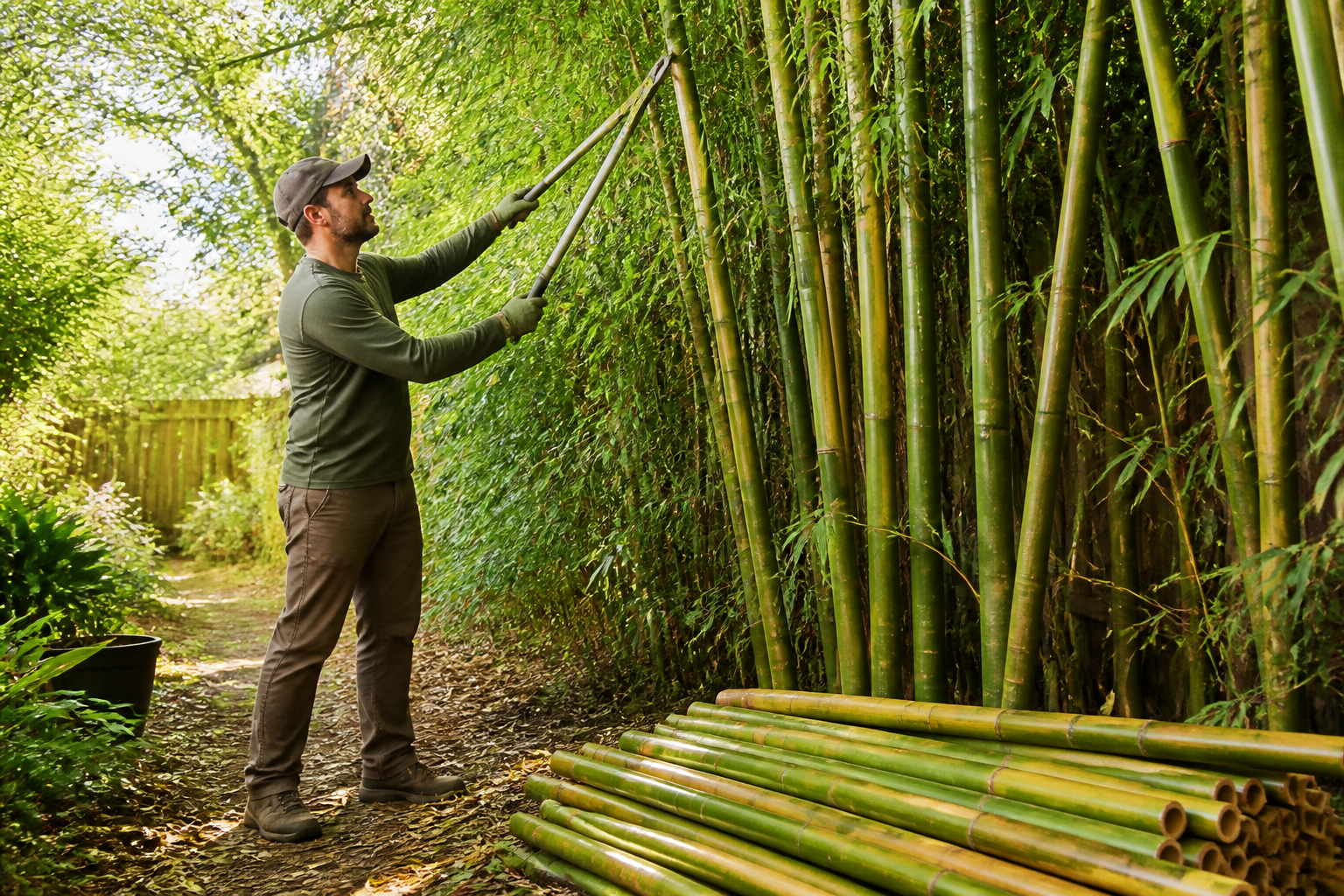
A sharp bypass lopper or pruning saw is essential. Dull blades crush the culm tissue, creating ragged wounds prone to rot and insect entry. Bypass loppers (with two sharp blades that pass each other like scissors) are preferred over anvil-type cutters, which crush tissue.
The Tool That Actually Cuts Through Mature Bamboo Culms Without Crushing Them
Harvesting 2–5 year old culms cleanly is critical — a crushed or splintered cut invites rot and pest entry right at the wound. Most standard pruners fail halfway through a thick cane, leaving you with ragged edges that compromise the entire pole’s lifespan.
What works
- The 28-inch reach lets you access older culms deep in the clump without bending into the tangle or disturbing younger shoots you’re leaving behind.
- Cuts through 2–3 year old canes in one smooth stroke — no crushing, no need to saw back and forth, which means a clean wound that seals faster and resists fungal entry.
- The pivot handle takes real pressure off your hands during winter harvest sessions when you’re cutting 15–20 culms in a morning; my wrists stayed fresh enough to do containment checks afterward.
What doesn’t
- Won’t bite through culms thicker than 1.5 inches in a single cut — you’ll need a pruning saw for your oldest canes, which means carrying two tools if you’re harvesting across age ranges.
- The handles start to fatigue after 25+ cuts if you’re not squeezing with good form; it’s efficient, not effortless, and poor technique will leave you sore by day two of a big harvest.
I almost abandoned these after my first season because I kept trying to force them through 4-year-old Moso culms — until I realized I should be reserving those for the saw and letting the loppers do what they’re built for. Get the Fiskars 28″ Loppers for Tree Trimming for your 2–3 year harvest work.
This post contains affiliate links. As an Amazon Associate, I earn from qualifying purchases at no extra cost to you.