I Cut Down a 40-Foot Bamboo Grove With a Cordless Chainsaw: Which One Survived

I Cut Down a 40-Foot Bamboo Grove With a Cordless Chainsaw: Which One Survived

This post contains affiliate links. As an Amazon Associate, I earn from qualifying purchases at no extra cost to you.

Last spring, I made a decision I immediately regretted: I let my neighbor’s running bamboo problem become my running bamboo problem. What started as a handful of shoots crossing the property line had quietly turned into a 40-foot-wide grove practically overnight. I needed a solution fast, and I needed it to be portable. That’s what sent me deep into a rabbit hole of cordless chainsaw cutting bamboo reviews, searching for something small enough to maneuver through a dense thicket but powerful enough to actually cut through mature culms.

I’m not a professional arborist. I’m a backyard bamboo grower who got in over his head. My full-sized gas chainsaw felt like overkill — and honestly, terrifying — inside a tight grove where culms were packed just a foot apart. I needed something I could swing with one hand, stop instantly, and restart without yanking a pull cord twenty times. Cordless and compact was the direction I was heading.

After two weekends of research and one very sore back, I landed on the Seesii Mini Chainsaw, 6-inch Mini Chainsaw Cordless. Here’s everything I learned — the good, the frustrating, and the one moment I almost threw it into the bamboo pile and walked away.

Why I Chose the Seesii Mini Chainsaw Over the Competition

My shortlist had about six tools on it. Most full-size cordless chainsaws were still too bulky for the spacing I was dealing with. Meanwhile, the ultra-cheap one-handed models on Amazon looked like they’d snap a chain the moment they hit a mature bamboo culm. I needed something in between.

The Seesii Mini Chainsaw, 6-inch Mini Chainsaw Cordless kept appearing in forum threads on bamboo gardening groups. Two separate people in a Facebook group for bamboo enthusiasts mentioned it specifically for grove work. That social proof mattered to me. Reviews also consistently noted that the two included batteries gave you enough run time to actually finish a session without waiting for a charge.

Price was a factor too. At roughly $50–$60 at the time of purchase, it wasn’t a throwaway tool, but it also wasn’t a $200 gamble. If it handled a summer of bamboo cutting, it would pay for itself in saved rental fees alone. I hit “buy” and started clearing a workspace in my yard.

First Impressions: Unboxing and Build Quality

The box arrived in two days. Inside was the saw, two lithium-ion batteries, a charger, a small chain oil bottle, a spare chain, a screwdriver, and a carrying bag. That felt like a complete kit — nothing I needed to hunt down separately before getting started.

Holding it for the first time, the weight surprised me. It’s light. Genuinely light — roughly 2.2 pounds with a battery installed. My first instinct was skepticism. Lightweight tools have let me down before. The housing is hard plastic with a rubberized grip section, and while it doesn’t feel like a $200 professional tool, nothing rattled and nothing flexed when I squeezed it. The chain guard clicked on and off firmly.

Chain tension was easy to adjust with the included screwdriver. The oil port is a simple fill cap on the side. One thing I noticed immediately: there’s a safety lock button you have to press before the trigger engages. It’s a two-step process to fire the blade. That annoyed me for the first ten minutes, then I grew to appreciate it — especially working in tight quarters with bamboo culms close to my arms.

My Testing Protocol: Two Weekends in a Dense Bamboo Grove

I tested this tool across two full weekends, plus a handful of evening sessions. Total active cutting time was probably six to seven hours spread over three weeks. The grove I was clearing included both young shoots (under an inch in diameter) and established culms ranging from 1.5 to nearly 3 inches thick.

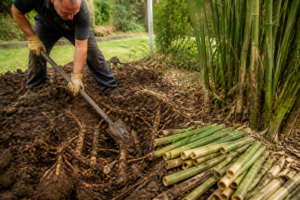
My process was methodical. I started at the outer edge and worked inward, cutting each culm at about knee height first to bring it down, then going back to cut at ground level for removal. This two-cut method reduced the chance of a falling culm landing on me inside the thicket — a real concern with bamboo, which tends to be top-heavy and tangled with neighboring culms.

Between sessions, I checked chain tension, topped up the oil reservoir, and swapped batteries. I ran each battery to depletion once to get a feel for real-world run time. I also wore gloves, safety glasses, and long sleeves every session — bamboo splinters are no joke and neither is a chainsaw, even a small one.

What Actually Happened: Honest Results

Cutting Performance on Bamboo

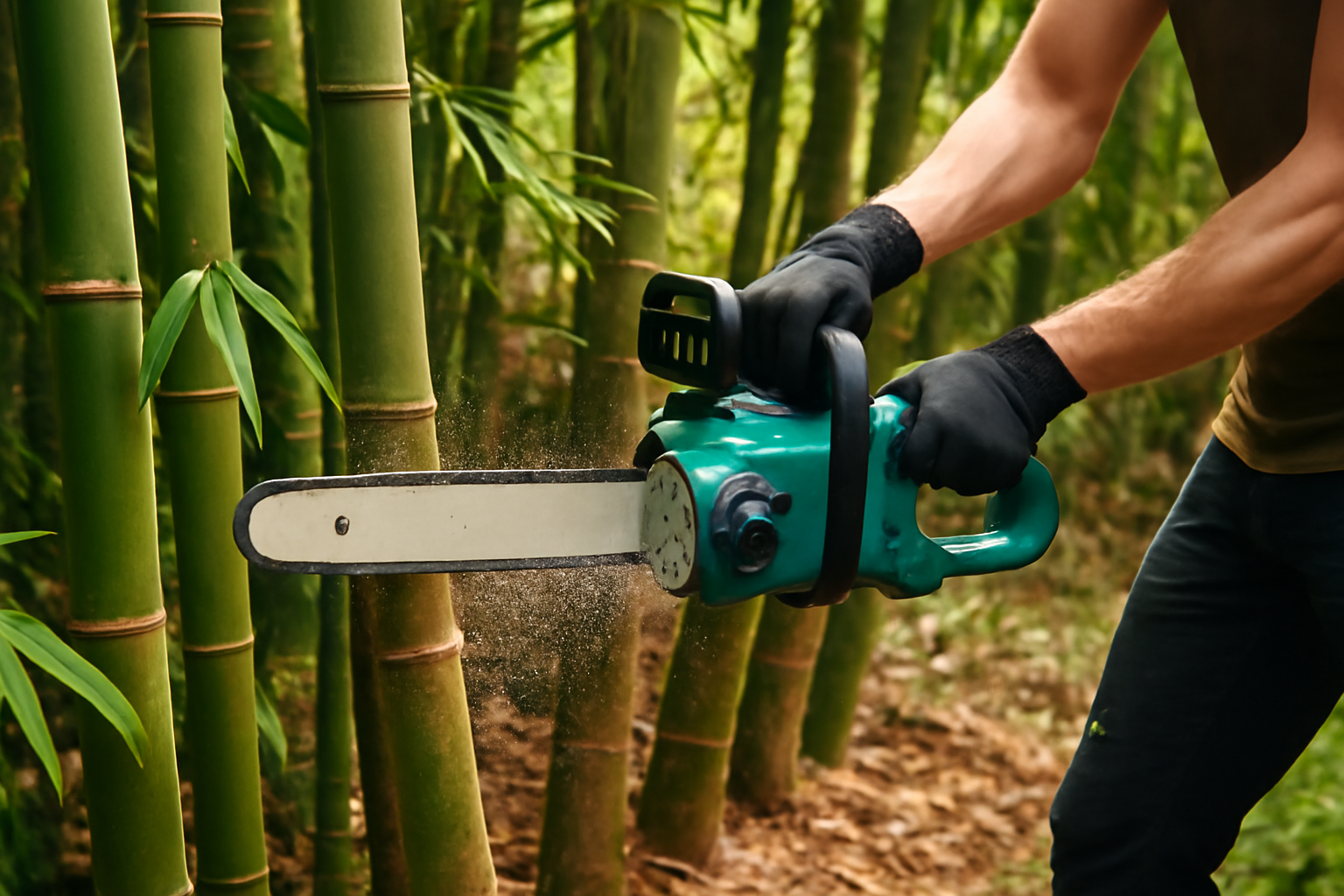
For culms up to about 2 inches in diameter, this thing cut cleanly and quickly. I’m talking two to three seconds per cut on a well-charged battery. The cuts were smooth, not ragged. Bamboo is actually a forgiving material for chainsaw work — it’s fibrous, not dense like hardwood, so the chain moved through it without bogging down on the smaller culms.

On the thicker culms — the ones pushing 2.5 to 3 inches — it still cut through, but noticeably slower. I had to apply light, steady pressure and let the chain do the work. Forcing it caused the motor to labor. Patience made the difference.

Battery Life in Real Conditions

Each battery lasted about 25 to 35 minutes of active cutting. That’s not 25 minutes of continuous use — it’s 25 minutes of real-world intermittent use: cut, reposition, cut again. For a solo session, two batteries gave me roughly an hour of productive work before needing a full recharge. Charging took about 90 minutes per battery.

Honestly, that rhythm worked well. Cut for 30 minutes, take a water break while the battery swaps, cut for another 30. Bamboo clearing is physical work regardless of the tool. Built-in rest breaks weren’t a hardship.

Maneuverability in Tight Spaces

This is where the Seesii Mini Chainsaw, 6-inch Mini Chainsaw Cordless genuinely earned its place. Inside the grove, I could swing the saw into angles my full-size chainsaw couldn’t dream of reaching. I cut culms at ground level by rolling my wrist downward. Cutting at odd angles between tightly spaced shoots was manageable. The short 6-inch bar was exactly what the situation demanded.

One-handed operation was possible for short bursts, though I defaulted to two hands for control and safety. The light weight reduced fatigue significantly over a long session.

The Moment of Doubt

Halfway through weekend two, the chain came loose. Not dangerous — it didn’t fly off — but it derailed and stopped cutting mid-session. My first reaction was frustrated resignation. I thought maybe I’d pushed the tool too hard, or bought into the hype of a cheap product.

Then I re-read the manual. Chain tension on this type of saw loosens as the chain heats up during use. That’s normal, apparently. A quick tension adjustment with the included screwdriver, two minutes of work, and I was back to cutting. It happened one more time over the remaining sessions. After that, I built tension checks into my routine between battery swaps. Problem effectively solved — but worth knowing going in.

The Downsides: What This Saw Does Not Do Well

No tool is perfect, and this one has clear limitations worth understanding before you buy.

  • Chain tension requires monitoring. As noted above, the chain loosens with heat and use. You’ll need to check and adjust it regularly. It’s easy but slightly tedious.
  • Not suitable for heavy hardwood. This is a bamboo and branch trimming tool. Trying to fell a tree of any meaningful diameter would likely overheat the motor or damage the chain quickly.
  • Oil reservoir is small. It holds enough oil for roughly one battery cycle of cutting. Frequent top-ups are necessary, and running it dry will shorten chain life significantly.
  • Limited run time per charge. If you have a massive clearing project, two batteries may feel restrictive. Having a third spare battery on hand would improve workflow.
  • Plastic housing is not rugged. This tool will not survive being dropped repeatedly on concrete. It’s designed for light-duty use, not a professional site environment.

None of these issues are dealbreakers for the intended use case. But going in with clear expectations will save you frustration.

Final Verdict: A Solid Cordless Chainsaw for Cutting Bamboo — With Caveats

If you’re doing this specific kind of work — clearing a bamboo grove, trimming culms at awkward angles, working in tight spaces where a full-size saw is impractical — the Seesii Mini Chainsaw, 6-inch Mini Chainsaw Cordless is a genuinely capable tool for the money. My cordless chainsaw cutting bamboo review comes down to this: it does what it promises, as long as you use it for what it’s designed for.

Buy This If:

  • You’re clearing or managing a bamboo grove of moderate size
  • You need to cut in tight, confined spaces
  • You want a lightweight, one-hand-capable option for branch and culm trimming
  • You’re on a budget and don’t need a professional-grade tool
  • You’re comfortable doing basic maintenance like chain tensioning

Skip This If:

  • You need to cut hardwood trees or logs regularly
  • You want a grab-and-go tool with zero maintenance needs
  • You have a very large project requiring hours of continuous cutting
  • You need something rated for professional or commercial use

By the end of those three weeks, my 40-foot bamboo grove was cleared. My back was sore, but the saw was still running. That’s a reasonable endorsement from someone who had zero brand loyalty going in.

What About the Alternative? CEEPUY Mini Chainsaw

During my research phase, the CEEPUY Mini Chainsaw Cordless, 6 Inch Portable Electric Chainsaw was the closest competitor I seriously considered. It offers a similar 6-inch bar, two batteries, and adds an automatic oiler — which would address one of my main maintenance complaints about the Seesii. Reviews suggest comparable cutting performance on light material.

The automatic oiling system is a meaningful upgrade for people who don’t want to monitor oil levels constantly. If that sounds like you, the CEEPUY is worth a close look. Pricing at the time of writing was similar to the Seesii, so the decision comes down to which feature set matters more to your workflow. Both tools occupy the same category and share similar limitations in terms of run time and power ceiling.

Either way, you’re choosing a light-duty cordless tool built for exactly this kind of job. For bamboo work specifically, both are more practical than a full-size saw. I went with the Seesii first and don’t regret it — but I’d have no hesitation recommending the CEEPUY to someone who wants that automatic oiler convenience from day one.