Key Takeaways
- The best time to divide clumping bamboo is early spring before new shoots emerge or in early autumn
- Each division should contain a minimum of 3–5 healthy culms and be cut at least 12–18 inches from the clump’s center
- Use a sharp mattock and pruning saw to cut through rhizomes cleanly—never attempt to tear divisions apart
- Keep roots moist throughout the division process and replant immediately at the original soil depth
- Post-planting care includes heavy watering, 4–6 inches of mulch, and protection from direct sun for 2–4 weeks
How to Divide Clumping Bamboo: A Complete Guide
Dividing an established clump is one of the questions I am asked about most. One of the most rewarding—and often misunderstood—techniques is learning how to divide clumping bamboo. Unlike running bamboo varieties, clumping species like Fargesia and Bambusa develop compact rhizome systems that respond remarkably well to division. When performed correctly, dividing bamboo plants allows you to create multiple mature specimens from a single parent clump within just one to two growing seasons.
This guide walks you through the exact methods our team uses to divide clumping bamboo successfully, including timing, tools, technique, and aftercare.
When Is the Best Time to Divide Clumping Bamboo?
Timing is critical when dividing your bamboo plants. TerraBamboo’s specialists recommend two optimal windows: early spring (just before new shoot emergence) and early autumn (late August through September in most climates).
Spring division is generally preferred because the parent plant is about to channel resources into new growth. The divided sections can establish roots before summer heat arrives. In temperate zones (USDA zones 6–9), this means mid-March through April. In warmer regions, early February through March works best.
Autumn division works well if you missed the spring window. Early September divisions benefit from cooler temperatures and autumn rains, though the new shoots will emerge more slowly. Avoid dividing in summer heat or late autumn, as transplant shock compounds existing stress.
Why Should You Divide Your Clumping Bamboo?
There are three main reasons growers divide clumping bamboo:
- Clump has outgrown its space: Healthy Fargesia robusta or Bambusa oldhamii can expand 12–18 inches annually. Division prevents the plant from overwhelming neighboring plantings.
- Propagate new plants: Dividing bamboo is the fastest, most reliable method to create genetically identical specimens without waiting years for seed germination.
- Rejuvenate declining vigor: A congested clump with dense rhizomes may slow growth. Division improves air circulation and nutrient availability to each culm (shoot).
What Tools Do You Need to Divide Clumping Bamboo?
Proper tools make dividing clumping bamboo significantly easier and safer. TerraBamboo’s horticulturists recommend:
- Mattock or trenching spade: A sharp, forged steel mattock is essential for breaking through compact soil and rhizome clusters. The curved head allows leverage without excessive force.
- Pruning saw or reciprocating saw: For severing rhizomes cleanly. A handsaw works for smaller divisions; a cordless reciprocating saw accelerates work on large, mature clumps.
- Spade or pry bar: To lift divided sections free once rhizomes are cut through.
- Wheelbarrow and tarp: Transport divisions quickly and keep roots protected from sun and wind.
- Pruning shears: For trimming culms and removing dead material post-division.
The INTERTOOL Small Cutter Mattock with its 1.5 lb forged steel head is ideal for smaller divisions and container-grown specimens. For larger landscape clumps, the NAUKII 36 Inch Pick Mattock provides superior leverage and reach. When it comes to cutting rhizomes, the REXBETI Folding Saw with SK-5 Steel blade delivers reliable performance without requiring electricity.
Step-by-Step Process: How to Divide Clumping Bamboo
Step 1: Prepare the Parent Plant
Water your bamboo clump deeply 2–3 days before division. Moist soil reduces transplant shock and makes rhizomes easier to separate. Thoroughly saturate the root zone so water penetrates 12–15 inches deep.
Step 2: Mark the Division Line
Stand back and identify where you’ll cut. I divide clumping bamboo by cutting at least 12–18 inches from the clump’s center. This distance ensures each division receives adequate rhizomes and culms. Mark the line with chalk or string to maintain accuracy.
Never attempt to divide a clump into more than two or three sections—smaller divisions with fewer than 3 culms are unlikely to establish successfully.
Step 3: Excavate Around the Division
Use your mattock to dig a trench around the marked division line. Work systematically to expose the rhizome system. On mature clumps, rhizomes may extend 18–24 inches deep, so dig accordingly. The Berry&Bird Gardening Pick Axes with wooden handle excels at breaking hardened soil around established clumps.
Step 4: Cut Through the Rhizomes
Once rhizomes are exposed, use a sharp pruning saw to cut cleanly through them. Never attempt to tear or snap rhizomes apart—this damages tissue and invites disease. A clean cut seals quickly and reduces infection risk. The Folding Camping Saw with triple-cut SK5 blade provides the precision needed for clean, efficient cuts through woody rhizome tissue.
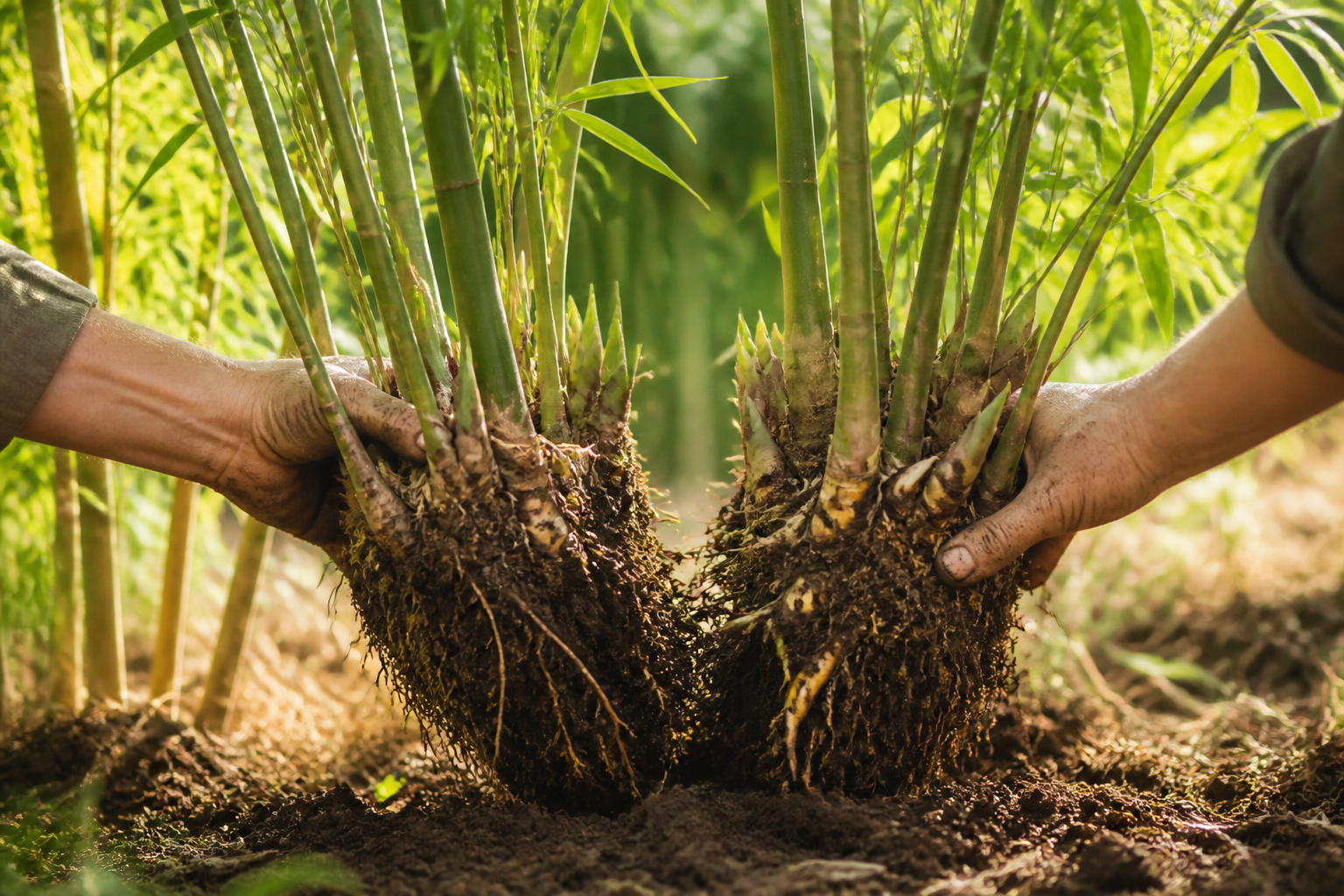
Work methodically around the division’s perimeter. Expect 10–15 rhizomes per division, depending on the species and clump age.
Step 5: Pry the Division Free
With rhizomes severed, use your spade as a fulcrum to lift the division free from the parent clump. On large divisions, work from multiple angles to avoid sudden shifts that could damage culms or expose roots to excessive air.
Step 6: Minimize Root Exposure
This is critical: move the division immediately to moist shade. Keep roots covered with damp burlap or mulch during transport. Even 15–20 minutes of sun exposure can stress tender new roots and reduce establishment success by 20–30%.
How to Handle and Trim the Division
Once separated, prepare the division for replanting. TerraBamboo’s horticulturists follow this protocol for dividing bamboo plants:
- Trim culms by approximately one-third: Removing 30% of the above-ground biomass reduces transpiration while the plant re-establishes roots. Stagger cuts at varying heights to maintain aesthetic form.
- Remove dead or damaged culms: Any culm showing disease, injury, or browning should be pruned at ground level. Dead material invites fungal colonization.
- Maintain minimum culm count: Ensure each division retains at least 3–5 healthy culms. Fewer than three reduces the division’s ability to photosynthesize and establish roots quickly.
- Inspect rhizomes: Wash away soil to check for rot or pest damage. Trim any blackened or mushy rhizome sections with a clean saw.
Replanting and Post-Division Care
Success when dividing clumping bamboo doesn’t end at transplant. The four weeks following division are critical for establishment.
- Replant at original soil depth: Position the division so the rhizome crown sits at or 1–2 inches below the soil surface. Deeper planting may cause rhizome rot; shallower planting risks drought stress.
- Water heavily: Saturate the planting zone immediately after transplanting. Continue deep watering every 2–3 days for the first 3 weeks, then taper to weekly as new growth emerges.
- Apply 4–6 inches of mulch: Use arborist chips or composted bark to maintain soil moisture and moderate temperature fluctuations. Keep mulch 3–4 inches away from culm bases to prevent rot.
- Provide afternoon shade: Screen transplants from direct sun for 2–4 weeks. A 30–50% shade cloth is ideal. Afternoon shade in particular reduces heat stress while morning light aids photosynthesis.
- Hold off on fertilizer: Delay feeding for 4–6 weeks. Young roots are sensitive to salt concentrations. Once new shoots reach 12 inches, apply a balanced, slow-release bamboo fertilizer (NPK 10-5-10 or similar).
The Tool That Finally Let Me Cut Through Mature Rhizomes Without Shattering Them
Dividing an established clump means slicing through thick, woody rhizomes—and a dull or oversized tool will either bounce off or crush the tissue you’re trying to separate cleanly. I learned this the hard way after losing two divisions to ragged cuts that rotted before they could establish.
What works
- The compact head is light enough to control on a delicate cut through the rhizome zone, but the mattock point still bites through 2–3 year old culm bases without requiring a sledgehammer swing.
- The smaller profile fits into tight spaces between culms where a full-size mattock would crush adjacent shoots—crucial when you’re trying to extract a clean division from a dense clump.
- Paired with a folding saw, it lets you score the rhizome first, then make one decisive cut without splintering the fibers, which means faster callus formation and lower rot risk on the new plant.
What doesn’t
- The head can loosen on the handle after heavy use—you’ll need to check and retighten it every few divisions, or the cutting angle gets sloppy.
- It’s not a substitute for a pruning saw on really thick rhizomes; you’ll still need both tools, and the mattock alone won’t cut all the way through on culms over 1.5 inches in diameter.
I almost gave up on this tool after the first division went sideways because I hadn’t secured the head properly—but once I locked it down and used it the way it was designed, it became the fastest part of my division workflow. Grab the INTERTOOL Small Cutter Mattock if you’re dividing clumping bamboo regularly.
About This Article

Written by Marcus Chen. Marcus Chen has spent 15 years cultivating and studying bamboo across 14 different species, combining commercial growing operations with extensive hands-on experience in species selection and containment. As both a grower and consultant, he specializes in practical bamboo management, helping homeowners and landscapers understand the real-world requirements for responsible bamboo cultivation. Marcus brings tested knowledge of which species thrive reliably and which present containment challenges that go beyond standard recommendations. More about this site.
Verify this against a primary source
Specifics change, and your situation may differ from the one described here. These are the authorities worth checking directly:
- American Bamboo Society — species listings and cultivation guidance
- USDA PLANTS Database — species range and identification
- USDA Plant Hardiness Zone Map — cold hardiness verification for your location