For years I bagged up every bamboo leaf that fell in my yard and hauled it to the curb, which I now recognize as a genuinely embarrassing waste of free mulch. Bamboo leaves break down into one of the better organic mulches you can put down, and the culms I thin out every season chip into a coarser layer that suppresses weeds for months — but there is a right way and a wrong way to use both, especially if you are mulching around anything other than more bamboo.
Mulching with bamboo leaves has completely changed how I approach soil amendment in my garden. What started as a lazy gardener’s attempt to avoid yard waste fees turned into a genuine discovery: bamboo is one of the most underutilized mulch sources for home growers. The leaves are nitrogen-rich, decompose at a steady rate, and cost exactly nothing if you’re already maintaining bamboo on your property. The chips from thinned culms add a decorative, long-lasting element that works beautifully in ornamental beds.
The catch is that bamboo mulch behaves differently than wood chips or shredded bark. It’s lighter, breaks down faster in some cases, and requires specific application techniques depending on what you’re growing. I’ve learned this through trial and error — mostly error — and I want to save you the same frustrating learning curve.
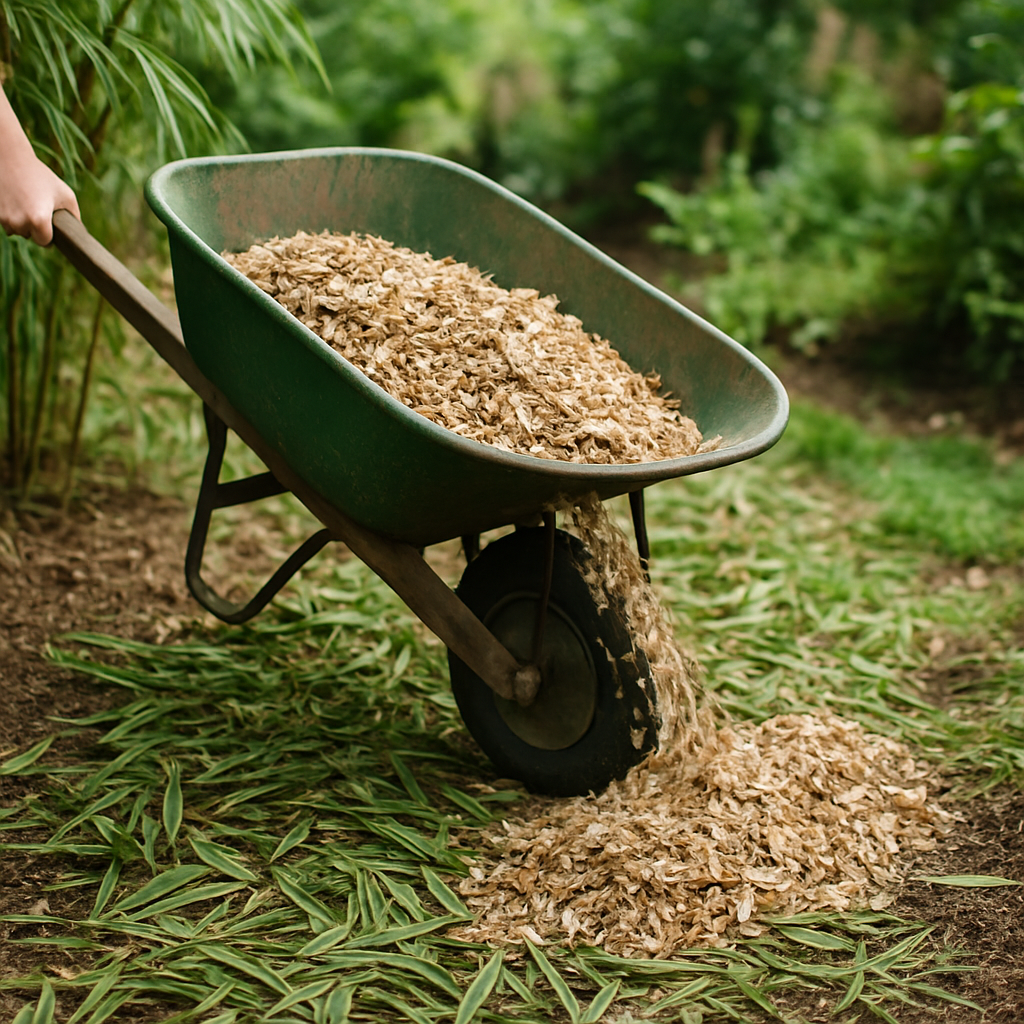
Collecting and Preparing Bamboo Leaves for Mulch
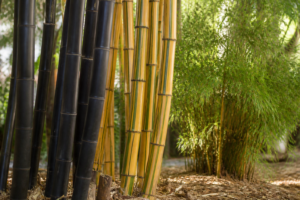
Bamboo leaves drop year-round, but the heaviest drop occurs in spring and early summer, particularly in clumping varieties like Fargesia robusta and Fargesia nitida. Running bamboos like Phyllostachys aurea and Phyllostachys nigra shed more continuously but in smaller volumes. I collect leaves in two ways depending on the season and workload.
During heavy leaf drop season, I use a leaf blower to gather fallen leaves into piles, then transfer them into a large mesh bin or open-sided compost cage. This keeps them contained and allows them to begin breaking down while still in the collection phase. Loose piles left on the ground tend to scatter, especially if you have any wind, and they’ll blow directly into your neighbors’ yards — a mistake I only needed to make once.
For the finer material, I don’t shred the leaves before application, but I do let them rest for 2 to 3 weeks after collection. This slight aging period allows the waxy outer coating of the leaf to soften slightly, which speeds decomposition once it hits the soil. Fresh bamboo leaves have a glossy finish that repels water; aged leaves absorb moisture more readily.
Measure your collected leaves in volume, not weight. A standard kitchen trash can holds about 30 to 40 gallons, which will mulch approximately 20 to 25 square feet at a 2-inch depth — enough for a modest vegetable bed or a border around a small shrub cluster.
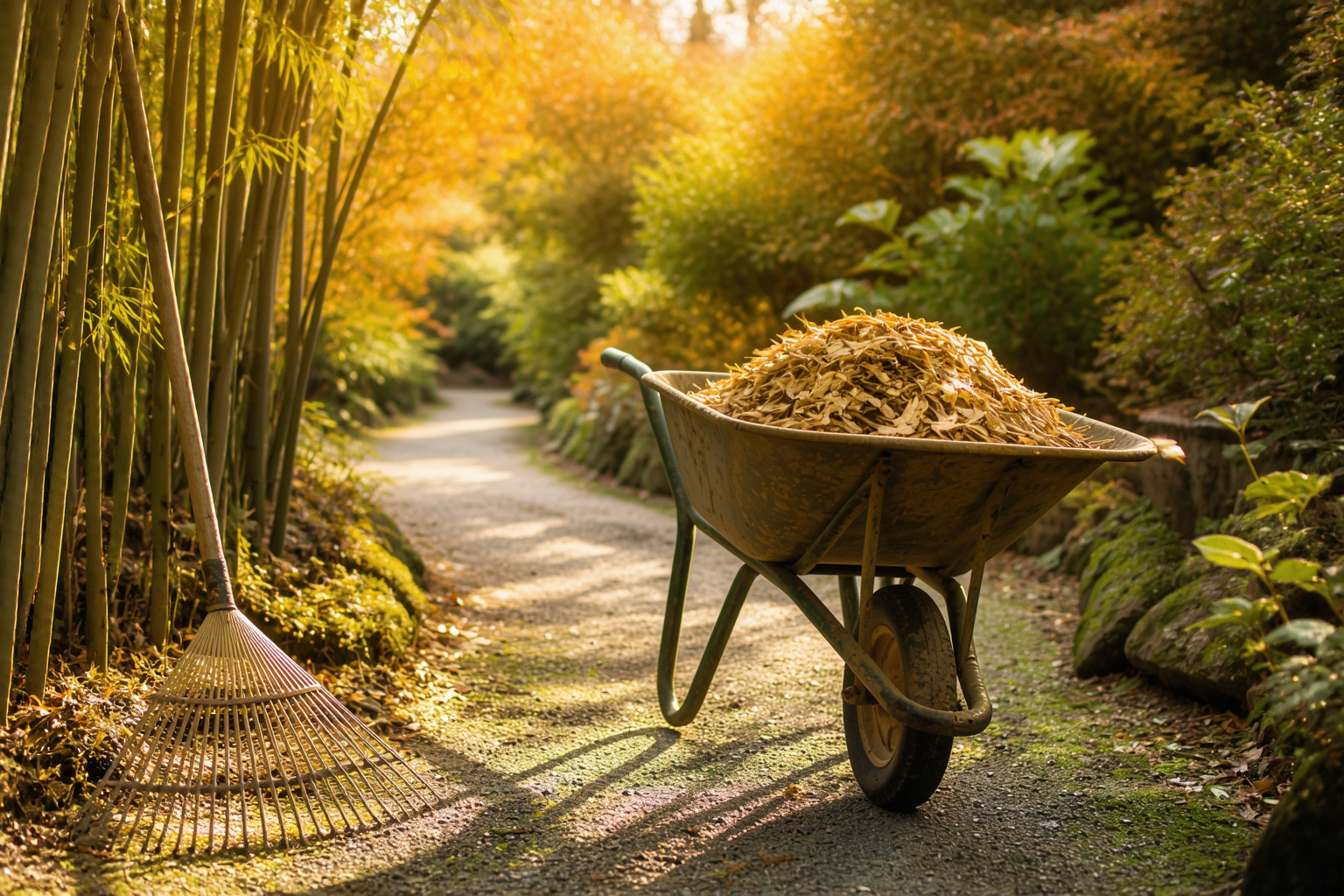
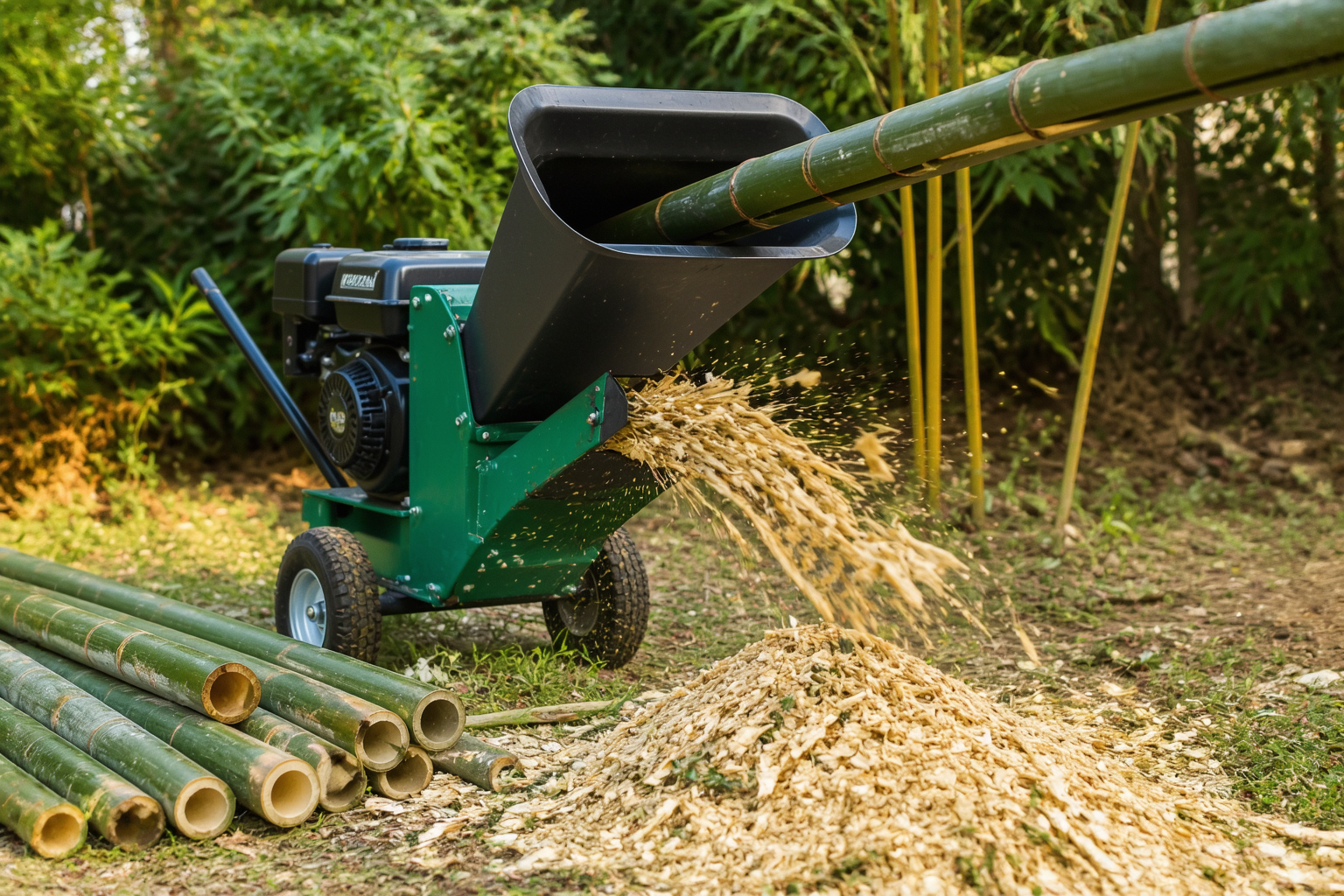
Processing Bamboo Culms Into Chips
Every year when I thin my bamboo stands — a necessary maintenance step to keep them vigorous and prevent overcrowding — I end up with dozens of 1- to 3-year-old culms that are too thick for the compost pile. Chipping these into mulch turns what would otherwise be yard waste into a finished landscape product.
For culm chipping, you need a chipper rated for woody material; a small electric chipper or manual chipper works fine for culm diameters up to 1.5 inches. Larger culms should be split lengthwise first before chipping. I’ve tried feeding whole culms into underpowered chippers, and it’s a frustrating, time-consuming process that strains the equipment. Split them, and the work goes about three times faster.
Here’s the step-by-step process I follow:
- Select culms that are at least one season old and fully hardened (newer culms are still too fibrous and jade-green inside).
- Use a pruning saw or reciprocating saw to cut culms into 12- to 18-inch lengths — shorter pieces chip more readily than long ones.
- For culms over 1 inch in diameter, split them lengthwise using a log splitter, axe, or maul. Aim for quarters or halves.
- Feed prepared pieces through the chipper, working steadily to avoid jamming.
- Collect chips in a tarped area — they scatter easily — and let them cure for 1 to 2 weeks before application.
The resulting chips are slightly coarser than commercial wood chips, with a natural tan to light brown color that looks deliberately chosen, not salvaged. They hold their structure for 12 to 18 months before breaking down, making them ideal for pathways, around shrubs, or under ornamental grasses.
Best Practices for Applying Bamboo Mulch
Application depth and location make a huge difference in how well bamboo mulch performs. I’ve made every mistake in this department, so let me be specific about what works.
Vegetable Gardens and Tender Perennials
In beds where I’m growing vegetables, berries, or moisture-loving perennials, I apply aged bamboo leaves to a depth of 2 to 3 inches. This is where the leaf mulch really shines — it’s light enough not to compact the soil, it breaks down relatively quickly (4 to 6 months), and it adds organic matter that improves soil structure season after season.
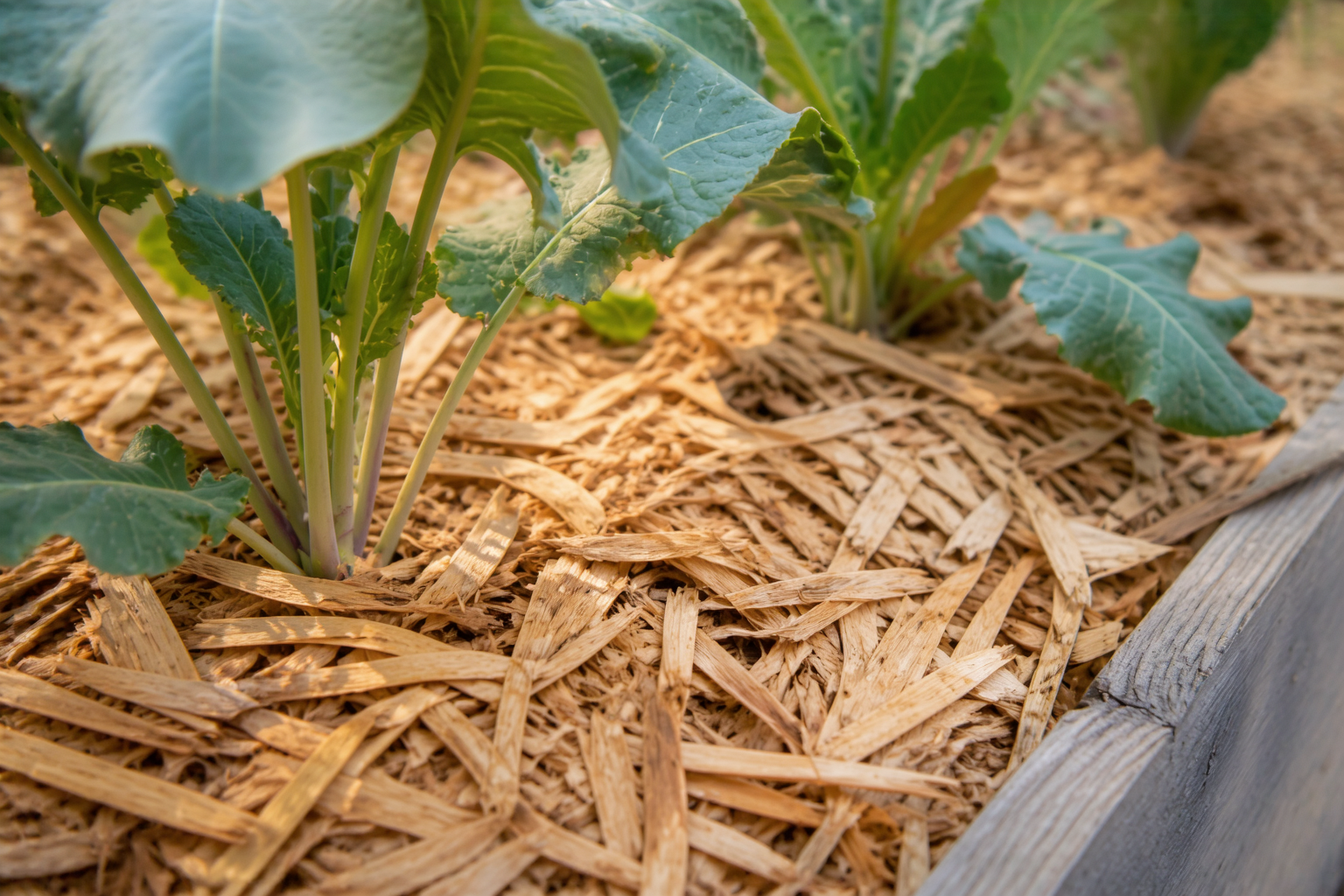
The one crucial rule: keep the mulch 3 to 4 inches away from the stems of young plants and the base of shrubs. I learned this the hard way when bamboo leaf mulch piled directly against young tomato transplants encouraged fungal issues. The leaves retain moisture right at the plant base, creating ideal conditions for Botrytis and other problems. That buffer zone is non-negotiable.
Ornamental Beds, Shrub Borders, and Under Bamboo
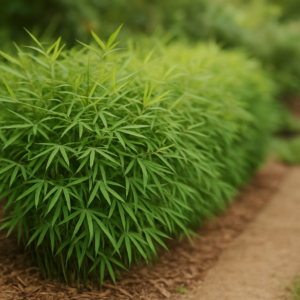
For ornamental plantings, I layer both materials. First, I put down a 2-inch base of aged bamboo leaves, which acts as a soil conditioner and weed suppressor. Then I top it with 1.5 to 2 inches of bamboo culm chips. This combination looks intentional, suppresses weeds effectively for an entire season, and the leaf layer beneath breaks down gradually while feeding the soil.
Interestingly, this same combination works brilliantly under bamboo itself. I mulch around my bamboo plantings this way to retain moisture, regulate soil temperature, and — honestly — to contain the litter naturally. It feels like a complete system rather than an improvisation.
Timing and Seasonal Considerations
Apply bamboo leaf mulch in spring and midsummer when soil moisture is consistent but before peak heat. In hot, dry climates, bamboo leaf mulch can dry out and blow away more easily than heavier materials, so I sometimes add a light straw layer on top in arid regions. In humid climates, applying mulch too heavily in fall can create matting and moisture problems over winter.
Bamboo culm chips can go down anytime you have them — they’re stable enough that seasonal timing is less critical. I refresh chip mulch once a year (spring is best) and add aged leaves between refreshes.
What Not to Do: Common Mistakes I’ve Made
Don’t use fresh bamboo leaves as a primary mulch layer around young plants. The wax coating means water runs right off, and they mat down into an impermeable layer if not aged first. I did this once with lettuce seedlings and created a moisture-blocking barrier that stunted growth for weeks.
Don’t apply bamboo leaf mulch more than 4 inches deep, even in ornamental beds. It compacts under its own weight and can become anaerobic, leading to sour-smelling, moldy mulch. Two to three inches is the ceiling for optimal results.
Don’t chip culms that haven’t fully hardened or that are still green inside. They’ll turn into a slimy, slow-decomposing mass rather than clean chips. Wait until culms are at least one full season old and tan throughout.
Don’t expect bamboo chips to suppress weeds indefinitely the way landscape fabric or heavy wood mulch does. They’re better than nothing, but at 12 to 18 months, they’re already breaking down, and weeds will find their way through if you don’t refresh periodically.
The Real-World Impact on Soil and Plant Health
I’ve been using bamboo mulch in my garden for five seasons now, and the cumulative effect on soil quality has been noticeable. Beds that I’ve mulched consistently with the leaf-and-chip combination have darker, richer soil with noticeably improved structure and water retention. Earthworm activity has increased visibly — more castings, more evidence of tunneling.
Plants in these beds consistently outperform those in unmulched or conventionally mulched areas of the same garden. Vegetables produce more heavily, perennials return stronger each year, and I’ve actually reduced supplemental fertilizing because the decomposing bamboo matter is adding slow-release nutrients steadily.
The financial and environmental math is simple: I’m not buying bagged mulch, I’m not hauling yard waste to the landfill, and I’m improving my soil with materials I already have on hand. That’s a win on every level.
Start Small and Build Your System
If you have bamboo on your property, you already have the raw materials for excellent, free mulch. You don’t need to overhaul your entire garden at once. Pick one bed — a vegetable garden row, an ornamental border, or a shrub area — and commit to collecting and applying bamboo leaves and chips there for one full season.
Pay attention to how the plants respond, how the mulch breaks down, and how your soil improves. By the end of the season, you’ll have your own experience with what works in your specific conditions, and you can scale up from there. I went from those embarrassing trash-bin years to a garden that basically mulches itself, and so can you.
The next time your bamboo drops leaves, don’t bag them. Collect them. Age them slightly. Apply them thoughtfully. Your soil — and your wallet — will thank you.
About This Article

Written by Marcus Chen. Marcus Chen has spent 15 years cultivating and studying bamboo across 14 different species, combining commercial growing operations with extensive hands-on experience in species selection and containment. As both a grower and consultant, he specializes in practical bamboo management, helping homeowners and landscapers understand the real-world requirements for responsible bamboo cultivation. Marcus brings tested knowledge of which species thrive reliably and which present containment challenges that go beyond standard recommendations. More about this site.
Verify this against a primary source
Specifics change, and your situation may differ from the one described here. These are the authorities worth checking directly:
- American Bamboo Society — species listings and cultivation guidance
- USDA PLANTS Database — species range and identification
- USDA Plant Hardiness Zone Map — cold hardiness verification for your location