Most of the bamboo advice I give — and most of the guides on this site — starts from a problem. Someone wants to block a view, or stop a neighbour’s grove from crossing a property line, or find something that survives a zone 6 winter. Those are constraint-first questions, and they have constraint-first answers.
This one is different. Every few weeks someone asks me which bamboo is the prettiest, and what they actually mean is: I want a plant that people stop and look at. That is a completely legitimate reason to grow bamboo, and in fifteen years of growing it commercially it is still the reason I keep a few groves that make me no money at all.
First, the thing nobody says plainly: “ornamental bamboo” is not a botanical category. There is no group of species set aside for decoration. It is a way of choosing — you are selecting for visual character rather than function. And the same species can be spectacular or dull depending entirely on how it is planted. Phyllostachys nigra planted as a solid hedge along a fence line is a green wall you cannot see the black in. The same plant, thinned to twenty culms with the lower branches stripped off and a pale wall behind it, is the best-looking thing in the garden. Species selection is maybe half the job. Placement and pruning are the other half, and I have given the second half its own section below because that is where people lose.
Coloured culms: the plants people actually mean
When someone says they want ornamental bamboo, nine times out of ten they have seen a photograph of coloured culms. This is the group with the highest ceiling and the highest failure rate, because a coloured culm you cannot see is worth nothing.
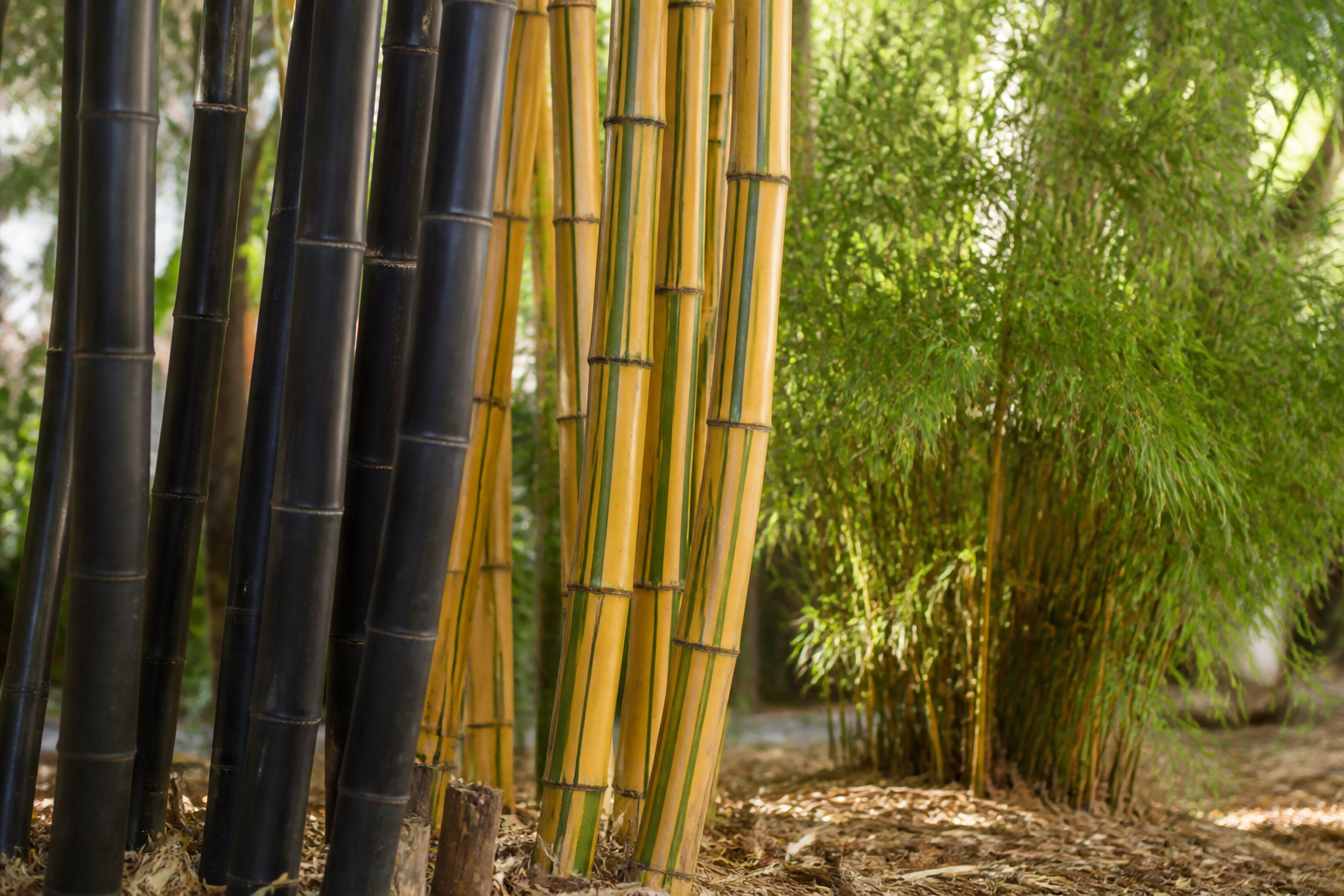
Phyllostachys nigra — black bamboo
Running. Broadly zones 7–10, with some success in warm pockets of zone 6. Height varies enormously with climate and soil — in the Southeast a mature, well-fed grove commonly runs in the twenties to low thirties of feet; in a cooler or drier site, considerably less.
The catch, and it is the single most common disappointment I deal with: new culms emerge green. They darken over the following season or two, sometimes three, and young plants in their first few years often produce thin culms that colour up less convincingly than the mature ones you saw in the photo. People buy a black bamboo, watch it throw green shoots, and assume they were sold the wrong plant. They were not — they were sold a plant that needs patience. I have written more on black bamboo specifically if that is where you are heading.
Phyllostachys aureosulcata ‘Spectabilis’ and ‘Aureocaulis’
Running. These are among the more cold-tolerant of the ornamental Phyllostachys — commonly grown down into zone 5 in sheltered sites, though top-kill of foliage in hard winters is normal at the cold end. Mature height typically in the twenties to low thirties of feet in good conditions, less in cold or poor ground.
‘Spectabilis’ has yellow culms with a green stripe in the groove; ‘Aureocaulis’ is essentially gold, with green striping appearing irregularly. Both are, to my eye, the most reliable colour-per-effort plants in the genus, because the gold shows from the first season rather than developing over years. The species also has a habit of producing occasional zigzagged culm bases near ground level, which some people find charming and some find untidy.
Phyllostachys vivax ‘Aureocaulis’
Running. Roughly zones 6–9. This is the big gold one — golden culms with green striping, on a plant that gets genuinely large in a good site. It is the most dramatic coloured bamboo I grow.
The catch is structural. P. vivax is relatively thin-walled for its diameter, and heavy wet snow or ice will bend and sometimes break culms that a comparable timber species would shrug off. If you get regular snow load, either site it where it has shelter or accept that you will occasionally be cutting out damaged culms.
Bambusa multiplex ‘Alphonse Karr’
Clumping. Warm zones — reliably around zone 8b and warmer, with damage likely in colder sites. Height typically in the mid-teens to mid-twenties of feet depending on how you manage it.
Yellow culms with fine green pinstripes, often flushed pink or red on new growth in sun. For anyone in the warm South this is the low-risk ornamental colour option, because it clumps and does not require a barrier. The catch is that it branches low and densely, so it needs deliberate cleaning up to show the culms at all — see below.
Variegated foliage: colour at eye level and below
Variegated bamboos work differently from coloured culms. The interest is in the leaf mass, which means they read from further away, in shade, and at low level — useful under trees, along paths, and in places where a tall culm feature would be wrong.
Pleioblastus variegatus (dwarf white-stripe bamboo) is running but small — typically knee-height to waist-height. Zones roughly 6–9. Its leaves are strongly striped cream-white, and the crucial management point is that the colour is best on new growth. Cut or mow the whole planting to a few inches in late winter or early spring and it comes back fresh and bright; leave it alone for three years and it becomes a scruffy, brown-flecked mat. Treat it as a perennial you shear, not a shrub.
Sasa veitchii is the odd one. Running, low, broad-leaved, hardy through much of zone 6. It is plain green through summer, and then in autumn the leaf margins wither to a pale buff while the centres stay green, giving a variegated effect that lasts all winter. It is the only bamboo I grow specifically for what it does when it starts to die back. The catch: it spreads determinedly at ground level and it looks tired in late summer heat, so give it shade and edges you can defend.
Hibanobambusa tranquillans ‘Shiroshima’ is a hybrid with unusually large leaves boldly striped in cream. Running, generally reliable in zone 6–7 and warmer, mature height usually somewhere in the eight-to-twelve foot range in my experience, though I have seen it stay shorter in dry shade. It is the best variegated bamboo I know for a shaded corner where you want brightness. Catch: the variegation is strongest in part shade and can bleach or scorch in full afternoon sun in hot climates.
Dramatic form and scale: bamboo as architecture
This group is not about colour at all. It is about the culm as a structural line.
Phyllostachys vivax and Phyllostachys bambusoides are the timber bamboos most people can actually grow — running, large-culmed, and capable of a grove that feels like a colonnade. P. vivax is the hardier and faster of the two, generally good from about zone 6; P. bambusoides wants zone 7 and warmer and is slower to reach size, but produces exceptionally straight, heavy culms once established. Both need space, water and feeding to do what you bought them for, and both need containment.
Semiarundinaria fastuosa (temple bamboo) is running, generally hardy in zone 6–7 and warmer, and grows as a narrow, strictly vertical column rather than a spreading mass. It is the most formal-looking bamboo I grow — good against architecture, good in a row flanking a door or gate. The catch is that its formality is also its limit: it does not do the loose, romantic thing at all.
Chusquea culeou is clumping, from the South American Andes, and has solid culms rather than hollow ones with dense whorls of short branches at each node — the texture is completely unlike any Asian bamboo, more bottlebrush than cane. It is a genuinely special specimen plant. My honest catch: it wants cool summers and dislikes prolonged heat and humidity. It is superb in the Pacific Northwest and in Britain; here in the Southeast I have never had one thrive, and I have stopped trying.
Fine texture and movement
If what you like about bamboo is the sound and the motion — the whole plant flexing in wind — you want fine leaves on arching culms, and that means Fargesia.
Fargesia rufa, F. robusta and F. nitida are all clumping, all shade-tolerant, all fine-leaved, and all cold-hardy well beyond most Phyllostachys — F. nitida in particular is one of the hardier bamboos in cultivation. Heights generally run from around head height to the mid-teens of feet depending on species and site. F. rufa is compact and forgiving; F. robusta is stiffer and more upright with conspicuous pale culm sheaths; F. nitida has the finest, most delicate leaf and dark culms, and arches beautifully when mature.
The catch is heat. Fargesia are mountain plants and they resent hot, humid summers. In the upper South and northward they are excellent. Where I am, they need real shade, consistent moisture, and even then they underperform. Do not buy one on the strength of a photograph taken in Scotland.
Otatea acuminata subsp. aztecorum (Mexican weeping bamboo) is the warm-climate equivalent — clumping, very fine-leaved, with slender culms that arch outward into a fountain. Zone 9 and warmer, or a large container that comes under cover. It is drought-tolerant once established and is the most graceful bamboo I have grown. Catch: it is genuinely tender, and one bad freeze ends it.
Small and container-scale
Pleioblastus pygmaeus is a very low running dwarf, usually ankle-to-knee height, useful as a mown groundcover or edging in zones 6 and warmer — but understand that it runs, and in open ground it will keep going. In a raised bed or a broad shallow container it is excellent.
Sasaella masamuneana ‘Albostriata’ gives you white-striped leaves on a knee-to-waist-high running plant, again best kept in a container or a hard-edged bed.
For a pot you actually want to keep for years, the compact Fargesia are the better bet in cool and temperate climates because they clump and will not spiral the pot with runners. Any bamboo in a container needs more water than you think, needs winter root protection in cold zones because the roots are far more exposed than in ground, and will need dividing every few years when it becomes rootbound.
Placement and pruning: where most ornamental plantings fail
Legging up the culms
This is the single biggest difference between a bamboo that reads as a feature and one that reads as a hedge, and almost nobody does it.
Left alone, most bamboos branch from low on the culm and fill in until you are looking at a wall of leaf. To turn that into a specimen, do two things. First, remove the lower branches — cut them flush at the node with hand pruners, working up from the ground to whatever height suits the plant and the viewing distance. On a tall Phyllostachys I typically clear the bottom third to half. Second, thin the culms: cut out the thin, crooked, and older ones at ground level so the survivors have air between them. A grove you can see through and walk into is a garden feature. A thicket is a boundary.
Do this on established plants, not new ones — a young plant needs its foliage to build the rhizome mass that produces the big culms you want. I usually leave a new planting alone for two to three years, then start thinning. Late winter is my preferred time, before new shoots emerge.
Backlighting
Black culms, gold culms and fine-leaved Fargesia all look twice as good with light behind them or raking across them low. Gold culms glow; black culms turn into hard silhouettes with a rim of light; fine foliage becomes translucent. Practically, that means siting a feature bamboo where you view it towards the morning or evening sun rather than with the sun behind you. If you have a choice of two spots, choose the one you will be looking at from indoors at the end of the day.
Contrast
Black bamboo against dark evergreens disappears. Put it against a pale rendered wall, a light fence, or open sky and it becomes graphic. Gold culms do the opposite — they need something dark behind them, a yew or holly hedge or a shaded recess, or the colour flattens out. Variegated foliage needs plain green neighbours, not more variegation.
Scale discipline
A timber bamboo in a small garden is usually a mistake, and not for the reason people expect. It is not that it is too big to fit — it is that you stand too close to see it. The form of a large grove only reads from a distance of several times its height. At five feet away you see three culms and a lot of leaf litter. If your longest sightline is thirty feet, plant something in the fifteen-foot range and leg it up, and you will get more visual value than a forty-foot bamboo would ever give you.
Winter
Ornamental value in winter is where these species separate. Coloured culms are at their best in winter, once you have legged them up — that is the season the stems do the work. Semiarundinaria fastuosa holds its form well. Sasa veitchii is deliberately at its most interesting in winter. Fargesia generally hold foliage but will curl their leaves tightly in cold and wind, which looks alarming and is normal. The ones that look tatty are the low variegated Pleioblastus and Sasaella after a hard winter, and any bamboo at the cold edge of its range after a bad freeze — expect browned foliage that needs cutting back in spring. In cold zones, plan the winter picture around culms, not leaves.
Containment: choosing for looks does not exempt you
Notice how many of the best-looking species above are Phyllostachys. All of them run. So do Semiarundinaria, Pleioblastus, Sasa, Sasaella and Hibanobambusa. Buying one as a specimen rather than a screen changes nothing about the rhizomes.
If you plant a running species in open ground, install containment at planting time. I will not rehash it here — the detail is in the guide to installing a root barrier. What I will say is that retrofitting a barrier around an established grove is several times the work of doing it at planting, and I have paid for that lesson myself.
The low-risk route is the clumpers. Fargesia for cool and temperate zones, roughly 5 through 8 depending on species, with shade required at the warm end. Bambusa multiplex cultivars for zone 8b and warmer. Chusquea culeou for cool-summer climates in roughly zones 7–9. Otatea for zone 9 and warmer or a movable container. If you are not sure what you are looking at, check whether a species clumps or runs before you buy, and if containment is a dealbreaker start with the clumping varieties that stay put. For anyone in a marginal winter climate, cross-reference against cold-hardy species by zone before falling in love with a photograph.
What I would buy for a first ornamental planting
- Zones 5–7, any garden size: Phyllostachys aureosulcata ‘Spectabilis’. Colour from year one, genuinely hardy, moderate size, and forgiving of imperfect soil. Put a barrier in, plant it against something dark, and leg it up in year three.
- Zones 5–8, small or shaded garden, no barrier wanted: Fargesia rufa or F. robusta. Clumping, well-behaved, beautiful in motion, and it will not put you in a dispute with a neighbour. Give it shade and water in the warmer part of that range.
- Zone 8b and warmer: Bambusa multiplex ‘Alphonse Karr’. Striped culms, clumping, and the single best colour-to-risk ratio available in the warm South. Budget an hour a year for stripping low branches.
What I would not start with: a timber bamboo in a small garden, for the scale reasons above; Chusquea culeou anywhere with hot humid summers, however much you want one; Otatea outside zone 9 unless you are committed to moving a heavy pot twice a year; and — the most common one — black bamboo bought by someone who wants black culms this season. Buy the black bamboo if you like the plant and can wait. If you cannot wait, buy the gold.
Frequently Asked Questions
What is the most ornamental bamboo?
There is no single answer, because it depends on what you want the plant to do visually and what your climate allows. If I had to name one plant that reliably stops people in their tracks, it is Phyllostachys nigra once the culms have blackened and the lower branches have been stripped off. For pure drama at scale, Phyllostachys vivax ‘Aureocaulis’. For grace and movement, a mature Fargesia nitida. All three are only spectacular when they are placed and pruned to be seen.
Are ornamental bamboos invasive?
Some are, and several of the most ornamental ones are among the more vigorous spreaders. Everything in the genus Phyllostachys runs, as do Sasa, Sasaella, Pleioblastus, Semiarundinaria and Hibanobambusa. Running does not mean unmanageable, but it does mean you need a barrier or an annual rhizome-pruning routine, installed at planting time. If you want none of that, choose a clumping genus — Fargesia, Bambusa, Chusquea or Otatea — matched to your zone.
How long before black bamboo actually turns black?
Individual culms emerge green and darken over the following season or two, sometimes three, usually starting with mottling and blotches before going fully dark. Sun exposure influences it — plants in more light generally colour faster and darker. On top of that, a young plant produces thin culms for its first few years, and those tend to be less impressive than the thicker mature ones. Realistically, plan on three to five years from a nursery plant before the grove looks like the photographs.
Can I grow an ornamental bamboo permanently in a pot?
Yes, with maintenance. Use the largest container you can handle, water far more than you would a shrub — potted bamboo dries out fast and browns off quickly when it does — and divide or root-prune every few years when it becomes rootbound. In cold zones the roots need protection because a pot offers nothing like the insulation of open ground. Clumping species and the true dwarfs are the best candidates; a large running Phyllostachys in a pot will be a struggle rather than a feature.
Should I prune an ornamental bamboo, and when?
Yes — this is what separates a specimen from a hedge. Once a plant is well established, usually after two or three years, remove the lower branches flush at the node and thin out weak, crooked and old culms at ground level so light and space get in between the stems. I do this in late winter before shooting starts. Do not do it to a young plant; it needs the leaf area to build the rhizome mass that produces bigger culms later.
About This Article

Written by Marcus Chen. Marcus Chen has spent 15 years cultivating and studying bamboo across 14 different species, combining commercial growing operations with extensive hands-on experience in species selection and containment. As both a grower and consultant, he specializes in practical bamboo management, helping homeowners and landscapers understand the real-world requirements for responsible bamboo cultivation. Marcus brings tested knowledge of which species thrive reliably and which present containment challenges that go beyond standard recommendations. More about this site.
Verify this against a primary source
Specifics change, and your situation may differ from the one described here. These are the authorities worth checking directly:
- American Bamboo Society — species listings and cultivation guidance
- USDA PLANTS Database — species range and identification
- USDA Plant Hardiness Zone Map — cold hardiness verification for your location