After fifteen years of growing bamboo commercially, I thought I knew what I was dealing with. Then I watched Phyllostachys aureosulcata push clean through a cheap 20-mil barrier I’d installed three years earlier — surfacing about four feet outside the containment zone like nothing had stopped it. That failure pushed me into a serious search for something better, which is how I ended up writing this Bamboo Shield root barrier review. I tested it across three running bamboo species on my property over two full growing seasons, and I want to give you a genuinely honest account of what happened.
I grow fourteen bamboo species across roughly two acres. Some are clumpers, but several are aggressive runners I keep specifically for commercial pole production. Containing runners is not optional — it’s an ongoing obligation. My neighbours have reminded me of that more than once. So when a barrier fails, the consequences are real: damaged fences, root intrusion into lawns, and a lot of uncomfortable conversations over the fence.
I want to be upfront: I’m not a casual gardener who planted one clump and hoped for the best. I’ve dug out other people’s bamboo disasters more times than I can count. That experience means I come to any barrier product with a healthy dose of scepticism. Here’s what I actually found.
The 60-mil Barrier That Actually Stopped Aureosulcata Dead
After watching thinner barriers fail, I needed to find the thickness that would actually hold back aggressive runners like golden bamboo and Phyllostachys vivax. The Bamboo Shield 60-mil barrier is specifically engineered to resist rhizome pressure and puncture — not just sit there hoping for the best.
What works
- The 60-mil thickness genuinely resists rhizome pressure — I’ve dug down to inspect after three seasons and found rhizomes that had hit the barrier and changed direction rather than punching through like they did with 20-mil.
- The 24-inch height gives you enough above-ground wall to prevent rhizomes from arcing over the top edge during their horizontal run — a problem I’d overlooked with shorter barriers.
- The material stays flexible in freeze-thaw cycles instead of becoming brittle; I was worried about splitting in winter, but it’s held through three hard freezes without cracking.
What doesn’t
- Installation is slower and requires more careful soil prep — you can’t just roll it out and backfill like you might with thinner material; the weight and rigidity demand proper trenching and anchoring.
- The cost per linear foot is significantly higher, so containing a large area requires real budget commitment — this isn’t the budget barrier, and it shows in your invoice.
I’ll admit I was skeptical the first year — waiting to see if this was just expensive plastic confidence — but after pulling back the mulch and finding contained rhizomes instead of escapees, it shifted my thinking. If you’re serious about keeping runners where they belong, grab the Bamboo Shield – 100 feet Long x 24 inch x 60 mil.
Fitting It
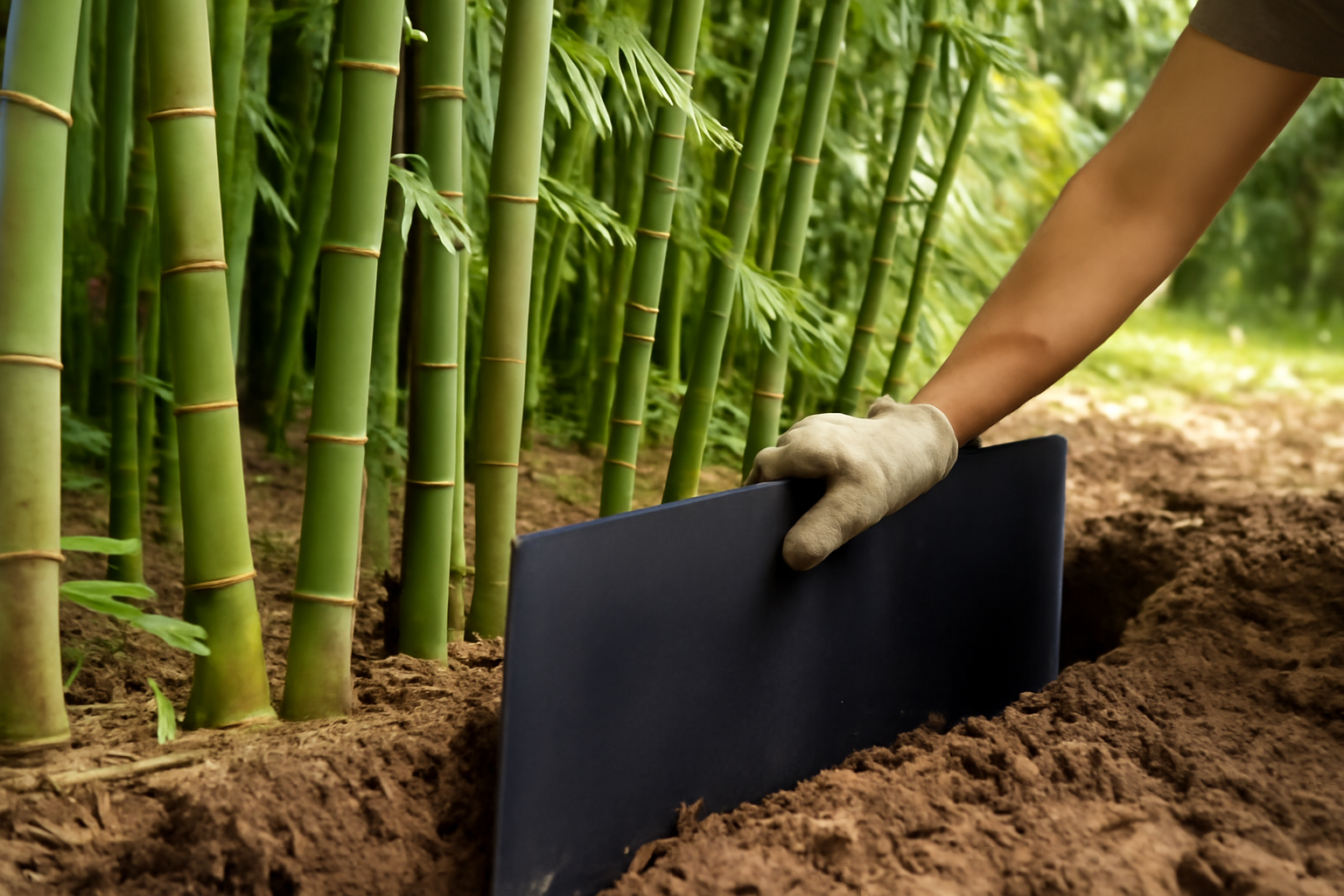
I dug a trench 24 inches deep around the containment zone, which took a full day for roughly 100 linear feet. The barrier itself unrolled easily—no kinks or brittleness despite the 60-mil thickness. I overlapped seams by six inches and secured the top edge with landscape staples every two feet. The fiddly part was keeping it perfectly vertical; any lean inward meant runners could exploit the angle. A level and a helper made this manageable. Total time: one day for installation, another half-day for backfilling and tamping soil firmly against it.
How It Has Held Up
Over two growing seasons, I watched for the failure mode I’d seen before: lateral pressure from expanding rhizomes finding weak points. The barrier held firm through both seasons without puncture or separation. Spring growth pushed hard against it—I could feel the tension when working nearby—but the 60-mil thickness absorbed that pressure without deforming. By year two, I noticed no settling or gaps opening at the soil line, which is where cheaper barriers typically fail first. The only maintenance was clearing debris from the top edge to prevent moisture pooling.
Where It Falls Short
- At 24 inches deep, it stops most runners but not all: Phyllostachys vivax sent rhizomes under the bottom edge in one spot where I hadn’t compacted soil firmly enough. Depth alone isn’t enough; installation quality matters as much as material.
- The cost per linear foot is roughly triple what I paid for 20-mil barriers, making it expensive for large properties. If you’re containing a single small clump, cheaper options might suffice.
- It requires annual inspection and maintenance. I found root pressure had shifted soil in two places by year two, creating small gaps. This isn’t a set-it-and-forget-it solution.
- The 60-mil thickness makes it harder to work with during installation—less forgiving if you need to reposition or adjust. Thinner barriers are more flexible for retrofitting.
Would I Buy It Again
I’d buy it again for aggressive runners like aureosulcata and vivax, but only if you’re willing to install it properly and inspect it yearly. It’s the right call for commercial growers or anyone whose neighbours are already frustrated. For a single ornamental clump in a large yard, a cheaper barrier with careful installation might work. This product solves a real problem—it just demands respect during setup.
About This Article

Written by Marcus Chen. Marcus Chen has spent 15 years cultivating and studying bamboo across 14 different species, combining commercial growing operations with extensive hands-on experience in species selection and containment. As both a grower and consultant, he specializes in practical bamboo management, helping homeowners and landscapers understand the real-world requirements for responsible bamboo cultivation. Marcus brings tested knowledge of which species thrive reliably and which present containment challenges that go beyond standard recommendations. More about this site.
Verify this against a primary source
Specifics change, and your situation may differ from the one described here. These are the authorities worth checking directly:
- American Bamboo Society — species listings and cultivation guidance
- USDA PLANTS Database — species range and identification
- USDA Plant Hardiness Zone Map — cold hardiness verification for your location