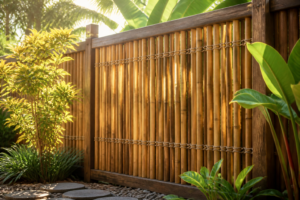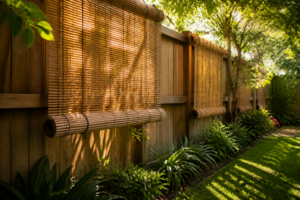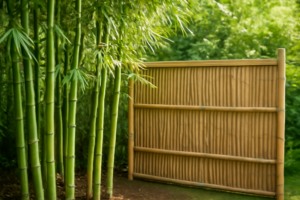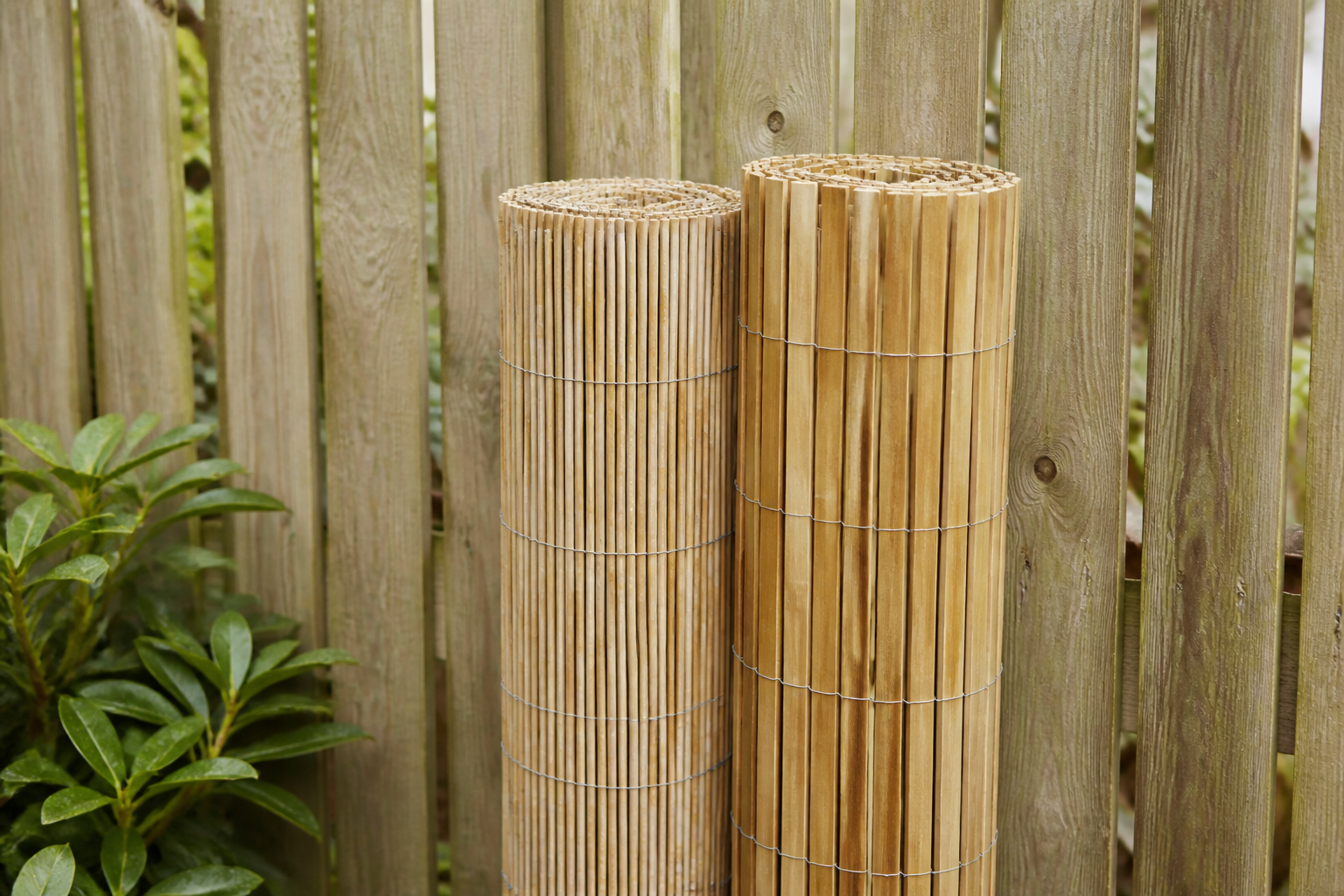
If you are standing in the fencing aisle holding two rolls that look broadly similar, here is the difference. Reed screening is made from bundled stems of water reed — Phragmites or a similar wetland grass — each stem thin, usually well under a centimetre across, wired together into a dense mat. It is cheap, light, flexible enough to roll tight, and it hides almost everything behind it the moment you put it up. Bamboo screening is made from bamboo culms: either split lengthwise into flat staves or left whole as small-diameter poles. The pieces are considerably thicker and stiffer, wired together at intervals rather than packed solid. It is heavier, more rigid, and it costs more.
One thing to sort out before you compare anything else: “bamboo screening” is two different products sold under one name. Split-cane rolls are made from canes sliced into flat sections, which makes a cheaper, lighter, thinner roll. Whole-cane rolls use intact small poles, and they are meaningfully more durable and meaningfully more expensive. If you are comparing the cheapest bamboo roll on the shelf against reed, you are almost certainly holding split cane, and you are not comparing like with like. A whole-cane bamboo roll and a reed roll are different classes of product. A split-cane roll and a reed roll are much closer competitors than the label suggests.
I have used both on my own growing operations — reed for temporary windbreak and nursery screening, bamboo for the boundaries I actually wanted to look at. What follows is how they differ on the things that decide the purchase.
Privacy and opacity: reed wins outright
Reed is denser. The stems are packed tight against each other, so from day one you get near-total concealment. If your only requirement is that the neighbours cannot see into the patio by Saturday, reed is the better buy and it is not close.
Bamboo has visible gaps. Whole-cane rolls in particular have a small gap between each round cane, because round things do not sit flush against each other. In bright backlight you will see slivers of what is behind. Split cane sits flatter and closes up more, but still not to the degree reed does. Most people find bamboo’s level of screening perfectly adequate — you get the sense of enclosure without total blackout — but if you want absolute opacity, reed does it and bamboo does not.
There is a wrinkle here. Reed thins as it ages. Stems break, shed and fall out, and the mat becomes patchy in a way that looks worse than bamboo’s even gaps. So reed wins on day-one opacity and can lose on year-three opacity.
How each one fails
This matters more than any lifespan number, because it tells you what you will be looking at.
Reed goes brittle. The stems are hollow and thin-walled, they lose flexibility under UV, and then they snap. You get a gradual thinning: a few stems break near the wire, the wire loosens where it no longer has anything to grip, and the panel starts shedding from the edges and the bottom. Once it starts, it accelerates, because every gap lets more light and wind into the mat. Reed rarely fails dramatically. It just gets scruffy and then gets scruffier.
Bamboo greys. All bamboo left outdoors loses its colour and goes silver-grey — that is not damage, it is the surface layer weathering, and plenty of people like the look. The real failure mode for split cane is that the splits keep going: a stave that was cut in half develops a hairline crack, the crack runs, and eventually the piece is loose enough to slip out from under the binding wire. That is what unravelling looks like. Whole-cane rolls are far more resistant to this because an intact culm is a tube, and a tube is much stronger than a curved strip.
Both materials also mould and rot, and I have given that its own section below, because it is the single most common reason either product dies early.
Lifespan, honestly
I am not going to give you a table of years, because the honest answer is that exposure decides it. The same roll of bamboo screening on a shaded north-facing fence in a mild climate and on a west-facing fence in full southeastern sun with afternoon storms will not last remotely the same length of time. I have seen screening in a sheltered courtyard still perfectly serviceable when an identical roll on an open boundary a hundred metres away had already been binned.
What I can give you is the ordering, and it is consistent: whole-cane bamboo lasts longest, split-cane bamboo is in the middle, reed is shortest. Treat reed as a short-to-medium-term product. Treat split cane as a medium-term product. Treat whole cane as the one worth maintaining. I wrote up how long bamboo fencing lasted for me in real conditions rather than in a catalogue, and the short version is that the fixing and the drainage mattered more than the product.
Wind: the thing most people ignore
Reed’s density is a liability in an exposed spot. A solid mat is a sail. Wind does not pass through it, so all of the load goes into the fixings, and reed’s own structure is too weak to distribute that load — the wire pulls through the stems, the stems tear, and you get a flapping section that then rips further with every gust. Reed failing in wind usually starts at a fixing point.
Bamboo is stiffer, so it resists the flapping better and holds its shape. But it is heavier, and a heavy panel swinging on a few ties puts real strain on the fence behind it. Whole-cane bamboo on a marginal fence in a windy garden is how fence posts snap.
If you are on an exposed site, neither product is a great answer, and the correct move is to fix whatever you buy at much closer intervals than the instructions suggest and to make sure the fence behind it is genuinely sound.
Appearance and ageing
New reed is a soft, uniform straw colour and reads as a texture rather than as individual pieces — quite Mediterranean, quite subtle. It fades toward grey and then toward a patchy, dusty grey-brown as stems break. It does not age gracefully.
New bamboo is warmer, more golden, and clearly reads as canes. As it silvers it goes to a fairly even driftwood grey, which most people find acceptable and some prefer. Whole cane in particular ages into something that looks deliberate rather than tired. If the screening is going somewhere you actually sit and look at, bamboo is the better-looking long-term option.
Cost, weight and fitting
Prices move around too much by region and season for me to quote figures, but the ordering is reliable: reed is cheapest, split-cane bamboo is next, whole-cane bamboo is the most expensive, sometimes by a wide margin.
Weight follows the same order in reverse. Reed rolls are genuinely light — one person can carry and hang a roll without much difficulty. Whole-cane bamboo is heavy enough that you want a second pair of hands and that you should think hard about what the fence is carrying. This is the part people underestimate: a tired timber panel fence that is already leaning will not enjoy having a heavy roll of bamboo bolted to it.
For cutting, reed is easier. It cuts with secateurs or heavy shears, and you can trim it to an awkward height without much thought. Bamboo needs a saw for whole cane, and cutting across the roll means you are also cutting the binding wire, so you need to re-secure the cut end or it will start to come apart. Split cane sits in between. Reed is also more forgiving around curves and corners because it is more flexible.
Rot at the ground line — read this bit
If either product fails early, this is usually why. Both reed and bamboo are hollow-stemmed grasses. Both wick water. If the bottom edge of the roll sits on soil, mulch, gravel or anything else that stays damp, water moves up into the stems and stays there, and you get mould, then softening, then collapse — from the bottom edge upward, while the top three-quarters of the panel still looks fine.
I have pulled down screening that was pristine at eye level and black mush at the ankles. Keep the bottom edge clear of the ground. Even a couple of inches of air gap makes a substantial difference, and a gap you can see daylight through is better than one you cannot. If you need the screening to reach the ground visually, it is better to build up the ground level with a gravel strip and still leave the material hanging clear than to let it rest on soil.
What actually determines lifespan
Material matters less than installation. Every roll I have seen last well was fitted properly, and every early failure I have seen had at least two of the following problems.
- Bottom edge off the ground. Covered above. This is the big one.
- Fix at closer intervals than you think you need. The failure is always at the fixings, so more fixings means less load per fixing. On an exposed site, halve whatever spacing you had in mind.
- Do not rely on the wire it ships with. That wire is for holding the roll together in transit and on the shelf, not for structural fixing to a fence. Use UV-stable cable ties or proper fixings. Cheap ties go brittle in a season and fail all at once.
- Support the top edge along its full length. A top edge that is only held in a few places will flap, and flapping tears reed and unzips split cane.
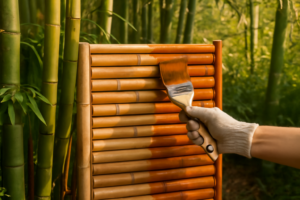
- Treat it. An exterior UV-protective product slows the fading and, more importantly, slows the embrittlement that leads to shedding and splitting. This is the one bit of maintenance with an obvious payoff — here is the exterior stain I use to slow UV damage.
If you want the full method, I have written up how to attach screening to an existing fence with the fixing spacings and the mistakes I made getting there.
Neither one is structure
This needs saying plainly. Reed and bamboo screening are cladding. They add zero strength to the fence behind them. They add load, wind area and weight, and they add all of that to a structure you have already decided is not good enough to look at.
If your fence is leaning, if the posts move when you push them, if the rails are soft — fix that first. Hanging screening on a weak fence is a reliable way to finish the fence off, usually in the first real storm, and then you are replacing the fence and the screening. If what you actually want is a bamboo boundary that stands on its own, that is a different product entirely, and I have compared bamboo fence versus bamboo screen separately.
Which should you buy?
Short-term, rental, or maximum concealment for the least money
Reed. It is cheap, it hides everything immediately, it is light enough to hang alone, and if you are moving in two years its shorter lifespan is irrelevant. Do not spend more than you have to on something you are leaving behind.
A sheltered spot where you care how it looks
Whole-cane bamboo. Shelter removes the main thing that kills screening, so you get the long life the material is capable of, and it ages into a colour worth living with. This is the case where paying more clearly pays back.
An exposed, windy site
Bamboo over reed, because reed’s density makes it a sail and reed’s structure cannot take the resulting load. But be honest about whether the fence can carry it, and fix at close intervals with good ties. If the fence is marginal, screening of any kind is the wrong answer and you should be looking at a proper fence or a planted windbreak.
A boundary that must last several years
Whole-cane bamboo, fitted well, clear of the ground, and treated. Reed will not do this without replacement, and split cane is a compromise you may regret.
A fence that cannot carry weight
Reed, and only if the fence is sound enough to carry anything at all. Reed is by far the lightest option. But test the fence first: push on the posts. If they move, do not hang anything.
The summary I give people
Reed buys you concealment. Bamboo buys you time. Reed is the better product for immediate privacy at low cost and low weight, and it is the honest choice for temporary situations. Whole-cane bamboo is the better product for anything you want to keep, and split-cane bamboo sits awkwardly in the middle — costing more than reed without delivering the durability that makes bamboo worth it.
And whichever you pick, most of the outcome is in your hands, not the manufacturer’s. Keep it off the ground, fix it properly, support the top, and treat it. I have seen a cheap roll fitted carefully outlast an expensive one fitted lazily, more than once.
Frequently Asked Questions
Which lasts longer, reed or bamboo screening?
Bamboo, and whole-cane bamboo by a clear margin over both split cane and reed. Reed’s thin, hollow stems go brittle and shed sooner than bamboo culms do. That said, exposure and fixing determine the actual number of years far more than the material does — sheltered reed that stays dry can outlast bamboo sitting in wet soil on an exposed boundary. I deliberately avoid quoting lifespans in years because the same roll performs completely differently in different positions.
Can you put reed or bamboo screening on a chain link fence?
Yes, and chain link is actually a decent host for both, because the mesh gives you fixing points anywhere you want them rather than only at the rails. Use UV-stable ties threaded through the mesh at close intervals, especially along the top edge. The catch is wind: chain link posts are often set for a fence that lets wind through, and cladding it turns it into a solid barrier. On an exposed site, check the posts before you add a sail to them. Reed’s lighter weight is an advantage here; its density is not.
Is bamboo screening worth the extra money over reed?
It depends on how long you need it. For a season or two, no — reed does the job for less. For a boundary you intend to keep, whole-cane bamboo usually works out better because you are not replacing it as often. Split-cane bamboo is the one I am least enthusiastic about: it costs more than reed without delivering whole cane’s durability, and splitting is its specific weakness.
Do I need to treat reed or bamboo screening?
You do not have to, but an exterior UV-protective product noticeably slows the embrittlement that causes reed to shed stems and split cane to crack further. Treat before you hang it if you can — you can reach both faces and the cut ends, which is where water gets in. Reapplication frequency depends on how much direct sun the panel takes.
Why does my screening rot at the bottom while the top looks fine?
Because the bottom edge is in contact with damp ground and both materials wick water upward through hollow stems. It is the most common failure I see, and it is almost entirely preventable. Lift the bottom edge clear so air can move under it, and do not let mulch, soil or leaf litter build up against it.
About This Article

Written by Marcus Chen. Marcus Chen has spent 15 years cultivating and studying bamboo across 14 different species, combining commercial growing operations with extensive hands-on experience in species selection and containment. As both a grower and consultant, he specializes in practical bamboo management, helping homeowners and landscapers understand the real-world requirements for responsible bamboo cultivation. Marcus brings tested knowledge of which species thrive reliably and which present containment challenges that go beyond standard recommendations. More about this site.
Verify this against a primary source
Specifics change, and your situation may differ from the one described here. These are the authorities worth checking directly:
- American Bamboo Society — species listings and cultivation guidance
- USDA PLANTS Database — species range and identification
- USDA Plant Hardiness Zone Map — cold hardiness verification for your location