This post contains affiliate links. As an Amazon Associate, I earn from qualifying purchases at no extra cost to you.
The Soil pH Meter That Helped Me Dial In My Bamboo Beds
Soil pH meter bamboo growing is not a phrase I would have Googled five years ago. Back then, I just dug, planted, and hoped. After fifteen years of growing bamboo commercially — and fourteen species across my property — I thought I understood what my plants needed. Then I started losing vigour in two of my Phyllostachys beds and couldn’t explain why. The culprit turned out to be pH drift, and I had no reliable way to track it in real time.
Bamboo is more pH-sensitive than most people realise. Most species prefer a slightly acidic to neutral range, roughly 5.5 to 7.0. Outside that window, nutrient uptake suffers — even when the soil looks and feels perfectly healthy. I had been adding organic matter every season, assuming that was enough. It wasn’t. My compost applications were quietly pushing certain beds toward the acidic end, and I had no numbers to prove it until I started testing properly.
Sending soil samples to a lab is accurate, but it’s slow and expensive when you’re managing multiple species beds spread across a working property. I needed something I could use on the spot, frequently, and without a lot of fuss. That’s what pushed me toward consumer-grade meters — and eventually toward the YAMRON 4-in-1 Soil Moisture Meter.
Why I Chose the YAMRON 4-in-1
I looked at a lot of options. Single-function pH probes are everywhere, but many of them are notoriously unreliable. The cheap dial-style meters drift badly over time. Lab-grade meters are accurate, but they require calibration solutions, electrode maintenance, and a level of care that doesn’t suit field use across muddy bamboo beds. I wanted something in between — digital readout, multi-function, and practical enough to actually use regularly.
The YAMRON 4-in-1 Soil Moisture Meter, Digital Plant Temperature/Soil Moisture Test & PH Meter/Sunlight Intensity, Backlight LCD Display for Gardening, Farming and Outdoor Plants stood out for a few specific reasons. First, the four-in-one functionality meant I could check moisture, temperature, pH, and light intensity from a single device. That matters on a working property where I’m already carrying tools. Second, the backlit LCD display was something I noticed in the listing. A lot of competitors skip that feature, and it makes a real difference when you’re working in dappled light under a bamboo canopy.
Third — and honestly most important — the price point was low enough that losing or breaking it in the field wouldn’t sting badly. I’ve ruined more equipment than I care to admit by dropping it in a rhizome trench. At this price, I could justify buying two.
First Impressions Out of the Box
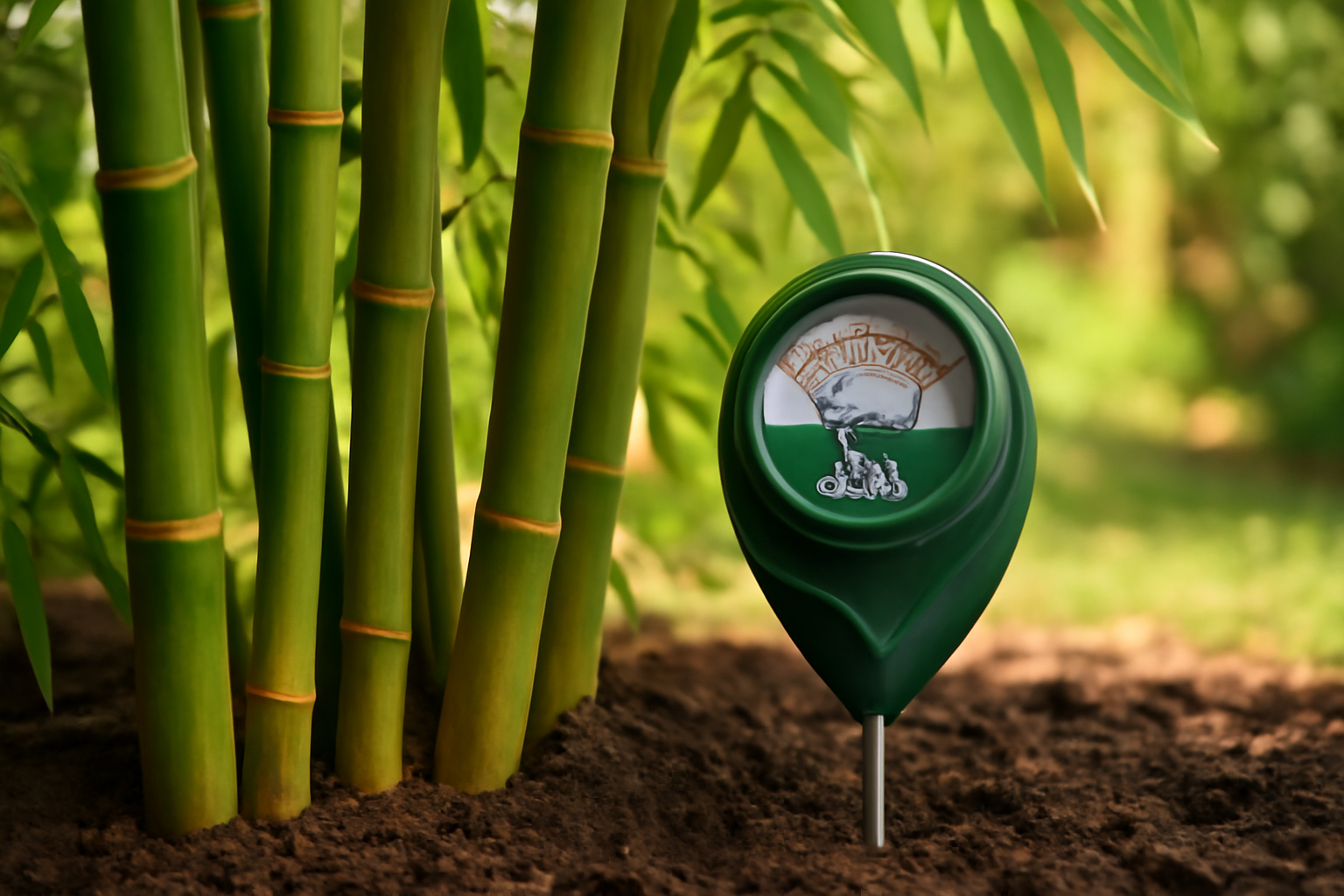
The meter arrived well-packaged — nothing loose, nothing rattling. The build is lightweight plastic, which I expected at this price. It doesn’t feel like a professional instrument. However, it also doesn’t feel flimsy in the way that some budget garden tools do. The probe is metal and reasonably sturdy. The LCD screen is clear, with decent contrast even before you activate the backlight.
Setup is minimal. There’s no calibration required out of the box, which is either a convenience or a limitation depending on how you look at it. The instructions are brief but functional. Switching between the four measurement modes is done with a simple button, and the readings update quickly on screen. My first impression was cautiously positive — it looked usable, even if I wasn’t yet sure how accurate it would be.
One thing I noticed immediately: the probe length is practical for bamboo beds. Many cheap moisture meters have short probes that only reach the top few centimetres of soil. This one goes deeper, which matters because bamboo rhizomes and feeder roots are not all near the surface.
My Testing Protocol Across the Property
I tested the YAMRON 4-in-1 Soil Moisture Meter, Digital Plant Temperature/Soil Moisture Test & PH Meter/Sunlight Intensity across six different bamboo beds over approximately eight weeks. The beds included three Phyllostachys species, one Fargesia, one Semiarundinaria, and one mixed clumper section near the boundary. Each bed has a different soil history — some have had heavy compost additions, one sits near a concrete path (which can raise pH over time), and the Fargesia bed is in partial shade with higher organic matter.
My routine was simple. Every three to four days, I took five readings per bed — one at the centre and four spread toward the edges. For each reading, I recorded pH, moisture, and soil temperature. Light readings I used less systematically, mostly to cross-check what I already knew about sun exposure. I also ran parallel tests using pH testing strips on soil slurry samples to get a rough cross-reference point.
I deliberately tested at different times of day and in varying moisture conditions. Soil meters can behave differently in very dry versus saturated soil, and I wanted to understand the meter’s real-world consistency rather than just its best-case performance.
What Actually Changed — Honest Results
The most useful discovery came in week two. The bed nearest the concrete path was reading consistently higher pH than I expected — hovering around 7.2 to 7.4. My testing strips agreed it was above neutral, though they’re not precise enough to give me a reliable number. I applied a sulphur-based acidifier and retested over the following two weeks. The readings dropped gradually and settled closer to 6.8, which is where I want that bed. That’s a real, trackable result.
The Fargesia bed confirmed what I suspected: pH was fine, but moisture levels were lower than expected at depth despite surface dampness. Fargesia doesn’t like to dry out. Adjusting my irrigation schedule based on those readings made a noticeable difference within a few weeks — new culm emergence improved, and the foliage looked less stressed by mid-summer.
Temperature readings were useful for timing. Knowing when soil temp dropped below 10°C helped me decide when to stop fertilising. That’s not a feature I expected to use much, but it turned out to be genuinely practical.
I’ll be honest: I had a moment of real doubt around week three. Several readings in one of my Phyllostachys aureosulcata beds were inconsistent — shifting nearly a full pH point between insertions just centimetres apart. I almost wrote the whole meter off. But after researching, I realised I was inserting the probe into pockets of decomposing material, which genuinely do have localised pH variation. Taking multiple readings and averaging them resolved the inconsistency. The meter wasn’t wrong — I was reading one part of a variable soil, not a uniform bed.
The Downsides You Should Know
No consumer-grade soil probe is a substitute for a lab test. I want to be clear about that. The pH readings from the YAMRON meter are useful for tracking trends and relative change over time. They are not laboratory-accurate. If you need precise numbers for a research or certification context, this is not your tool.
The meter also requires reasonably moist soil to function properly. In very dry conditions, readings become unreliable. On my drier beds in summer, I sometimes had to water lightly before taking measurements. That’s common with this type of probe, but it’s worth knowing upfront.
Here are the main limitations I encountered during testing:
- pH accuracy varies in very dry or very rocky soil
- No calibration function means you’re trusting the factory settings
- The plastic housing is lightweight — treat it carefully in rough terrain
- Battery compartment access is a little awkward
- The instruction manual could be more detailed for first-time users
None of these are deal-breakers for the use case I bought it for. However, someone expecting lab-level precision will be disappointed. Know what you’re buying.
Final Verdict: Who Should Buy This Soil pH Meter for Bamboo Growing
After two months of consistent use, the YAMRON 4-in-1 Soil Moisture Meter, Digital Plant Temperature/Soil Moisture Test & PH Meter/Sunlight Intensity, Backlight LCD Display for Gardening, Farming and Outdoor Plants has earned a permanent spot in my field kit. It’s not a precision instrument — but for tracking trends, catching pH drift early, and monitoring moisture across multiple beds, it does exactly what I need it to do.
For practical soil pH meter bamboo growing use, here’s my honest breakdown of who this suits:
- Buy this if you’re managing multiple bamboo beds and want a fast, portable way to monitor soil conditions regularly
- Buy this if you’re new to bamboo and want to understand your soil before your plants start struggling
- Buy this if you want four measurements in one device at a sensible price point
- Skip this if you need laboratory-grade pH accuracy for commercial certification or research
- Skip this if you’re only growing one or two plants and rarely check soil conditions
Most bamboo problems I see on neighbours’ properties — poor vigour, unexpected die-back, patchy spreading — trace back to soil conditions that were never checked. A tool like this won’t solve every problem, but it removes the guesswork. That alone is worth the price.
You can find the YAMRON meter here: YAMRON 4-in-1 Soil Moisture Meter on Amazon.
A Note on the Alternative Option
If the YAMRON is out of stock or you want to compare before buying, there’s a closely matched alternative worth considering. The 4-in-1 Soil Moisture Meter Digital PH Meter/Soil Moisture/Plant Temperature/Sunlight Intensity with Backlight LCD Display offers very similar functionality — the same four measurements, backlit display, and general build quality. I’ve handled it briefly and it reads comparably in the field. My primary reason for preferring the YAMRON came down to availability and minor differences in probe length. Either one would serve a bamboo grower well at this level of use.