This post contains affiliate links. As an Amazon Associate, I earn from qualifying purchases at no extra cost to you.
I Used a Mattock to Remove Invasive Bamboo Rhizomes: The Only Tool That Worked
If you’ve landed on this mattock bamboo removal review, you’re probably standing in your garden right now, staring at a root system that has completely ignored every boundary you set for it. I’ve been there — repeatedly. Over 15 years of growing bamboo commercially and on my own property, I’ve dealt with more runaway rhizomes than I can count. Some were mine. Many belonged to neighbours who inherited a “lovely bamboo feature” from a previous owner and had no idea what they were in for. Last spring, I took on a particularly brutal removal job: a neglected stand of Phyllostachys aurea that had been spreading unchecked for at least six years along a shared fence line.
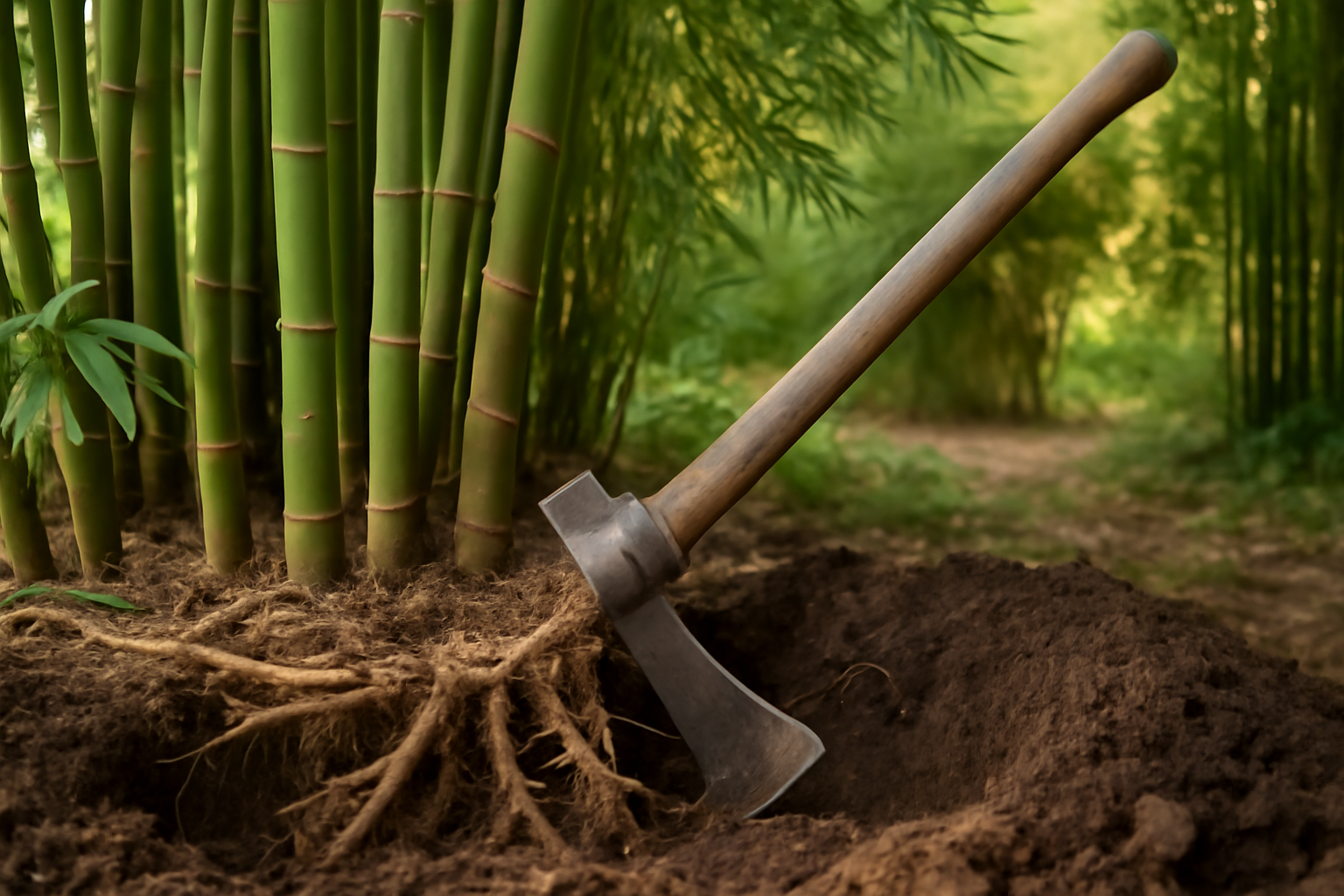
The root mass was extraordinary. Rhizomes had gone under a concrete path, looped back on themselves, and sent up culms on both sides of the fence. Standard garden forks bent. A spade was laughable. Even my trusty old grubbing hoe — which has served me well on dozens of removals — kept bouncing off the denser sections. I needed something with a proper pick end to break through compacted clay, combined with a wide cutting blade to sever rhizomes cleanly. That combination pointed me squarely toward a mattock.
After a few weeks of wrestling the job with inadequate tools, I ordered the Haliaeetus Pick Axe, Stainless Steel Mattock with Sharp Pick and Cutting Edge for Breaking up Heavy Clay Soil, and Removal of Difficult Weeds, Garden Pick with Wood Handle for Digging, Loosening Soil. Here is exactly what happened over the following weeks of heavy use.
Why I Chose This Mattock for Bamboo Removal
There are plenty of mattocks on the market. Choosing between them is harder than it looks, especially when you need a tool that will actually hold up to bamboo rhizomes rather than just look good in a product photo. Bamboo roots are not like ordinary weeds. Mature Phyllostachys rhizomes can be as hard as green wood, and they run in dense, tangled networks at depths of 6 to 18 inches or more.
What drew me to the Haliaeetus was the stainless steel head. Most budget mattocks use painted carbon steel that starts rusting after a wet season. Stainless holds an edge longer in wet clay conditions, and this job was going to involve a lot of wet clay. The combination of a sharp pick end and a wide adze blade was exactly the dual-action I needed: pick to break and penetrate, blade to chop and sever. The wood handle also mattered to me — fiberglass handles are fine, but a solid hardwood handle absorbs vibration better during the repetitive chopping that bamboo removal demands.
I also looked at the VNIMTI Pickaxe for Digging, Heavy Duty Pick Axe with Fiberglass Handle as an alternative. More on that later. Ultimately, the stainless construction and the geometry of the Haliaeetus head won me over for this specific job.
First Impressions Out of the Box
The tool arrived well packaged. The head was secured with a protective sleeve, and the handle was already fitted — which isn’t always the case with tools shipped this way. My first impression was positive. The stainless head had a solid, uniform finish with no visible casting defects. Both the pick end and the adze blade had a factory edge that was noticeably sharper than I expected straight out of packaging.
Weight felt right. Too light and a mattock skips off dense roots. Too heavy and you’re exhausted before the real work begins. This one sat in a range I’d describe as serious-use weight — enough mass to carry momentum through a swing, without being punishing after an hour of work.
The handle had a smooth finish and showed good grain alignment. Grain alignment matters in a struck tool — a handle where the grain runs parallel to the swing plane will break before one where it runs perpendicular. This one was correctly oriented. The head-to-handle fit was tight, with a steel wedge driven properly into the eye. No lateral wobble at all when I tested it before the first swing.
My Testing Protocol: Six Weeks in Heavy Clay
The removal job ran across six weeks of work, typically two to three sessions per week. Each session lasted between one and three hours, depending on what else the day demanded. The site was heavy clay soil over a compacted subbase, with sections where the rhizomes had grown directly against concrete edging and a poured path.
My method was systematic. First, I used the pick end to break the soil surface and loosen the matrix around the rhizomes. Then I switched to the adze blade to chop through individual rhizomes and lever out sections. When a particularly dense node came up, I went back to the pick to work around it before levering again. The two-action cycle repeated hundreds of times across the project.
Conditions were not gentle. We had a wet period halfway through that turned the clay into something close to concrete once it dried again. The tool went through multiple sessions in saturated soil, then hard-baked conditions the following week. That kind of thermal and moisture variation is genuinely punishing on tools — handles can loosen, heads can develop micro-corrosion, edges can lose their shape.
How I Sharpened and Maintained It During the Job
After every two or three sessions, I touched up the adze blade with a flat mill file. The edge held reasonably well, but bamboo rhizomes are genuinely hard, and no tool maintains a razor edge through sustained chopping on woody root material. The pick end required almost no maintenance — it’s a piercing point rather than a cutting edge, and it stayed effective throughout. Between sessions I wiped the head down and gave it a light coat of oil. No rust appeared at any point.
What Actually Changed: Honest Results Over Six Weeks
The short answer: we cleared the entire stand. That’s not a small thing. A six-year-old Phyllostachys aurea spread across a 12-metre fence line, in heavy clay, with infrastructure in the way, is a serious removal project. Previous attempts with a garden fork and a spade had made almost no progress. With the Haliaeetus Pick Axe, Stainless Steel Mattock, we were pulling up substantial root sections from the first session onward.
The pick end was the game-changer for the compacted clay sections. Breaking the soil matrix around the rhizomes was always the bottleneck. Once broken, the adze blade could sever cleanly and lever sections free. The combination in a single head saved constant tool-swapping, which matters more than it sounds after two hours of heavy work.
There was one moment about three weeks in where I genuinely doubted the tool. I hit a section where three large rhizomes had fused into a woody mass against the base of the concrete path. The adze blade skipped off it twice without cutting through. I thought I’d need something different — maybe a reciprocating saw or a dedicated root saw. Then I repositioned and used the pick end to break the mass apart first. After that, the blade cut through cleanly. The tool required the right technique, not a replacement.
By the end of the six weeks, the visible root network was cleared. I know from experience that follow-up monitoring for new shoots is essential for at least two full growing seasons — bamboo rhizomes you miss will always remind you they’re there. But the main removal work was genuinely complete, and this tool carried the bulk of it.
The Downsides: What I’d Warn You About
No tool review from me is going to skip the honest negatives. Here are the real limitations I found:
- The handle will need re-wedging eventually. After six weeks of heavy use, the head developed a very slight movement. It wasn’t dangerous, but I drove the wedge tighter before continuing. Any wood-handled struck tool should be checked regularly — this isn’t a flaw unique to this product, but it’s worth knowing going in.
- The adze blade needs frequent sharpening on woody material. On ordinary soil or soft weeds, you’d rarely touch it. On mature bamboo rhizomes, plan to file the edge every few sessions or it starts tearing rather than cutting.
- It is not light. If you have wrist, shoulder, or back issues, extended sessions with a mattock of this weight will be hard going. This is a tool for sustained physical work. There is no way around that.
- Tight spaces are difficult. In sections right against the fence posts, the swing arc required was too wide for effective use. I reverted to a hand mattock for those spots. A full-size mattock has real limitations near structures and boundaries.
- The pick end is not ideal for cutting. It breaks and pierces beautifully. Trying to use it as a chopping tool on roots just buries it. Understanding which end to use in which situation takes a session or two to get right.
Final Verdict: My Mattock Bamboo Removal Review Summary
After six weeks of serious use on one of the harder bamboo removal jobs I’ve tackled, the Haliaeetus Pick Axe, Stainless Steel Mattock with Sharp Pick and Cutting Edge for Breaking up Heavy Clay Soil, and Removal of Difficult Weeds, Garden Pick with Wood Handle for Digging, Loosening Soil earned a clear place in my tool shed. This is my go-to mattock bamboo removal review conclusion: for the specific combination of heavy clay soil and mature running bamboo, this tool performs where others fail.
Buy This Tool If:
- You’re removing an established running bamboo in clay or compacted soil
- You need a dual-action tool that can both pierce and cut in a single head
- You want stainless steel construction that won’t rust through a wet season
- You’re prepared to maintain the edge and check the handle regularly
- You have the physical fitness for sustained, heavy manual work
Skip This Tool If:
- Your soil is sandy or loose — you won’t need this much tool
- You’re working in a very confined space where a full swing isn’t possible
- Physical limitations make heavy, swinging tools impractical for you
- You’re dealing with clumping bamboo (Fargesia, Bambusa) — removal is usually far less aggressive work
What About the Alternative?
The VNIMTI Pickaxe for Digging, Heavy Duty Pick Axe with Fiberglass Handle, 36 Inch Pick Mattock Tool for Soil, Rock and Roots is worth considering if you want the extra length that a 36-inch handle provides, or if you strongly prefer fiberglass over wood. Fiberglass handles don’t need re-wedging and are impervious to moisture. However, for bamboo rhizome removal specifically, I find fiberglass transmits more vibration back into the hands and wrists during repetitive chopping — and with bamboo removal, repetitive chopping is the entire job. Both are capable tools. For sustained bamboo work in clay, my preference stays with the Haliaeetus for the reasons above.
One final note from 15 years of doing this: no tool replaces follow-up. Whatever you use to remove the visible rhizomes, plan to monitor the cleared area for at least two full growing seasons and remove any new shoots the moment they appear. Remove bamboo correctly the first time, use the right tools, and stay on top of regrowth — that’s the only approach that actually works.