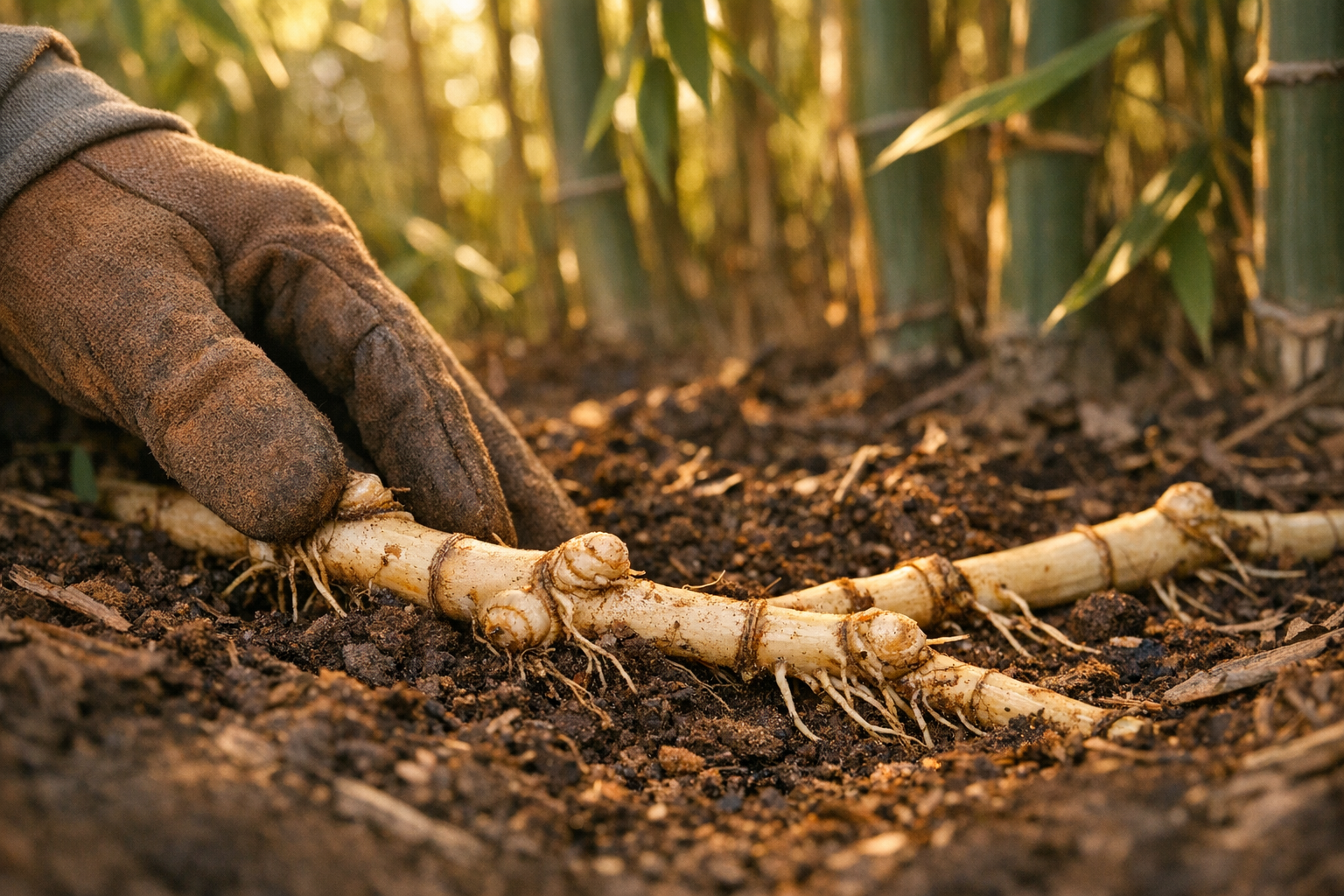
I learned the hard way that bamboo for small yards isn’t just “pick clumping, avoid running.” When you’re working with under a quarter acre—maybe 8,000 to 10,000 square feet total—a single containment failure with a spreading species can consume your entire usable yard within 18 months. I’ve watched neighbors’ Phyllostachys aurea rhizomes tunnel under fences and erupt in flower beds three properties over. On a small lot, that’s not just a landscaping problem; it’s a relationship problem. This post is specifically for people in tight residential spaces where the margin for error is essentially zero, and where standard root-barrier advice from general gardening sites doesn’t account for the physical constraints of a small footprint.
Why Standard Running Bamboo Advice Fails on Tiny Lots
Most gardening resources treat bamboo containment as a binary choice: use a barrier or pick clumping. That logic works fine on a half-acre where you can install a 30-foot barrier perimeter and still have room to maneuver. On a quarter-acre lot, you’re often working with 60 to 80 linear feet of property line, and your actual plantable space—after setbacks, hardscape, and existing structures—might be just 1,000 to 2,000 square feet. A running bamboo species like Phyllostachys nigra (black bamboo) or Phyllostachys vivax (vivax bamboo) will test every inch of a barrier you install. I’ve seen beautifully maintained barriers fail because homeowners didn’t account for the cumulative pressure of three growing seasons of rhizome expansion, or because a single gap at a gate became an escape route.
The real problem: on a small lot, you can’t afford a containment breach. You also can’t afford the maintenance load of annual barrier inspections across tight perimeter edges. You need a species strategy, not just a barrier strategy.
Clumping Bamboo Species That Actually Stay Put Under 10,000 Square Feet
If you’re serious about never worrying about bamboo escaping your property line, clumping bamboo is the answer for small yards. Unlike running types, clumping bamboo expands radially from a central crown at a predictable rate—typically 12 to 24 inches per year—without sending out long lateral rhizomes. For small lots, this is the difference between a plant and a threat.
Fargesia robusta ‘Campbell’ is my top recommendation for small spaces under 0.25 acres. It reaches 12 to 15 feet tall with a mature clump spread of about 8 to 10 feet. The culms are fine and elegant, and it doesn’t sprawl aggressively. Space individual plants 10 feet apart if you want them to eventually form a grove; if you want a single specimen that won’t encroach on neighbors, one plant per 400 square feet is safe. I’ve had a ‘Campbell’ for six years in an 8-by-10-foot bed with absolutely zero escape attempts.
Fargesia nitida ‘Great Wall’ is more compact—reaching 8 to 12 feet—with a denser branching pattern and narrower mature clump (6 to 8 feet). It’s excellent for corner spaces or narrow side yards on small properties. The foliage is feathery and darker, giving it a more refined look in confined spaces. Plant it 8 feet on center if you want visual continuity.
Borinda fungosa is taller (15 to 20 feet) but slower-growing and very tight-clumping. If you want vertical screening on a small lot without width creep, this is your species. Mature clump spread maxes out around 5 to 7 feet. Use one plant per 20 linear feet of fence line you want to screen.
The absolute rule for small yards: avoid every running species. Not “be cautious with.” Avoid. Phyllostachys, Pseudosasa, Sasa, and Pleioblastus genera are all runners, even dwarf cultivars. On a quarter-acre lot, they’re not worth the insurance premium of anxiety.
If You Insist on Running Bamboo: Barrier Installation for Tight Spaces
I understand the appeal—running bamboo grows faster and can fill larger spaces quicker. If you absolutely must use a running species on a small lot, you need a barrier system designed for confinement, not convenience. This is non-negotiable.
Install a physical rhizome barrier at least 30 inches deep and 24 inches above grade around the entire planting area. The barrier must be continuous—one gap is a failure. For a small yard installation, you’ll want rigid HDPE (high-density polyethylene) barrier material that won’t degrade in 5 years. The 50ft 24in 60mil Tree Root Barrier is solid for small-lot applications: 60mil thickness is heavy enough to resist puncture from aggressive rhizomes, the 24-inch above-grade height creates a visible lip that catches escaped shoots before they fully emerge, and 50 feet covers one small residential corner or a side-yard installation without seaming (which is where failures happen).
Installation specifics for small yards: excavate a 30-inch-deep trench around the planting zone. Line it with the barrier, overlapping seams by at least 12 inches. Tape all seams with waterproof, UV-resistant HDPE tape—not duct tape, not flex seal. The above-grade portion must be visible so you catch any rhizomes trying to escape over the lip. Backfill and compact in 4-inch lifts. On a small lot, budget one day for a 30-foot installation if you’re doing it yourself, or $400 to $600 if hiring labor at $15/hour in most regions.
Then: inspect the barrier every spring and fall. On a small property, you can actually do this—walk the entire perimeter in 20 minutes. Check for gaps, cracks, or rhizomes trying to climb the lip. This is the only way running bamboo stays contained on a tight lot.
Spacing and Layout for Maximum Utility on a Quarter-Acre
Space matters more on small lots because every plant needs to earn its place. Here’s how I’d approach it:
- Privacy screening (side or back property line): Space Fargesia robusta ‘Campbell’ 10 feet on center along the line. Three to four plants create a solid visual barrier within two seasons without consuming your entire yard depth.
- Corner plantings (front or entryway): Single specimen of Fargesia nitida ‘Great Wall’ or Borinda fungosa in a 3-by-3-foot bed. No crew, no sightline clutter, elegant focal point. Mature spread is 6 to 8 feet, contained.
- Shade canopy (backyard lounge area): Two Fargesia robusta ‘Campbell’ plants spaced 12 feet apart create dappled shade within three years without dominating a small yard.
- Container growing: If you’re on the absolute tight end of the quarter-acre spectrum, Fargesia nitida cultivars grow respectably in 20-gallon fabric pots with annual feeding. This keeps them completely contained and gives you flexibility to move them if your landscape needs change.
The key for small yards: plant for specimen value, not acreage coverage. A single mature clumping bamboo is a landscape statement on a small lot. Two or three create visual rhythm. More than that, and you’re fighting density and sightlines.
The Long View: Three-Year Reality Check
After three years on a small property, you’ll know whether your bamboo choice was sound. With clumping species, you’ll see mature form emerging—no surprises, no escape attempts, minimal maintenance beyond annual culm thinning. With running bamboo and a barrier, you’ll either have calm confidence in your system (if you installed it correctly) or lingering dread about what’s happening in the soil you can’t see. I’ve never met a small-lot running bamboo owner who chose “calm confidence” in year three.
For a property under 10,000 square feet, clumping bamboo is the rational choice. It lets you enjoy the plant instead of managing it like a contained threat. That’s the angle most general bamboo advice misses—on small lots, elegance and restraint are features, not compromises.
About This Article

Written by Marcus Chen. Marcus Chen has spent 15 years cultivating and studying bamboo across 14 different species, combining commercial growing operations with extensive hands-on experience in species selection and containment. As both a grower and consultant, he specializes in practical bamboo management, helping homeowners and landscapers understand the real-world requirements for responsible bamboo cultivation. Marcus brings tested knowledge of which species thrive reliably and which present containment challenges that go beyond standard recommendations. More about this site.
Verify this against a primary source
Specifics change, and your situation may differ from the one described here. These are the authorities worth checking directly:
- American Bamboo Society — species listings and cultivation guidance
- USDA PLANTS Database — species range and identification
- USDA Plant Hardiness Zone Map — cold hardiness verification for your location