Most bamboo fences that fail early were finished as if they were cedar. The owner grabbed whatever stain was on sale, brushed it on the face, and a season later the panels looked like driftwood and the bottoms had gone soft. I have made versions of that mistake myself. This guide covers how to choose a finish category rather than a brand, how to prepare the surface so the finish actually stays, how to apply it, and how to tell when it needs doing again.
Why bamboo is not wood
Bamboo is a grass, not a timber, and that one fact explains most of what goes wrong with bamboo fences. Start with the outside of a culm. The outer skin is hard, waxy and rich in silica. It sheds water and resists anything trying to penetrate it. That is why a finish that soaks happily into cedar tends to sit on bamboo instead. Preparation matters more than the product you choose, because the product has to grip a surface that does not want to take it.
The inside is a different story. Once you cut or split a culm, you have exposed open vascular tissue, and that tissue drinks water. Cut ends, the bottom edge and any split or crack are where failure starts, not the broad face. A fence can look fine across its face for two seasons while the bottom of each post quietly goes soft.
Bamboo is also hollow and segmented. If water gets into an internode through an open end or a split, it sits there, and the culm rots from the inside while the outside still looks sound. That is one reason I am so insistent on sealing ends, and it is why ground contact is so dangerous. The timeline is covered in how fast bamboo rots in ground contact.
Finally, separate the two enemies. UV is the main threat to appearance: unfinished bamboo grays within a season or two in direct sun. Water and ground contact are the threats to structure. A good finish helps with both, but no finish can rescue a culm left sitting in wet soil.
Choosing a finish category
Shop by category, not by brand. Then read the label to confirm which category the product really is, and check that it is rated for exterior use on a surface that gets wet. Here is what each category does for bamboo.
Penetrating oil-based exterior sealers and wood preservatives
This is the mainstream choice for bamboo fencing. Penetrating oil-based products soak into the skin and the first layer of fiber better than film formers do, and they fail by gradually fading and wearing rather than peeling off in sheets. On a waxy culm, penetration is always partial, so do not expect the product to sink in the way it would on pine. Think of it as a layer bonded to the surface. Recoating is straightforward: clean, dry, and apply again.
Exterior semi-transparent stains
Stains add pigment, and pigment is what blocks UV. This is the central trade-off of the whole subject. The more pigment a finish carries, the better it protects against graying and the less of the bamboo’s natural golden tone and grain you see. A clear finish keeps the most color and protects the least. A heavily pigmented finish protects well but largely turns the fence into a painted surface. Semi-transparent stains sit in the middle, and that is where most of my own fences end up. I explain what I use and why in the exterior stain I actually use on my own fence.
Film-forming finishes: exterior varnish, polyurethane and marine spar
These look excellent the day you finish, and they are usually the wrong choice outdoors on bamboo. Bamboo moves with changes in humidity, and a rigid film cracks on a surface that moves. Once the film cracks, water gets underneath and lifts it from the skin. Repair then means stripping, not recoating, and stripping bamboo’s nodes and split faces is miserable work. I would not put a film finish on a fence, and I have had to strip one off a panel that was otherwise sound.
Water-based exterior sealers
Water-based products have lower odor and clean up with water, which matters if you are working in a dense neighborhood or a closed garage. The catch is that they usually penetrate less into a waxy culm than oil-based products, so more of the film sits on the surface. Check whether the product is rated for UV protection, because a clear water-based sealer protects appearance poorly. A pigmented water-based exterior stain is a reasonable option if low odor is the priority.
Mineral oil and food-safe oils
This is the query I see most often, so here is the straight answer. Mineral oil belongs on indoor bamboo: cutting boards, utensils and kitchen pieces. It is the wrong product for an outdoor fence. It does not cure, so it stays slick and gathers dirt. It offers no UV protection, so the fence grays underneath it. For how it behaves on kitchen pieces, see mineral oil on indoor bamboo.
Boiled linseed and tung oil
These are traditional, slow-curing oils with a natural look that many people like. Their weak spot is climate. In humid conditions they are prone to mildew, because the surface stays damp and organic for a long time and the oil gives mold something to feed on. In a dry climate they can perform reasonably. In the humid Southeast, where I grow, I have seen them mildew, and I would not recommend them for a fence there. Some boiled linseed products contain metallic driers, so read the label. Handle the rags with care too: rags soaked in linseed-based oil can self-heat and catch fire if left in a pile. Lay them flat to dry outdoors, or submerge them in water in a sealed metal container before disposal.
Borate preservatives
Borate preservatives help against fungal decay and insects, and they can be a useful supplement on cut ends and in spaces that stay dry. But they are water-soluble, so they leach out when the bamboo gets wet, and they do not last outdoors on their own. They do nothing about UV graying and nothing about water soaking in through the skin. Treat a borate as one layer under a proper finish, not as the finish itself, and follow the label closely. Borates do not replace keeping the bottom edge off the ground.
What not to use
- Interior stains and finishes. They are not formulated for UV exposure or moisture.
- Latex house paint. It hides the bamboo entirely and peels as the culm moves.
- Deck paint, or any film-forming coating sold for a surface that stays dry.
- Any product that does not state it is intended for exterior use.
Finish types at a glance
Use this table to compare categories. Recoat intervals are ranges, and exposure drives them more than anything else on this list.
| Finish type | UV protection | How it fails | Recoat interval | Best for |
|---|---|---|---|---|
| Clear penetrating exterior sealer | Low | Gradual graying, water soaks in | Shorter, exposure-dependent | Owners who accept natural graying |
| Semi-transparent oil-based exterior stain | Moderate | Slow fading and chalking | Roughly one to three years, exposure-dependent | Most fences and screens |
| Heavily pigmented exterior finish | High | Slow wear, color loss | Exposure-dependent | Sun-heavy sites where protection matters most |
| Water-based exterior sealer or stain | Low to moderate, depends on pigment | Wear on the surface, less penetration | Exposure-dependent | Low odor and easy cleanup |
| Film-forming varnish, polyurethane, spar | Varies, film breaks down | Cracks, lifts, water gets under | Strip rather than recoat | Not recommended outdoors |
| Mineral oil | None | Gathers dirt, never cures | Frequent | Indoor items only |
| Boiled linseed or tung oil | Low to moderate | Slow cure, mildew in humid climates | Exposure- and climate-dependent | Dry climates, traditional look |
| Borate preservative | None | Leaches out when wet | Per label | A supplement under a finish |
Preparation: the part that decides the outcome
Most failures I have seen were not caused by the wrong product. They were caused by a finish applied to a dirty, damp or waxy surface. Preparation is the step readers skip, and it decides how long everything else lasts.
Clean new bamboo first
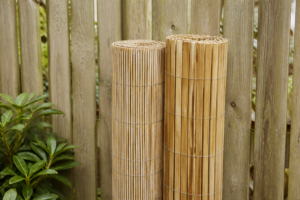
A new rolled panel or fresh culm carries a waxy bloom and factory dust, and finish will not grip through it. Wash with a mild cleaner and water, using a soft brush and working along the length of the culm. Rinse thoroughly, because residue left behind can interfere with adhesion. Let it dry completely. Skip the wire brush. It scratches the skin and raises fiber.
Do not use a pressure washer. It drives water into the culm through every crack and open end, raises fibers along the grain and can split the skin. On rolled panels it can strip the wire ties or loosen the weave. A garden hose and a soft brush do the job without damage.
Deal with mold, mildew and gray surface
Weathered bamboo often has mold or mildew on the lower sections and a gray, UV-damaged fiber layer on the sun side. Scrub mold with a cleaner made for the purpose, or a diluted solution used according to its label, then rinse well. Bleach solutions can lighten the surface unevenly and roughen it, so test on an offcut first if you use one.
For gray, weathered fiber, a light scuff with a fine abrasive pad can help a finish key into the hard skin. Keep it light. Aggressive sanding removes the skin you are trying to finish and raises fibers that then soak up product unevenly.
Make sure it is dry
Bamboo must be dry before finishing, or the finish traps water inside the culm and the bond fails. My rule of thumb is several dry days after washing, in mild weather, with no rain forecast through the application and drying window. Check the cut ends especially. If they still feel cool and damp to the touch, keep waiting. For why properly cured material behaves so differently, see curing poles properly before you build with them.
Treat the ends and bottom edge first
Cut ends, the bottom edge and any splits get the most generous treatment, and they go first. Flood them until they stop taking product. Then keep the bottom edge off the soil. Ground contact beats any finish, and no sealer will save a culm sitting in damp earth. Use a footing, a gap or a raised rail. A finish on a bottom that touches the ground only buys time.
Application
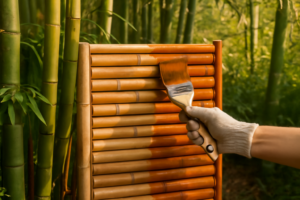
Pick your tool for the surface. A roller is what most people reach for and the wrong tool for round culms. It cannot reach the gaps between canes or the grooves around the nodes, and it leaves an uneven film on a ribbed surface. A brush works well. On larger jobs, my preference is a sprayer followed by a brush-out: the spray gets product into the texture quickly, and the brush works it into the grooves and pushes out any pooling.
Work along the culm, not across it. Brushing across the grain leaves lap marks and pushes product into the gaps unevenly. Long strokes along the length of each culm give a more even finish and a cleaner look.
Flood the cut ends, the nodes and any splits, and keep applying until they stop drinking. Then wipe off the excess from the surface so nothing stays tacky.
Apply two thin coats rather than one heavy one. On a non-absorbent surface, a heavy coat sits on top, runs, takes longer to dry and can stay soft. Two thin coats penetrate better and look better. Let each coat dry as the manufacturer directs before you apply the next.
Follow the temperature and humidity limits on the label. Avoid direct hot sun, which dries the surface too fast and leaves lap marks. Avoid cold, damp conditions and heavy dew. Never finish before rain, and do not start a coat if rain is forecast before it will have dried.
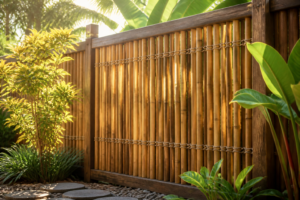
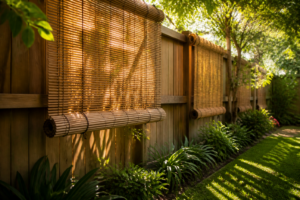
Finish both faces wherever the panel is accessible, and do as much as possible before anything is hung. It is far easier to work a panel flat on the ground than on a ladder with a fence in the way. Once it is finished and fully dry, hang it. If you are fixing screening to an existing fence, the mounting steps are in attaching screening to an existing fence.
Plan for more product than you would need for a flat fence. The ribbed surface, the gaps and the nodes all take more material per square meter. Do not trust the coverage figure on the label, which assumes a smooth board. Finish a test section, measure how much you used, and calculate the rest from that.
Choosing a stain color
Pigment shifts bamboo’s golden tone toward the color of the stain. A clear finish keeps the natural look but protects the least. Once you choose a pigmented finish, you are choosing a color, and that is the decision most people rush.
Bamboo takes stain unevenly. The hard skin varies across a culm and from culm to culm, and the nodes absorb differently from the sections between them. Expect some variation and some blotchiness around the nodes, especially where the skin is thick or the surface has weathered. An even scuff before staining reduces this.
Test before you commit. Use an offcut or a hidden end, ideally from the same batch as the fence, and test several culms because they vary. Judge the test once it is dry, since a wet finish always looks darker than it will end up. Color also shifts as the finish weathers, so look at the test again after a few weeks if you can.
Remember the asymmetry. Going darker is easy: add another thin coat or a deeper shade. Going lighter later means stripping or waiting for weathering to take the color back, and neither is quick. If you are unsure, start with the lighter option and build up.
Maintenance: recoat when the surface tells you to
Do not recoat on a calendar. Recoat when the surface shows you it is time. Watch for these signs:
- Water no longer beads on the face and soaks in instead.
- Gray is returning in patches, especially on the sun-facing side.
- The surface is chalky and rubs off on your hand.
- The sheen has gone dull or patchy, or the color is fading unevenly.
- Mold or dark staining is showing at the lower sections.
- Cut ends or splits look dry, rough or lifting.
For most fences, expect recoat intervals somewhere in the range of one to three years, but exposure drives that heavily. A shaded north-facing run can go longer, while a fence in full sun or one that takes driving rain can need attention sooner. Let the signs above decide. For context on how one of my fences behaved over time, see how long bamboo fencing lasted for me.
The faces and spots that fail first are the face that takes the most direct sun, the bottom edge, the cut ends, and anywhere water sits, such as the top of a rail or a split. On a rolled panel, check the wire ties and the places where the weave has been cut. For a rolled panel’s longer-term behavior, see how a rolled panel held up over two years.
Between full recoats, spot-treat. Clean the area, let it dry fully, then work a thin application into splits, cut ends and the bottom edge, wiping off the excess. Do not glob product into a split. It will stay tacky and look worse than the crack. Spot treatment extends the time to a full recoat, but it does not replace one.
For a full recoat, clean and dry the surface first. Scuff lightly if the surface has gone gray and chalky, then apply thin coats of the same category, following the manufacturer’s instructions for prep and recoat timing. If you want to switch categories, read the label first and test a patch, because some finishes will not bond over others.
Frequently Asked Questions
What is the best sealer for a bamboo fence?
There is no single best product, but there is a best category for most fences: a penetrating oil-based exterior sealer or stain, pigmented enough to resist UV and labeled for exterior use. Choose the amount of pigment based on the color you want and how much sun the fence gets. Clear finishes protect the least, film-forming finishes are usually the wrong choice outdoors, and mineral oil is not an option at all. Follow the manufacturer’s instructions for preparation and recoating.
Can you stain bamboo fencing?
Yes. Exterior semi-transparent stains work well on bamboo fencing, provided the surface is clean, dry and lightly scuffed where it has weathered. Expect some unevenness, because the skin and nodes take stain differently, so test on an offcut or a hidden end first. Pigmented stain gives the best UV protection but covers more of the natural color.
Do I need to seal a bamboo fence at all?
If you want to keep the look and slow down the deterioration, yes. Unfinished bamboo outdoors grays within a season or two, and cut ends and bottoms take on water whether or not the face looks bad. A finish will not stop decay on a bottom that sits in soil, but it cuts down the water that gets into exposed ends, which is where failure starts.
Can I use mineral oil on an outdoor bamboo fence?
No. Mineral oil does not cure, provides no UV protection and attracts dirt, so an outdoor fence will gray underneath it and look grimy. It belongs on indoor items like cutting boards and utensils. For outdoor work, use a product labeled for exterior use.
How do I know when a bamboo fence needs recoating?
Watch the surface rather than the calendar. When water soaks in instead of beading, gray returns, the surface chalks or the sheen goes patchy, it is time. Sun-facing faces, bottom edges and cut ends fail first, so check those before anything else.
About This Article

Written by Marcus Chen. Marcus Chen has spent 15 years cultivating and studying bamboo across 14 different species, combining commercial growing operations with extensive hands-on experience in species selection and containment. As both a grower and consultant, he specializes in practical bamboo management, helping homeowners and landscapers understand the real-world requirements for responsible bamboo cultivation. Marcus brings tested knowledge of which species thrive reliably and which present containment challenges that go beyond standard recommendations. More about this site.
Verify this against a primary source
Specifics change, and your situation may differ from the one described here. These are the authorities worth checking directly:
- American Bamboo Society — species listings and cultivation guidance
- USDA PLANTS Database — species range and identification
- USDA Plant Hardiness Zone Map — cold hardiness verification for your location