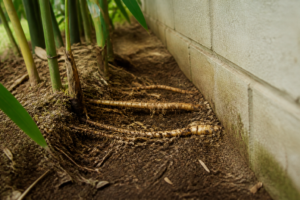
If you have already decided that chemical is the route, you have probably learned the first hard truth about killing bamboo: one spray does not kill it. Bamboo is a grass, and grasses are built to come back. An established grove is a clonal network of rhizomes that can run a long way underground, and those rhizomes store enough energy to push new culms for several seasons after the visible growth is gone. Any herbicide that works on bamboo has to be absorbed by green leaf and carried down into that rhizome system. A single application to a tall grove will look like failure a few weeks later and like regrowth a few months after that. What kills bamboo is the right active ingredient, applied to enough healthy green leaf, at the right point in the plant’s cycle, and repeated over more than one season. Get those four things right and the brand name on the bottle matters much less. Get any one of them wrong and the strongest product on the shelf will disappoint you.
This post assumes you have chosen chemical and want to know which product to buy, how to use it and when. If you are still deciding between digging, smothering and spraying, start with all seven removal methods compared. This guide stays on the chemistry and the technique.
Read the active ingredient, not the brand name
Garden centers and search results are full of product names, and most of them tell you nothing about whether a product will work on bamboo. Turn the bottle over and find the line that lists the active ingredient and its percentage. Shop by that. Two products with different names and the same active ingredient at the same concentration will behave the same way on your grove. Two products with similar names and different active ingredients may not behave anything alike. Here are the three families that matter for bamboo.
Glyphosate
Glyphosate is the default for a reason. It is systemic. It is absorbed through green foliage, moves through the plant’s vascular system and reaches the rhizomes. It has essentially no residual activity in soil: it binds tightly to soil particles and is broken down by soil microbes, so it does not sterilize the ground. That is why it is the usual choice when there are plants you want to keep nearby, and why you can usually replant sooner than you could after imazapyr. Confirm the timing on your label and then read replanting the ground afterwards.
Glyphosate is not a one-shot answer on bamboo, and most failures come from a handful of predictable mistakes. The first is too little leaf. A tall grove presents a lot of stem and comparatively little leaf area within reach, and a thin, wide spray over a mature stand delivers too little product to the leaves that matter. The second is poor foliage condition. Drought-stressed leaves, leaves dulled by dust after a dry spell, and leaves already yellowing from cutting do not absorb well and are not moving sugars toward the roots. The third is rain before the product has dried. Check the label for the rain-free period and respect it. The fourth is buying the wrong strength. Concentrates sold for brush and stump work are much stronger than the ready-to-use products on lawn and garden shelves. Compare the percentage of active ingredient on each label, not the marketing on the front, and find the rate for woody brush or hard-to-control perennial grasses before you open the bottle.
Keep in mind that glyphosate is non-selective. It will damage almost any green plant it reaches, including the ones you want. Drift is a real hazard, and a spray that lands on a neighbor’s hedge is a problem you will be solving for longer than the bamboo.
Imazapyr
Imazapyr is markedly more effective on bamboo and other hard-to-kill grasses than glyphosate. It is absorbed through both foliage and roots, and it persists in the soil. That persistence is the whole trade-off. Imazapyr can move laterally through soil and be taken up by the roots of nearby trees, shrubs and hedges, so it can kill or badly damage plants well outside the area you sprayed. It can also leave ground unplantable for a long time, and how long depends on your soil, rainfall and temperature.
Imazapyr is the wrong choice near desirable trees, on a slope above a neighbor’s garden, over or near a septic drain field, or anywhere you plan to plant soon. It is the right choice mainly for an isolated stand on open ground that you are willing to write off for a while. Some imazapyr products are sold for industrial or right-of-way work and carry use restrictions that exclude homeowner use. Read the label before you assume a product is available for your site. Do not choose it simply because it is the stronger option.
Triclopyr, and the Crossbow question
Triclopyr, and combinations of triclopyr with 2,4-D, are broadleaf and woody-plant herbicides. They are built for brambles, vines, saplings and brush with broad leaves. Bamboo is a grass, and grasses are largely tolerant of these chemicals. That mismatch sits at the heart of most of the “will Crossbow kill bamboo” searches, and it is why people who try these products on bamboo report disappointing results.
So, directly: no, Crossbow will not reliably kill bamboo. It is a triclopyr and 2,4-D product, and neither active ingredient is a good match for a grass. You may see some leaf burn and temporary browning, and then the culms come back. These products earn their place on broadleaf plants growing alongside the bamboo, such as blackberry or privet, and you should check the label for the plants it lists. If you have a bamboo problem and a bramble problem, treat them as two separate jobs.
What will not work
Several products are sold on the promise of killing weeds, and they fail on bamboo for predictable reasons.
- Lawn weed-and-feed products and selective broadleaf lawn herbicides. They are formulated to spare grasses, which is exactly what bamboo is, so they work against you.
- Salt. It persists in the soil, damages soil structure and harms neighboring plants, and it does not reliably reach the rhizomes.
- Bleach. It acts on contact, does not move through the plant, and is hazardous to handle and apply.
- Vinegar. The acetic acid burns the leaves it touches and does nothing to the rhizome system.
- Diesel. It burns foliage, contaminates soil and water, and in some places applying it as a pesticide is illegal regardless of whether it seems to work.
The common thread is that none of these move from leaf to rhizome. Burning the top of a grove does not kill the grove. The rhizomes are still alive underneath, and they will send up new culms.
Comparing the active ingredients
Use this table to match an active ingredient to your site. The cells are deliberately brief. The explanations above carry the detail.
| Active ingredient | How it is taken up | Soil persistence | Effectiveness on bamboo | Main risk | Best suited to |
|---|---|---|---|---|---|
| Glyphosate | Foliage; moves to rhizomes | Essentially none | Good with enough healthy leaf and repeat treatments | Non-selective; drift harms nearby plants | Stands near plants you want to keep |
| Imazapyr | Foliage and roots | Long; moves laterally in soil | Markedly stronger than glyphosate on bamboo | Kills or damages trees and shrubs outside target; ground stays unplantable | Isolated stand on open ground you will write off |
| Triclopyr | Foliage; mainly broadleaf plants | Shorter than imazapyr | Poor; grasses largely tolerant | Wasted effort on bamboo | Broadleaf brush and saplings, not bamboo |
| Triclopyr plus 2,4-D | Foliage; mainly broadleaf plants | Shorter than imazapyr | Poor; grasses largely tolerant | Same mismatch; some products are restricted | Broadleaf companions, not bamboo |
Technique: cut and regrow first
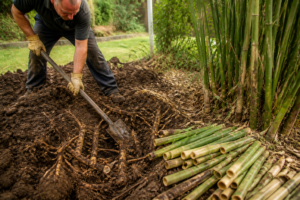
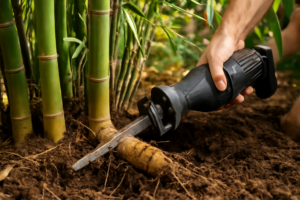
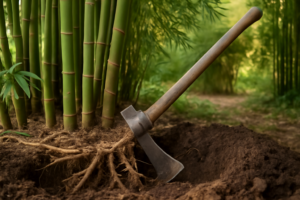
If you take only one thing from this post, take this. On a mature grove, cut the entire stand to ground level, remove or lay down the cut culms, and wait. The plant will push a flush of new shoots from the rhizomes, and those shoots will produce fresh leaves. Young leaves absorb herbicide far better than the old, tough, waxy leaves on culms that have been standing for years. A knee-high flush can be sprayed thoroughly with a backpack sprayer. A culm taller than you can reach is not sprayable in any meaningful way. This single change does more for your results than any product choice.
Wait until the new foliage is fully expanded and healthy before you spray. Do not spray the cut culms lying on the ground, and do not spray the yellowing leaves left on the cut stubble. Check your local green-waste rules for what to do with the cut material.
Treat the cut stump while it is wet
Cut-stump application is a separate technique for stems you are removing anyway. Treat the freshly cut stump at ground level immediately, while the cut is still wet and the vascular tissue is open. You have minutes, not hours. Once the cut dries and seals over, the window is gone.
Bamboo culms are hollow and segmented, so pouring product into an internode does not put it where it needs to go. It runs down the hollow stem and pools in the wrong place. The useful target is the cut surface at the base of the stump and the outer wall just below the cut. Use a cut-stump product and concentration that the label permits for that use, and apply it by the method the label describes. Do not improvise by filling hollow culms. Cut-stump treatment supports the foliar program. It can help with isolated stems and stumps, but it will not clear a grove by itself.
Timing: spray in late summer and autumn
Bamboo moves sugars and energy down into the rhizomes in late summer and autumn. That is when a foliar application is carried where it needs to go. In spring the plant does the opposite. It draws energy up out of the rhizomes to build new culms, so whatever you spray gets carried upward into shoots that are already leaving the ground. You waste product and get a poor result. Timing is the second biggest lever after cut-and-regrow, and it is the one most homeowners ignore because spring is when the weekend is free.
The exact window depends on your climate, your species and the weather that year. Use the calendar in how long killing bamboo actually takes as a starting point, then adjust it to what you see on your own grove. Your label will also give temperature guidance, and there is no point spraying when it is too cold for active growth. Avoid drought, extreme heat and rain in the forecast.
Winter is a different problem. A grove that looks dead in cold weather is mostly dormant, and the reasoning in why winter timing works against you applies here. Do not conclude the grove is finished because it looks bare in January.
Coverage: wet the leaves, not the ground
Herbicide has to stay on the leaf long enough to be absorbed. Aim for thorough wetting of the foliage, to the point where the leaves are covered but the spray is not running off and dripping from the stems. Bamboo leaves are waxy, which is why a surfactant matters. Many concentrates already include one, so read the label before adding anything. Some labels say not to add a surfactant, and adding one where the label does not permit it is not acceptable, no matter how well you think it will work.
Use low pressure and a coarse nozzle where you can, and do not spray on windy days. Drift is the fastest way to turn a bamboo project into a fight with your neighbor and a dead hedge on the other side of the fence.
Containment: treat the whole clone
Treat the whole clonal system, not just the part growing on your side of the fence. A grove is one organism connected by rhizomes that can run well beyond the visible culms. The details of how far they reach are in how deep the rhizomes actually run. If you treat only what grows on your side, the grove rooted next door will keep pushing culms over the line, and you will be back at the start.
If the stand crosses a boundary, talk to your neighbor before you begin, agree on a plan for their side, and keep mowing or cutting anything that crosses the line during treatment. Shoots left to grow on the far side will feed the rhizomes you are trying to starve. Keep notes on what you cut and when, because you will need them for the next season.
Repeat schedule and what partial success looks like
Plan on repeat treatments. The usual pattern is cut, wait for the flush, spray, and then cut and spray again on whatever regrows, across more than one season. In my experience, a mature stand sprayed once does not stay dead. Expect the first season to look like failure in some places and partial success in others, and expect to follow up on new flushes.
Partial success looks like fewer culms, thinner culms, shorter culms and slower regrowth after each cut. That is progress, even if it does not look like a victory. Failure looks like the same density, the same height and vigorous full-height culms appearing a few weeks after each spray. Photograph the stand from the same spots every time, count culms in a marked area, and judge the trend across seasons rather than panicking over a single flush.
Safety and the label
The label is the law. Rates, protective equipment, re-entry intervals and permitted sites are all on it, and applying a product in a way the label does not allow is illegal whether or not it works. Read the whole label before you buy and again before you mix.
- Do not apply near water, wells, drains or ditches, and follow the label’s buffer requirements.
- Watch for root-zone overlap with trees and shrubs you want to keep. With imazapyr this is a serious problem. With glyphosate the main risk is drift.
- Wear the protective equipment the label specifies. That usually includes chemical-resistant gloves, eye protection, and long sleeves and pants, but follow the label’s list.
- Keep children and pets off treated ground for the period the label specifies.
- Some products are restricted-use or professional-only in some places. Check before you buy.
- A licensed professional applicator is a legitimate option for a large stand, an awkward stand or one close to structures.
I will not give you mixing ratios or application rates here, and you should be wary of any source that does without pointing you to a label. The figure you need is the rate the label gives for woody brush or hard-to-control perennial grasses, and it varies with the product’s concentration. Find it on your label and use that number.
Which should I buy?
Match the product to your situation, not to whichever bottle looks strongest.
- Bamboo tangled among trees and shrubs you want to keep: a glyphosate-based program with cut-and-regrow, careful drift control and repeat treatments. Do not use imazapyr.
- An isolated stand on open ground that you are willing to sterilize for a season: imazapyr may be the right tool, provided the label allows your use and nothing you want is within reach of the root zone or the soil movement.
- A stand along a shared boundary: glyphosate with cut-and-regrow, coordinated with your neighbor, and no imazapyr. Treat the whole clone.
- A reader who wants to replant the area soon: glyphosate, followed by the replanting guidance on the label and the timeline in the restoring-your-yard post.
- A reader unwilling to use chemicals at all: the chemical-free method is slower, but it is a legitimate route and it will not poison the ground.
Frequently Asked Questions
What is the best herbicide to kill bamboo?
There is no single best one. For most homeowners with trees, shrubs or a neighbor’s garden in play, glyphosate applied to a cut-and-regrow flush is the right answer. Imazapyr is more effective on bamboo, but only on a stand you can isolate on open ground. The best product is the one whose active ingredient fits your site, applied correctly and repeated.
Will Crossbow kill bamboo?
Not reliably. Crossbow contains triclopyr and 2,4-D, which are built for broadleaf plants and woody brush. Bamboo is a grass and is largely tolerant of both. You may see temporary leaf damage, but the culms will return. Use it on broadleaf companions growing near the bamboo, not on the bamboo itself.
Can I replant after using glyphosate?
Glyphosate has essentially no soil activity, so replanting can often happen sooner than after imazapyr. Follow the label’s guidance, make sure the stand is fully dead with no active regrowth, and check the restoring-your-yard post for what thrived and what did not.
Does one application kill bamboo?
No. Expect repeat treatments across more than one season, usually on new flushes after cutting. A single spray on a mature grove is the most common reason people conclude that a product does not work.
Should I hire a professional?
For a large stand, one close to a house, a slope, a septic system, or anything that needs a restricted-use product, a licensed applicator is a sensible option. Get quotes that name the active ingredient, the method and the number of planned follow-up treatments. For a sense of how the numbers compare, see what DIY and professional removal cost.
About This Article

Written by Marcus Chen. Marcus Chen has spent 15 years cultivating and studying bamboo across 14 different species, combining commercial growing operations with extensive hands-on experience in species selection and containment. As both a grower and consultant, he specializes in practical bamboo management, helping homeowners and landscapers understand the real-world requirements for responsible bamboo cultivation. Marcus brings tested knowledge of which species thrive reliably and which present containment challenges that go beyond standard recommendations. More about this site.
Verify this against a primary source
Specifics change, and your situation may differ from the one described here. These are the authorities worth checking directly:
- American Bamboo Society — species listings and cultivation guidance
- USDA PLANTS Database — species range and identification
- USDA Plant Hardiness Zone Map — cold hardiness verification for your location