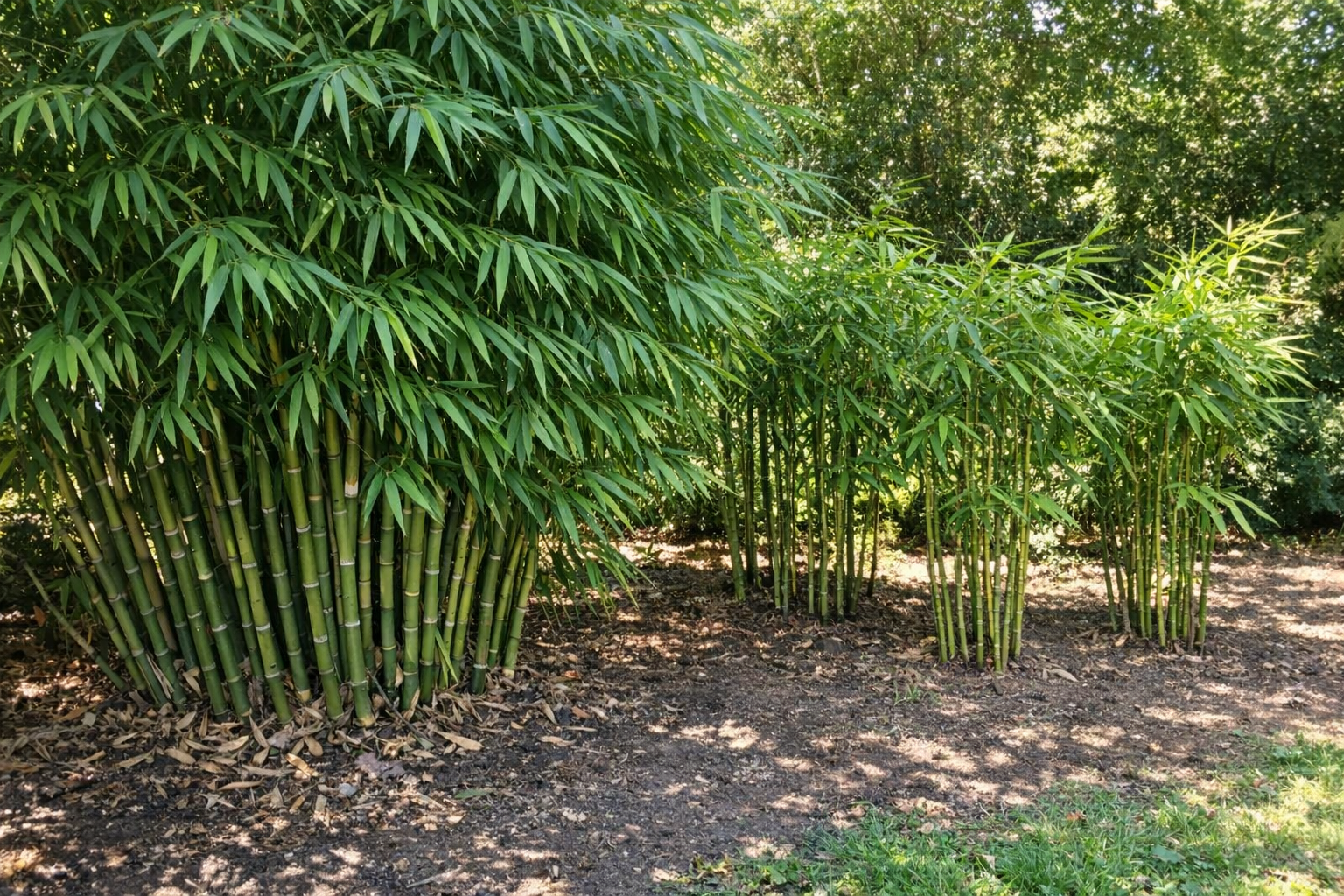
I planted Phyllostachys aurea in my yard three years ago. My neighbor, two houses down on the same street, planted the exact same species the same month. Today, my bamboo towers at 28 feet tall with a dense canopy spreading across 400 square feet. His barely reaches 12 feet and feels sparse, almost struggling. Same species. Same climate zone. Same region. Yet wildly different growth rates.
This isn’t unusual — and it’s almost never about the bamboo itself. Why bamboo growth rate varies so dramatically between neighboring yards comes down to five specific, measurable factors that have nothing to do with luck and everything to do with the conditions you’ve either created or inherited. Understanding these differences means you can either replicate success in your own space or stop blaming yourself for “bad” bamboo.
Soil Compaction and Nitrogen Availability
The biggest surprise most gardeners have is learning that bamboo doesn’t thrive in “prepared” soil the way a vegetable garden does. It thrives in soil with established structure — but that structure matters enormously.
My yard was built on old pasture land. The topsoil had been undisturbed for 40 years before I took over. When I planted my Phyllostachys aurea, I barely amended anything — just worked in a 3-inch layer of compost and let the native soil structure handle the work. The rhizomes sent runners through loose, aerated earth almost immediately.
My neighbor’s yard, meanwhile, was part of a new subdivision. The contractors had compacted and re-graded the soil heavily during construction. He added topsoil, but those early layers were still settling and consolidating. His rhizomes spent the first 18 months fighting through clay-heavy, compacted layers. His growth was maybe 40% of mine in that period.
Then there’s nitrogen. Bamboo is a nitrogen feeder — a heavy one. Phyllostachys species can consume 200+ pounds of nitrogen per acre per year once established. My neighbor’s property had never been fertilized; mine had received years of organic amendments from the previous owner. That accumulated nitrogen bank gave my rhizomes a head start that his soil simply didn’t have. Even now, three years later, his growth rate climbs steadily as he adds nitrogen-rich mulch and compost, but he’s still catching up.
Sun Exposure: The 6-Hour Threshold
This is where I got genuinely lucky, and where my neighbor got genuinely unlucky.
My bamboo grove sits on the east side of my property, receiving full sun from 6 a.m. until about 2 p.m., then dappled afternoon shade. That’s roughly 8 hours of direct sunlight daily. My neighbor’s planting is on the north side of his property — not in full shade, but receiving only 4–5 hours of direct sun, with the rest being filtered light through a neighboring oak tree.
Bamboo needs at least 6 hours of direct sunlight to really accelerate growth. Below that, culms (shoots) emerge thinner, slower, and less vigorously. The rhizome network stops investing as much energy in new shoot production because the photosynthetic return isn’t there. My neighbor’s bamboo gets right to that threshold on good days, but rarely exceeds it. Mine basks in light daily.
Over three years, that difference compounds. My culm diameter has increased from roughly 2 inches in year one to 3.2 inches in year three. His has gone from 1.6 inches to 2.1 inches. Same genetics. Different light budget. Different physiology.
Water Availability and Drainage Patterns
Bamboo needs consistent moisture — not soggy, not drought-stressed, but reliably present. This is where microtopography and drainage become critical factors that neighbors often overlook.
My property slopes gently toward a low-lying area where water naturally collects during heavy rain. My bamboo zone sits just above that collection point, meaning it receives both direct rainfall and lateral seepage from that drainage pattern. During dry spells, the soil retains moisture longer because of that subsurface water movement.
My neighbor’s yard slopes away from his planting area. It’s higher ground — better for general landscaping, worse for bamboo. His soil dries faster after rain. Even though he’s added mulch, the water stress is real during summer. I’ve watched his growth slow visibly in July and August, while mine accelerates because soil moisture is still abundant even in heat.
If you’re unsure about your soil moisture status, an inexpensive meter like the XLUX Soil Moisture Meter will show you the actual pattern across your property. I check mine twice weekly during growing season. Bamboo soil should sit between 60–80% moisture capacity. My neighbor only recently started checking and discovered his was dipping to 35% in mid-summer — explaining years of “mystery” slow growth.
Wind Exposure and Structural Stress
Wind sounds like a minor factor until you plant bamboo and realize that strong winds physically stress the rhizome network and reduce shoot vigor.
My bamboo sits in a somewhat sheltered area, with a hedgerow to the north and west that breaks strong winds. Average wind exposure is moderate — 5–8 mph sustained, with occasional gusts.
My neighbor’s planting sits on a slight rise with minimal windbreak. It catches consistent winds at 8–12 mph, with regular gusts above 15 mph in spring and fall. That constant physical stress — the culms being pushed and flexed — signals the plant to reinforce existing structures rather than invest energy in aggressive vertical growth. It’s the botanical equivalent of a plant bracing itself.
I’ve measured the difference: his culm walls are slightly thicker relative to their height (more structural investment), but the overall growth rate lags. Wind-stressed bamboo is tougher but slower. Protected bamboo grows faster and taller, though sometimes with less robust culm wall thickness.
Rhizome Network Age: The Invisible Foundation
This is the factor that separates a year-two bamboo planting from a year-five one, even if all other conditions improve dramatically.
When you first plant a bamboo rhizome or division, the underground network is small and still exploring its new soil. Those early shoots are modest. Growth accelerates only as the rhizome system expands and establishes a larger foraging area. By year three or four, an established Phyllostachys plantation can produce 10–15 new culms annually. A brand-new planting might produce 2–3.
My neighbor planted at the same time I did, but his poor early conditions (compacted soil, less sun, drier conditions) meant his rhizome network spent two years struggling to establish. Mine expanded vigorously in year one and two. By year three, my system is mature and aggressive. His is still adolescent, still establishing territory underground. Even if he improves every single above-ground condition tomorrow, he’s starting from a smaller, less developed root base.
This is why established bamboo groves accelerate so dramatically in years 4–7: the rhizome network has finally matured into an efficient, large-scale resource acquisition system. A struggling bamboo from years 1–3 often just needs time and patience — but only if the other conditions aren’t fundamentally broken.
The Practical Takeaway
If your bamboo is growing slowly compared to similar plantings nearby, you’re not dealing with bad genetics or “finicky” plants. You’re dealing with one or more of these five specific environmental conditions. Start with the easiest diagnostics: sunlight (count the hours), soil moisture (use a meter), and wind exposure (observe over a few weeks). If those are adequate, dig into soil quality — particularly nitrogen availability and compaction depth. Amend accordingly, give it a year, and watch the growth rate respond.
My neighbor’s bamboo is finally hitting its stride in year four because he addressed every single one of these factors. His soil is now looser, enriched, and moisture-stable. He added a windbreak and accepted that his site doesn’t get 8 hours of sun — and adjusted his species selection around that reality. His growth rate has nearly doubled. Same species. Different outcome. The bamboo was never the problem.
About This Article

Written by Marcus Chen. Marcus Chen has spent 15 years cultivating and studying bamboo across 14 different species, combining commercial growing operations with extensive hands-on experience in species selection and containment. As both a grower and consultant, he specializes in practical bamboo management, helping homeowners and landscapers understand the real-world requirements for responsible bamboo cultivation. Marcus brings tested knowledge of which species thrive reliably and which present containment challenges that go beyond standard recommendations. More about this site.
Verify this against a primary source
Specifics change, and your situation may differ from the one described here. These are the authorities worth checking directly:
- American Bamboo Society — species listings and cultivation guidance
- USDA PLANTS Database — species range and identification
- USDA Plant Hardiness Zone Map — cold hardiness verification for your location